Download the free crew talk
The one-page talk, editable Word version, and guidance below are open to everyone. No account required.
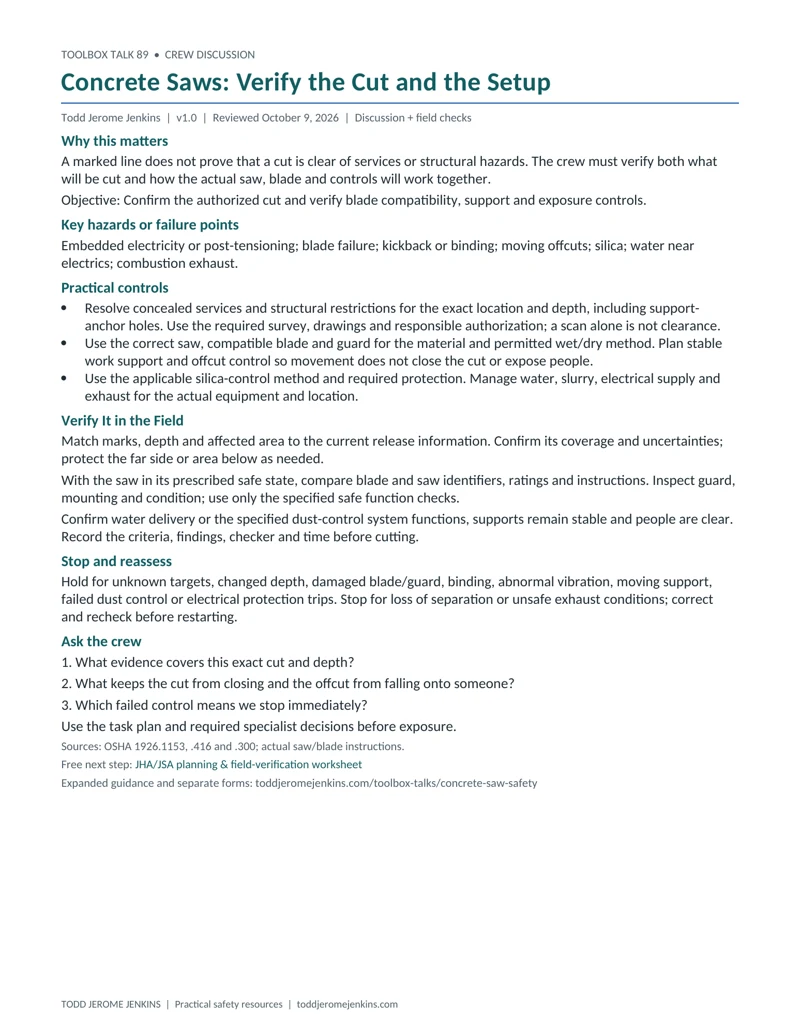
Preview the one-page crew talk
Supporting documents
Included with free Safety & Systems membership.
Supervisor field check
A separate check to verify conditions and controls before work. Includes a one-page PDF and editable Word file.
Attendance sheet
A separate sign-in sheet to record the crew discussion. Includes a one-page PDF and editable Word file.
Need the crew records? Join free to use these supporting documents and the Safety & Systems Academy. No payment details. Email updates are optional.
Get supporting documents — free membershipAlready a member? Use the same link to sign in.
A 5–10 minute crew discussion, plus time to verify the actual controls. The crew talk and Word version are public. Separate supervisor and attendance records are included with free Safety & Systems membership.
Why this matters
A marked line does not prove that a cut is clear of services or structural hazards. The crew must verify both what will be cut and how the actual saw, blade and controls will work together.
Learning objective
Confirm the authorized cut and verify blade compatibility, support and exposure controls.
Key hazards or failure points
Embedded electricity or post-tensioning; blade failure; kickback or binding; moving offcuts; silica; water near electrics; combustion exhaust.
Practical controls
- Resolve concealed services and structural restrictions for the exact location and depth, including support-anchor holes. Use the required survey, drawings and responsible authorization; a scan alone is not clearance.
- Use the correct saw, compatible blade and guard for the material and permitted wet/dry method. Plan stable work support and offcut control so movement does not close the cut or expose people.
- Use the applicable silica-control method and required protection. Manage water, slurry, electrical supply and exhaust for the actual equipment and location.
Verify It in the Field
- Match marks, depth and affected area to the current release information. Confirm its coverage and uncertainties; protect the far side or area below as needed.
- With the saw in its prescribed safe state, compare blade and saw identifiers, ratings and instructions. Inspect guard, mounting and condition; use only the specified safe function checks.
- Confirm water delivery or the specified dust-control system functions, supports remain stable and people are clear. Record the criteria, findings, checker and time before cutting.
Stop and reassess
Hold for unknown targets, changed depth, damaged blade/guard, binding, abnormal vibration, moving support, failed dust control or electrical protection trips. Stop for loss of separation or unsafe exhaust conditions; correct and recheck before restarting.
Crew discussion questions
- What evidence covers this exact cut and depth?
- What keeps the cut from closing and the offcut from falling onto someone?
- Which failed control means we stop immediately?
For each required control, record its acceptance source and criterion, safe verification method, responsible checker, actual result and time. Use VERIFIED, HOLD/NOT VERIFIED, or N/A with a reason. A tick alone is not evidence. Complete all applicable task inspections; do not enter danger or improvise a test to fill out a form.
Leader preparation and practical detail
Match the complete cutting task
Illustrative situation: a planned outdoor slab cut moves into an enclosed room. The same saw and wet method cannot simply follow it. Review exhaust, silica, electrical and surrounding-work conditions before selecting the equipment and controls.
Blade compatibility includes the method
The Husqvarna manual consulted is for a particular combustion-engine handheld cutter. It shows why blade type, ratings, mounting, material and wet/dry use must be checked together. It does not authorize a different saw or blade. A compatible wet-cutting system must be selected; adding water indiscriminately to any blade is unsafe.
Plan for movement before it starts
Use the actual saw instructions to address kickback, pinching and stance. Do not side-load a cutting blade or ask a helper to catch an offcut. Support and separation arrangements must account for the material after the cut, not only before it. Do not use a gasoline saw indoors; assess other locations where exhaust can accumulate.
The silica row matters
Handheld and walk-behind saws are different Table 1 entries, with different respiratory-protection conditions. Wet cutting alone is not a declaration that no respirator is needed. The silica competent person confirms the full applicable method or assessed alternative. Read the linked silica talk for the full plan and cleanup handoff.
Short supervisor field check
- Match marks, depth and affected area to the current release information. Confirm its coverage and uncertainties; protect the far side or area below as needed.
- With the saw in its prescribed safe state, compare blade and saw identifiers, ratings and instructions. Inspect guard, mounting and condition; use only the specified safe function checks.
- Confirm water delivery or the specified dust-control system functions, supports remain stable and people are clear. Record the criteria, findings, checker and time before cutting.
Confirm the relevant trained/authorized people, unresolved items, interim protection, correction owner and recheck. Record required release authority and rebrief anyone affected. The separate sheet supports these records; it does not replace a specialist inspection, permit or engineering determination.
Attendance and follow-through
Use the separate attendance sheet for participants, roles, discussion concerns, actions and late-arrival rebriefs. Attendance is not proof of competence, functioning controls or authorization to work. Keep completed records private under employer procedures.
Technical scope and references
Reviewed October 9, 2026 for construction crew preparation. Apply the actual task, jurisdiction and relevant standard provisions. Manufacturer sources below are reference examples, not approval of your equipment. No site-specific design, permit, exposure assessment, product SDS or current model manual was supplied; obtain the applicable documents before work. This discussion does not replace required training.
- OSHA 1926.1153 — Construction silica; full applicable Table 1 method or alternative assessment.
- OSHA 1926.416(a) — Identify and control electrical-contact hazards before work.
- OSHA 1926.300 — Tool condition and applicable guarding.
- Husqvarna K770 II operator manual, March 2026 — Selected English safety/operation sections; model-specific reference, not your equipment approval.
- Hilti detection-system applications — Manufacturer guidance on embedded hazards and structural consequences; not US law.
Connect this discussion to your JHA/JSA
Use the related worked JHA/JSA/AHA example to prepare task steps, hazards and controls. Return to What Changed Today? when the plan or conditions change.
Related Todd Jerome Jenkins article: How to Conduct a Job Safety Analysis.
Related crew discussions
Put one check into practice
Use the free JHA/JSA planning and field-verification worksheet to record today’s change, the required protection and the evidence needed before exposure.