Download the free crew talk
The one-page talk, editable Word version, and guidance below are open to everyone. No account required.
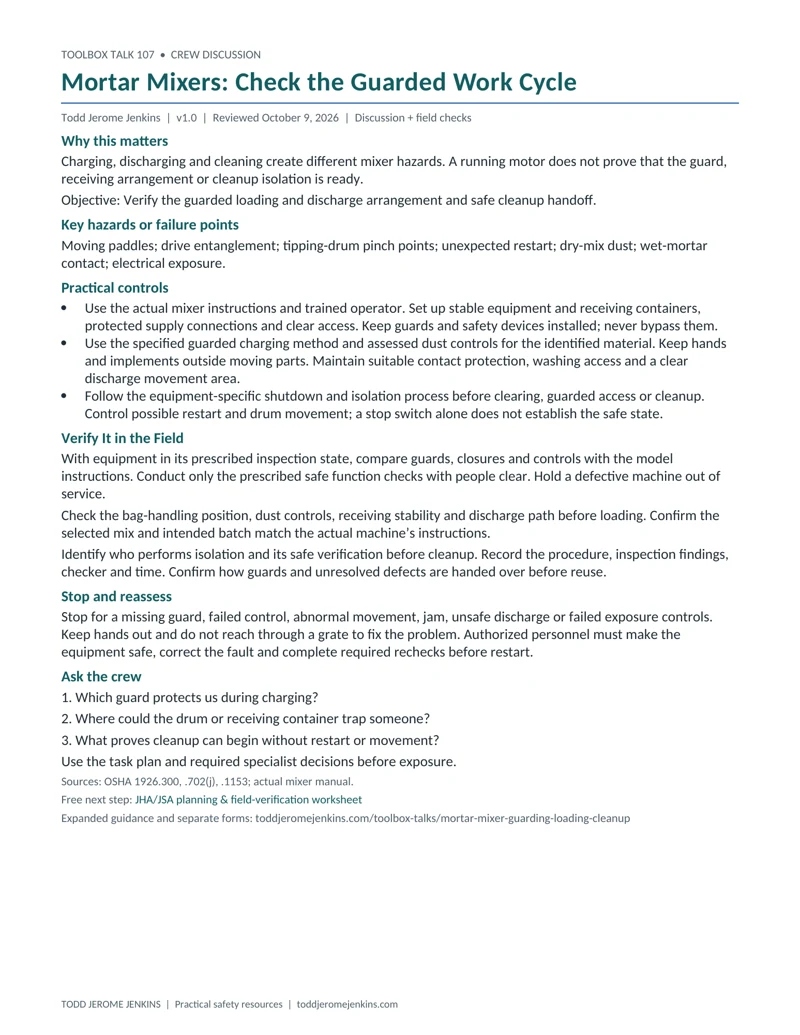
Preview the one-page crew talk
Supporting documents
Included with free Safety & Systems membership.
Supervisor field check
A separate check to verify conditions and controls before work. Includes a one-page PDF and editable Word file.
Attendance sheet
A separate sign-in sheet to record the crew discussion. Includes a one-page PDF and editable Word file.
Need the crew records? Join free to use these supporting documents and the Safety & Systems Academy. No payment details. Email updates are optional.
Get supporting documents — free membershipAlready a member? Use the same link to sign in.
A 5–10 minute crew discussion, plus time to verify the actual controls. The crew talk and Word version are public. Separate supervisor and attendance records are included with free Safety & Systems membership.
Why this matters
Charging, discharging and cleaning create different mixer hazards. A running motor does not prove that the guard, receiving arrangement or cleanup isolation is ready.
Learning objective
Verify the guarded loading and discharge arrangement and safe cleanup handoff.
Key hazards or failure points
Moving paddles; drive entanglement; tipping-drum pinch points; unexpected restart; dry-mix dust; wet-mortar contact; electrical exposure.
Practical controls
- Use the actual mixer instructions and trained operator. Set up stable equipment and receiving containers, protected supply connections and clear access. Keep guards and safety devices installed; never bypass them.
- Use the specified guarded charging method and assessed dust controls for the identified material. Keep hands and implements outside moving parts. Maintain suitable contact protection, washing access and a clear discharge movement area.
- Follow the equipment-specific shutdown and isolation process before clearing, guarded access or cleanup. Control possible restart and drum movement; a stop switch alone does not establish the safe state.
Verify It in the Field
- With equipment in its prescribed inspection state, compare guards, closures and controls with the model instructions. Conduct only the prescribed safe function checks with people clear. Hold a defective machine out of service.
- Check the bag-handling position, dust controls, receiving stability and discharge path before loading. Confirm the selected mix and intended batch match the actual machine’s instructions.
- Identify who performs isolation and its safe verification before cleanup. Record the procedure, inspection findings, checker and time. Confirm how guards and unresolved defects are handed over before reuse.
Stop and reassess
Stop for a missing guard, failed control, abnormal movement, jam, unsafe discharge or failed exposure controls. Keep hands out and do not reach through a grate to fix the problem. Authorized personnel must make the equipment safe, correct the fault and complete required rechecks before restart.
Crew discussion questions
- Which guard protects us during charging?
- Where could the drum or receiving container trap someone?
- What proves cleanup can begin without restart or movement?
For each required control, record its acceptance source and criterion, safe verification method, responsible checker, actual result and time. Use VERIFIED, HOLD/NOT VERIFIED, or N/A with a reason. A tick alone is not evidence. Complete all applicable task inspections; do not enter danger or improvise a test to fill out a form.
Leader preparation and practical detail
Follow this mixer’s operating cycle
The manufacturer manual inspected covers Multiquip WM45H/E models and demonstrates why the safety grate, drive protection and dump-handle movement matter. It includes model-specific operating instructions; do not transfer them to another mixer. Keep guarding effective during prescribed charging and discharge. Do not invent an interlock where the actual model has none.
A wet final batch does not settle dust exposure
Dry-bag opening, charging and dried-residue cleanup need their own silica assessment and control method. Do not borrow the masonry-saw Table 1 row for mixing. For tasks outside Table 1,1926.1153(d) applies as scoped, with required respiratory protection and program where indicated. Identify the material and actual exposure evidence before selecting controls.
Treat guarded access as a separate task
Ordinary discharge and access to paddles are different activities. Follow the actual isolation procedure, including stored or gravitational movement, before exposure during cleaning or clearing. Section 1926.702(j) addresses hazardous maintenance/repair in concrete and masonry construction. The one-cubic-yard loading-skip rule in 702(b) is not a blanket guarding specification for small mortar mixers.
Keep the example bounded
The linked JHA uses a guarded electric paddle mixer outdoors at ground level. It excludes fuel-powered operation, towing and repairs. A gasoline replacement introduces exhaust and fuel hazards requiring a revised assessment. Link wet-cement, silica and energy-isolation resources for their focused checks; no batch capacity, electrical configuration or cleaning recipe is established here.
Short supervisor field check
- Actual model, instructions and operator identified.
- Guards and controls checked without exposure.
- Charging dust and contact controls ready.
- Discharge path and receiving stability verified.
- Isolation and return-to-service handoff established.
Confirm the relevant trained/authorized people, unresolved items, interim protection, correction owner and recheck. Record required release authority and rebrief anyone affected. The separate sheet supports these records; it does not replace a specialist inspection, permit or engineering determination.
Attendance and follow-through
Use the separate attendance sheet for participants, roles, discussion concerns, actions and late-arrival rebriefs. Attendance is not proof of competence, functioning controls or authorization to work. Keep completed records private under employer procedures.
Technical scope and references
Reviewed October 9, 2026 for construction crew preparation. Apply the actual task, jurisdiction and relevant standard provisions. Manufacturer sources below are reference examples, not approval of your equipment. No site-specific design, permit, exposure assessment, product SDS or current model manual was supplied; obtain the applicable documents before work. This discussion does not replace required training.
- OSHA 1926.300 — Construction equipment condition and moving-part/point-of-operation guarding.
- OSHA 1926.702 — Paragraph(j) maintenance/repair isolation; paragraph(b) has specific concrete loading-skip scope.
- OSHA 1926.1153 — Task-specific silica assessment, control, housekeeping and respiratory provisions.
- Multiquip WM45H/E manual, Rev. 2, December 5, 2025 — Selected safety sections; model-specific manufacturer reference only.
Connect this discussion to your JHA/JSA
Use the related worked JHA/JSA/AHA example to prepare task steps, hazards and controls. Return to What Changed Today? when the plan or conditions change.
Related Todd Jerome Jenkins article: How to Conduct a Job Safety Analysis.
Related crew discussions
Put one check into practice
Use the free JHA/JSA planning and field-verification worksheet to record today’s change, the required protection and the evidence needed before exposure.