Download the talk and separate crew records
Free to download without an account. Each PDF is one page. Use the Word version to adapt the record to your task and approved procedures.
Supervisor field check
Download supervisor field check (PDF, 1 page)Editable supervisor field check (Word)Preview the one-page crew talk
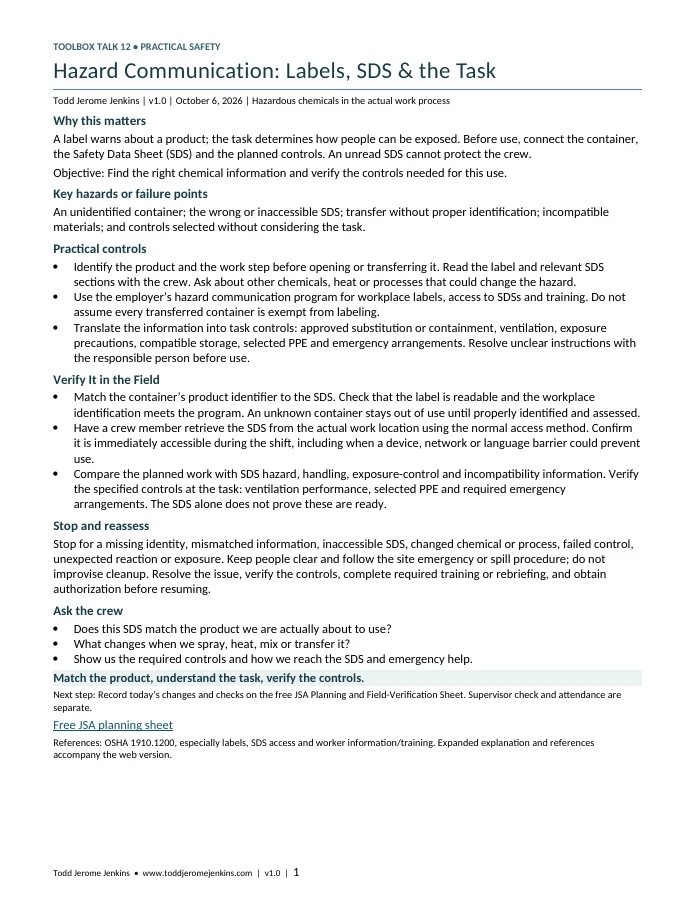
One-page crew talk, with separate supervisor and attendance sheets. Plan a 5–10 minute discussion and allow the time needed for field verification. All downloads are free; no account is required.
Learning objective
Find the right chemical information and verify the controls needed for this use.
Start with today’s work
Illustrative scenario: A worker brings an unlabeled spray bottle to a cleaning task. Another worker says it is probably the usual cleaner, but the supplier changed last week. Keep the bottle out of use. Establish the product through the site’s identification process, obtain the matching SDS, and review the task and controls. Familiar color or odor is not an acceptable identity check.
Key hazards or failure points
An unidentified container; the wrong or inaccessible SDS; transfer without proper identification; incompatible materials; and controls selected without considering the task.
Practical controls
- Identify the product and the work step before opening or transferring it. Read the label and relevant SDS sections with the crew. Ask about other chemicals, heat or processes that could change the hazard.
- Use the employer’s hazard communication program for workplace labels, access to SDSs and training. Do not assume every transferred container is exempt from labeling.
- Translate the information into task controls: approved substitution or containment, ventilation, exposure precautions, compatible storage, selected PPE and emergency arrangements. Resolve unclear instructions with the responsible person before use.
Verify It in the Field
- Match the container’s product identifier to the SDS. Check that the label is readable and the workplace identification meets the program. An unknown container stays out of use until properly identified and assessed.
- Have a crew member retrieve the SDS from the actual work location using the normal access method. Confirm it is immediately accessible during the shift, including when a device, network or language barrier could prevent use.
- Compare the planned work with SDS hazard, handling, exposure-control and incompatibility information. Verify the specified controls at the task: ventilation performance, selected PPE and required emergency arrangements. The SDS alone does not prove these are ready.
For each required control, identify the acceptance source and safe check method, assign a person with the required competence and authority, and record the actual result and time. Use VERIFIED, HOLD/NOT VERIFIED, or N/A with a reason. A checkmark alone does not demonstrate that protection works.
| Control | Safe verification | Criterion, evidence and response |
|---|---|---|
| Product match | Compare container identifier and supplied chemical information with the SDS before opening or transferring. | 1910.1200(f)–(g), label/SDS and employer program. Record product and SDS revision; mismatch means HOLD. |
| Immediate SDS access | Worker retrieves the correct SDS through the normal workplace method without an access barrier. | 1910.1200(g)(8) and employer program. Record retrieval method and any failure; resolve before exposure. |
| Task controls | Review the actual use and verify each selected control using its specified safe method. | SDS, exposure assessment, 1910.1200(h), control instructions and site procedure. Record actual results; the SDS is information, not a completed field check. |
These are examples, not a complete task inspection. Check all required controls. Do not enter danger, defeat a safeguard or improvise a test. If the criterion, method or result is uncertain, hold affected work and get the appropriate technical help. No actual equipment model, product SDS or site permit was supplied for these examples; use the documents for your task.
Leader preparation and explanation
Read the sections that answer the task questions
Use Section 1 for identification, Section 2 for hazards, Section 4 for first aid, Section 6 for accidental release, Section 7 for handling/storage, Section 8 for exposure controls/PPE and Section 10 for reactivity and incompatibilities. Section 16 includes revision information. Read other sections when relevant. This is a way to navigate the SDS, not permission to ignore information that affects the job.
Distinguish shipped and workplace labels
OSHA 1910.1200 has different provisions for shipped labels and permitted workplace labeling systems. The portable-container immediate-use exception is narrow; it is not a general exemption for every secondary bottle or every container used by the same person. Apply the employer’s compliant program and the current standard, and keep required information legible.
Prove access at the point of use
Electronic access is permitted when it creates no barrier to immediate access during the shift. Have a worker demonstrate the normal retrieval path at the work location. If login, connectivity or device access prevents retrieval, fix the arrangement before use. Make the hazard information and training understandable to the people doing the work.
Use current rules without importing old deadlines
The OSHA rulemaking page identifies the 2024 Hazard Communication update and links to subsequent compliance-date information. Old 2015 transition instructions in archived material are not current implementation guidance. Check the latest official rulemaking notices for the applicable transition schedule. No unverified deadline is supplied here.
Stop and reassess
Stop for a missing identity, mismatched information, inaccessible SDS, changed chemical or process, failed control, unexpected reaction or exposure. Keep people clear and follow the site emergency or spill procedure; do not improvise cleanup. Resolve the issue, verify the controls, complete required training or rebriefing, and obtain authorization before resuming.
When conditions change, return to Pre-Job JHA/JSA: What Changed Today? and revise the affected task plan with the crew.
Three crew discussion questions
- Does this SDS match the product we are actually about to use?
- What changes when we spray, heat, mix or transfer it?
- Show us the required controls and how we reach the SDS and emergency help.
Short supervisor field check
- Actual product/container identifiers match the relevant SDS and task inventory.
- Shipped or workplace labels meet the applicable program requirements and are legible.
- Workers can obtain the SDS immediately during the shift without access barriers.
- Task controls address exposure, handling, incompatibilities and emergency response.
- Required hazard information/training is complete; changed products or processes are reassessed.
Use the separate supervisor sheet to record the task and change, JHA/JSA revision, acceptance source, safe method, verifier, actual result, unresolved items, corrective action, recheck and required restart authorization. Link specialist inspection records rather than copying private or unnecessary details.
Attendance and follow-through
Use the separate attendance sheet for participant names, roles and acknowledgment, meeting details, concerns, actions and rebriefs. Attendance is not proof of competence, functioning controls or permission to work. Keep completed records under the employer’s privacy and recordkeeping procedures; never post completed sign-in sheets publicly.
Related JHA/JSA resource and existing video
How to Conduct a Job Safety Analysis connects the task steps, hazards and controls. For related background, see How to Read a Safety Data Sheet.
Related crew discussions
One next step
Use the free JSA Planning and Field-Verification Sheet to record today’s changes and checks with the crew.
Sources and references
Sources reviewed October 6, 2026. Apply each regulation’s industry and activity scope, and current state or local requirements where applicable. Guidance is identified separately. This discussion resource supports preparation; it does not replace task procedures, required training, permits or specialist decisions.
- OSHA 29 CFR 1910.1200 — Labels and workplace alternatives in (f), SDS content/access in (g), and employee information/training in (h).
- OSHA — Hazard Communication Rulemaking — 2024 rule and linked compliance-date updates; use the current official notices for transition dates.