Download the free crew talk
The one-page talk, editable Word version, and guidance below are open to everyone. No account required.
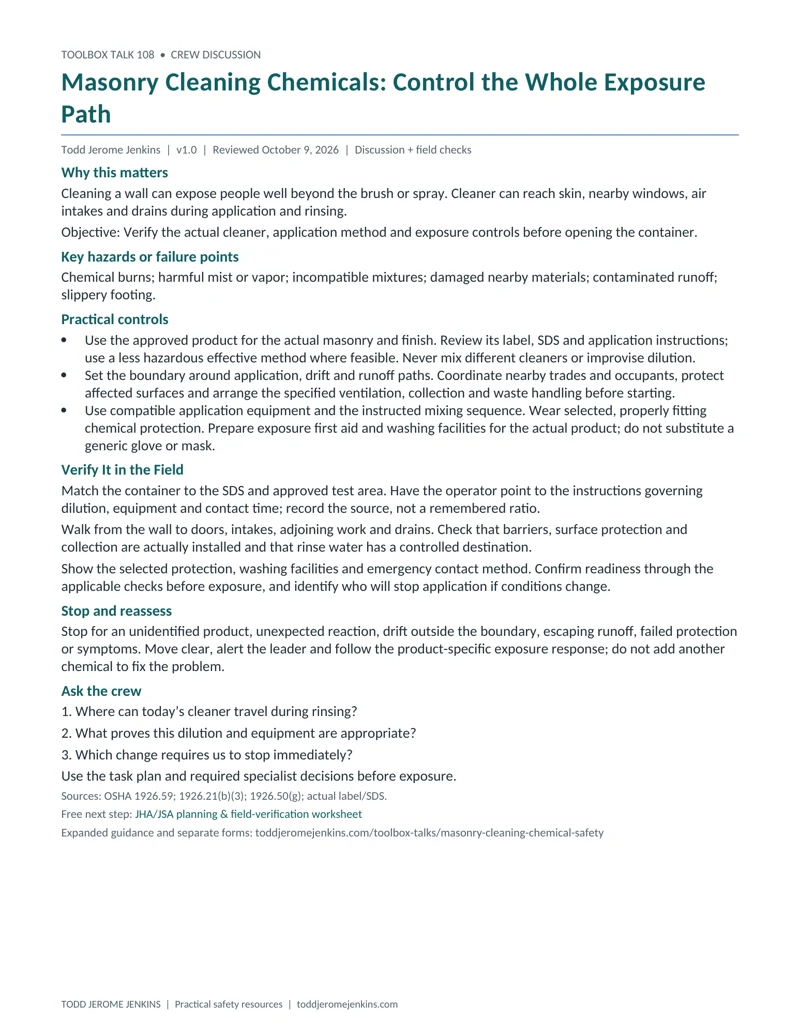
Preview the one-page crew talk
Supporting documents
Included with free Safety & Systems membership.
Supervisor field check
A separate check to verify conditions and controls before work. Includes a one-page PDF and editable Word file.
Attendance sheet
A separate sign-in sheet to record the crew discussion. Includes a one-page PDF and editable Word file.
Need the crew records? Join free to use these supporting documents and the Safety & Systems Academy. No payment details. Email updates are optional.
Get supporting documents — free membershipAlready a member? Use the same link to sign in.
A 5–10 minute crew discussion, plus time to verify the actual controls. The crew talk and Word version are public. Separate supervisor and attendance records are included with free Safety & Systems membership.
Why this matters
Cleaning a wall can expose people well beyond the brush or spray. Cleaner can reach skin, nearby windows, air intakes and drains during application and rinsing.
Learning objective
Verify the actual cleaner, application method and exposure controls before opening the container.
Key hazards or failure points
Chemical burns; harmful mist or vapor; incompatible mixtures; damaged nearby materials; contaminated runoff; slippery footing.
Practical controls
- Use the approved product for the actual masonry and finish. Review its label, SDS and application instructions; use a less hazardous effective method where feasible. Never mix different cleaners or improvise dilution.
- Set the boundary around application, drift and runoff paths. Coordinate nearby trades and occupants, protect affected surfaces and arrange the specified ventilation, collection and waste handling before starting.
- Use compatible application equipment and the instructed mixing sequence. Wear selected, properly fitting chemical protection. Prepare exposure first aid and washing facilities for the actual product; do not substitute a generic glove or mask.
Verify It in the Field
- Match the container to the SDS and approved test area. Have the operator point to the instructions governing dilution, equipment and contact time; record the source, not a remembered ratio.
- Walk from the wall to doors, intakes, adjoining work and drains. Check that barriers, surface protection and collection are actually installed and that rinse water has a controlled destination.
- Show the selected protection, washing facilities and emergency contact method. Confirm readiness through the applicable checks before exposure, and identify who will stop application if conditions change.
Stop and reassess
Stop for an unidentified product, unexpected reaction, drift outside the boundary, escaping runoff, failed protection or symptoms. Move clear, alert the leader and follow the product-specific exposure response; do not add another chemical to fix the problem.
Crew discussion questions
- Where can today’s cleaner travel during rinsing?
- What proves this dilution and equipment are appropriate?
- Which change requires us to stop immediately?
For each required control, record its acceptance source and criterion, safe verification method, responsible checker, actual result and time. Use VERIFIED, HOLD/NOT VERIFIED, or N/A with a reason. A tick alone is not evidence. Complete all applicable task inspections; do not enter danger or improvise a test to fill out a form.
Leader preparation and practical detail
Define the released work
Use the linked JHA for a ground-level test area and controlled low-pressure rinse. It does not cover abrasive blasting, high-pressure washing or elevated access. The actual product instructions and job assessment must establish the equipment, dilution, substrate compatibility and exposure controls. A successful test patch does not establish worker exposure safety.
Follow the chemical beyond the wall
Ask the crew to identify where liquid, mist and vapor could go during preparation, application and rinsing. Coordinate the building’s ventilation and occupancy arrangements with the responsible people; do not casually disable required building systems. Record who maintains separation and what requires a pause. Waste and discharge approval must come from the site’s applicable requirements; dilution or clear appearance does not authorize drain disposal.
Verify protection before exposure
Match chemical protective equipment to the product and task, including actual material compatibility and proper fit. Respirator requirements, where applicable, need the employer’s respiratory-protection process; this talk does not select a cartridge. Section 1926.50(g) requires suitable emergency drenching or flushing facilities for possible injurious corrosive exposure. Use the actual response instructions and site checks, without inventing a universal rinse duration.
Use product examples narrowly
The referenced PROSOCO sheet illustrates why product-specific review matters: it addresses adjacent substrates, application equipment and a particular dilution procedure. Its values and claims apply to that product and are not general masonry-cleaning instructions. This talk does not recommend a brand. Link the chemical exposure first-aid talk for response readiness and the spill-response talk for cleanup limits.
Short supervisor field check
- Product and method matched.
- Boundary and adjacent areas checked.
- Runoff destination controlled.
- Protection and washing verified.
- Exposure response understood.
Confirm the relevant trained/authorized people, unresolved items, interim protection, correction owner and recheck. Record required release authority and rebrief anyone affected. The separate sheet supports these records; it does not replace a specialist inspection, permit or engineering determination.
Attendance and follow-through
Use the separate attendance sheet for participants, roles, discussion concerns, actions and late-arrival rebriefs. Attendance is not proof of competence, functioning controls or authorization to work. Keep completed records private under employer procedures.
Technical scope and references
Reviewed October 9, 2026 for construction crew preparation. Apply the actual task, jurisdiction and relevant standard provisions. Manufacturer sources below are reference examples, not approval of your equipment. No site-specific design, permit, exposure assessment, product SDS or current model manual was supplied; obtain the applicable documents before work. This discussion does not replace required training.
- OSHA 1910.1200, through 1926.59 — Hazard communication: labels, accessible SDS and employee information. Construction adopts the requirements through 1926.59.
- OSHA 1926.21(b)(2)–(3) — Recognition of unsafe conditions and training for harmful-substance handling.
- OSHA 1926.50(g) — Suitable facilities for immediate emergency drenching/flushing where injurious corrosive exposure may occur.
- OSHA/NIOSH — Protecting Workers Who Use Cleaning Chemicals — 2012 guidance still hosted by OSHA; product selection, dilution training, ventilation and protective equipment.
- PROSOCO Sure Klean 600 product data sheet — Product-specific illustration only: preparation, substrate protection, equipment and dilution. Do not transfer its limits to other cleaners.
Connect this discussion to your JHA/JSA
Use the related worked JHA/JSA/AHA example to prepare task steps, hazards and controls. Return to What Changed Today? when the plan or conditions change.
Related Todd Jerome Jenkins article: How to Conduct a Job Safety Analysis.
Related crew discussions
- Hazard Communication Labels Sds Task
- Chemical Exposure First Aid Readiness
- Chemical Spill Response Limits
Put one check into practice
Use the free JHA/JSA planning and field-verification worksheet to record today’s change, the required protection and the evidence needed before exposure.