Download the talk and separate crew records
Free to download without an account. Each PDF is one page. Use the Word version to adapt the record to your task and approved procedures.
Supervisor field check
Download supervisor field check (PDF, 1 page)Editable supervisor field check (Word)Preview the one-page crew talk
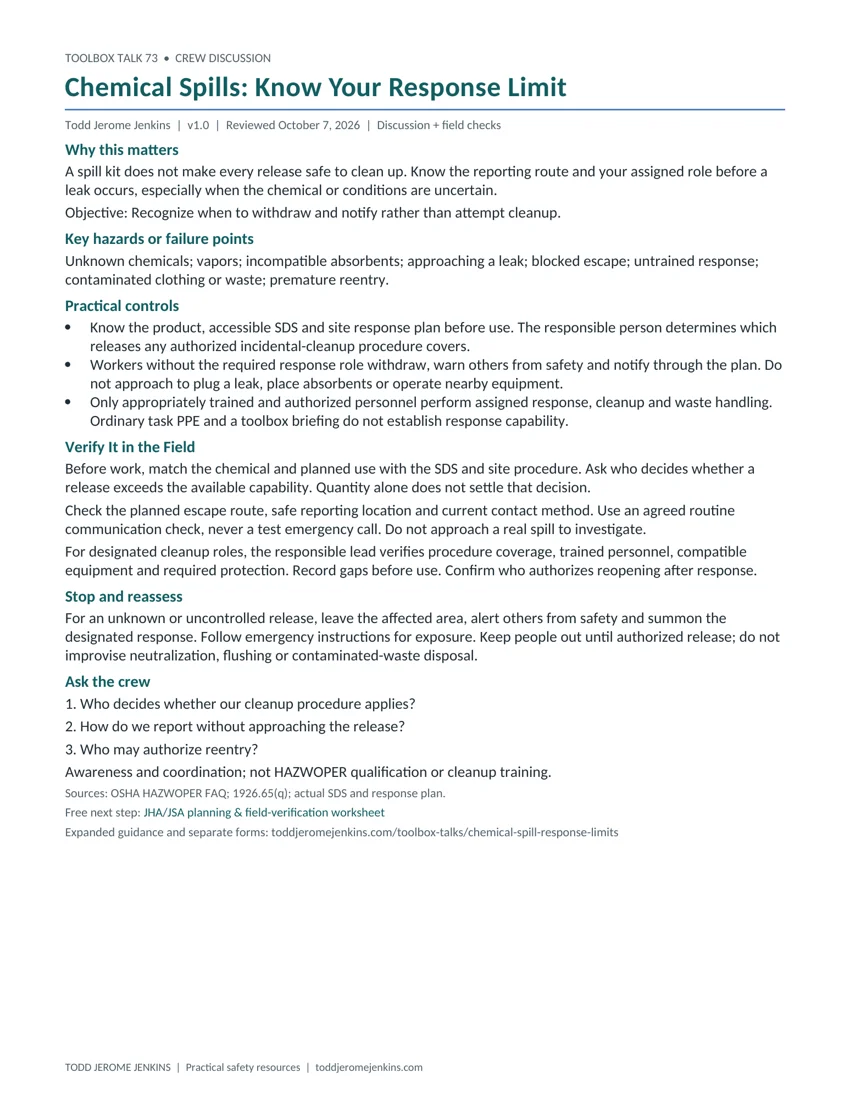
A 5–10 minute crew discussion, plus the time needed for field verification. All six downloads are free without a required signup.
Why this matters
A spill kit does not make every release safe to clean up. Know the reporting route and your assigned role before a leak occurs, especially when the chemical or conditions are uncertain.
Learning objective: Recognize when to withdraw and notify rather than attempt cleanup.
Key hazards or failure points
Unknown chemicals; vapors; incompatible absorbents; approaching a leak; blocked escape; untrained response; contaminated clothing or waste; premature reentry.
Practical controls
- Know the product, accessible SDS and site response plan before use. The responsible person determines which releases any authorized incidental-cleanup procedure covers.
- Workers without the required response role withdraw, warn others from safety and notify through the plan. Do not approach to plug a leak, place absorbents or operate nearby equipment.
- Only appropriately trained and authorized personnel perform assigned response, cleanup and waste handling. Ordinary task PPE and a toolbox briefing do not establish response capability.
Verify It in the Field
Before work, match the chemical and planned use with the SDS and site procedure. Ask who decides whether a release exceeds the available capability. Quantity alone does not settle that decision.
Check the planned escape route, safe reporting location and current contact method. Use an agreed routine communication check, never a test emergency call. Do not approach a real spill to investigate.
For designated cleanup roles, the responsible lead verifies procedure coverage, trained personnel, compatible equipment and required protection. Record gaps before use. Confirm who authorizes reopening after response.
Use the separate field check to record the acceptance source and criterion, safe method, checker, actual result and time. Mark VERIFIED, HOLD/NOT VERIFIED, or N/A with a reason. A checkmark alone is not evidence that protection works. Complete all required task checks; do not enter danger or improvise a test.
| Control | Safe verification | Evidence |
|---|---|---|
| Clear role limits | Crew explains reporting and withdrawal actions under the plan. | Assigned role, decision contact and corrected misunderstanding. |
| Usable escape and contact | Inspect route before exposure and make a normal communication check. | Route, contact method, actual result and backup. |
| Authorized response readiness | Responsible lead compares actual personnel and equipment with procedure. | Coverage, compatible equipment and unresolved limits. |
Stop and reassess
For an unknown or uncontrolled release, leave the affected area, alert others from safety and summon the designated response. Follow emergency instructions for exposure. Keep people out until authorized release; do not improvise neutralization, flushing or contaminated-waste disposal.
Crew discussion questions
- Who decides whether our cleanup procedure applies?
- How do we report without approaching the release?
- Who may authorize reentry?
A situation to discuss
Illustrative situation: a small amount of an unfamiliar liquid leaks beside a warm process. A worker reaches for the spill kit, then holds back because the chemical and vapor hazard are unknown. The crew withdraws and notifies the designated responder instead of deciding safety from the puddle size.
Leader preparation and practical detail
A small release can still be an emergency
OSHA’s HAZWOPER explanation distinguishes incidental releases from emergencies using the substance, circumstances, potential escalation and available knowledge, equipment and procedures. There is no universal gallon cutoff that makes cleanup safe. An uncertain chemical, confined location or unexpected reaction changes the assessment. [1]
Match actions to the assigned role
Construction 1926.65(q) distinguishes response roles. Awareness-level responders recognize and notify; they do not become a containment team because they attended this discussion. Operations and technician roles have different training and duties. Employers using the evacuation-only exception must meet its applicable conditions. Have the responsible employer establish the arrangement before the work. [2]
Make return a separate decision
Once the visible liquid is gone, residual exposure, contamination and waste may still need attention. The site procedure and appropriate specialists establish cleanup verification and reopening criteria. This talk supplies no universal respirator, absorbent, neutralizer or air reading. Record the authorized decision and any continuing restrictions before the crew returns.
Short supervisor field check
- Chemical and current SDS accessible.
- Response limits and decision owner identified.
- Safe escape, reporting and communication checked.
- Assigned response capability verified by responsible lead.
- Reentry, cleanup and waste responsibilities established.
Record unresolved items, restrictions, correction owner, recheck result and required restart authorization. Reference permits and specialist inspections rather than treating this form as a replacement. Rebrief workers affected by a change.
Attendance and follow-through
Use the separate attendance sheet for participants, discussion concerns, actions and late-arrival rebriefs. Attendance does not establish competence, verify controls or authorize work. Keep completed records private under the employer’s recordkeeping procedures.
Technical scope and references
General awareness with construction HAZWOPER provisions cited. Apply the appropriate industry rule and employer response arrangement. This briefing does not classify an actual release, certify responders, or replace the product SDS and incident-specific assessment. [1, 2]
References reviewed October 7, 2026. Apply the industry, activity and jurisdiction that govern the work. No actual site permit, equipment manual, exposure assessment or engineering determination was supplied for this general discussion.
- OSHA HAZWOPER FAQs — Incidental releases and emergencies — Question 8 explains why circumstances and capability matter as well as quantity.
- OSHA 1926.65 — Hazardous waste operations and emergency response — Construction emergency-response plans, evacuation-only conditions and responder roles in paragraph (q).
Connect this discussion to your JHA/JSA
Use How to Conduct a Job Safety Analysis to connect task steps, hazards and controls. Revisit Pre-Job JHA/JSA: What Changed Today? when conditions change.
Related Todd Jerome Jenkins video: What Is a Safety Data Sheet and How Do You Read It?.
Related crew discussions
- Hazard Communication: Labels, SDS & the Task
- Emergency Evacuation: Know the Route and Count the Crew
- Chemical Exposure: Verify the Help Before Use
- Emergency Readiness: Can We Reach Supplies and Call for Help?
- Incident Response: Protect People and Call for Help
Put one check into practice
Use the free JHA/JSA planning and field-verification worksheet to record today’s changes, important controls and the evidence needed before exposure.