Download the talk and separate crew records
Free to download without an account. Each PDF is one page. Use the Word version to adapt the record to your task and approved procedures.
Supervisor field check
Download supervisor field check (PDF, 1 page)Editable supervisor field check (Word)Preview the one-page crew talk
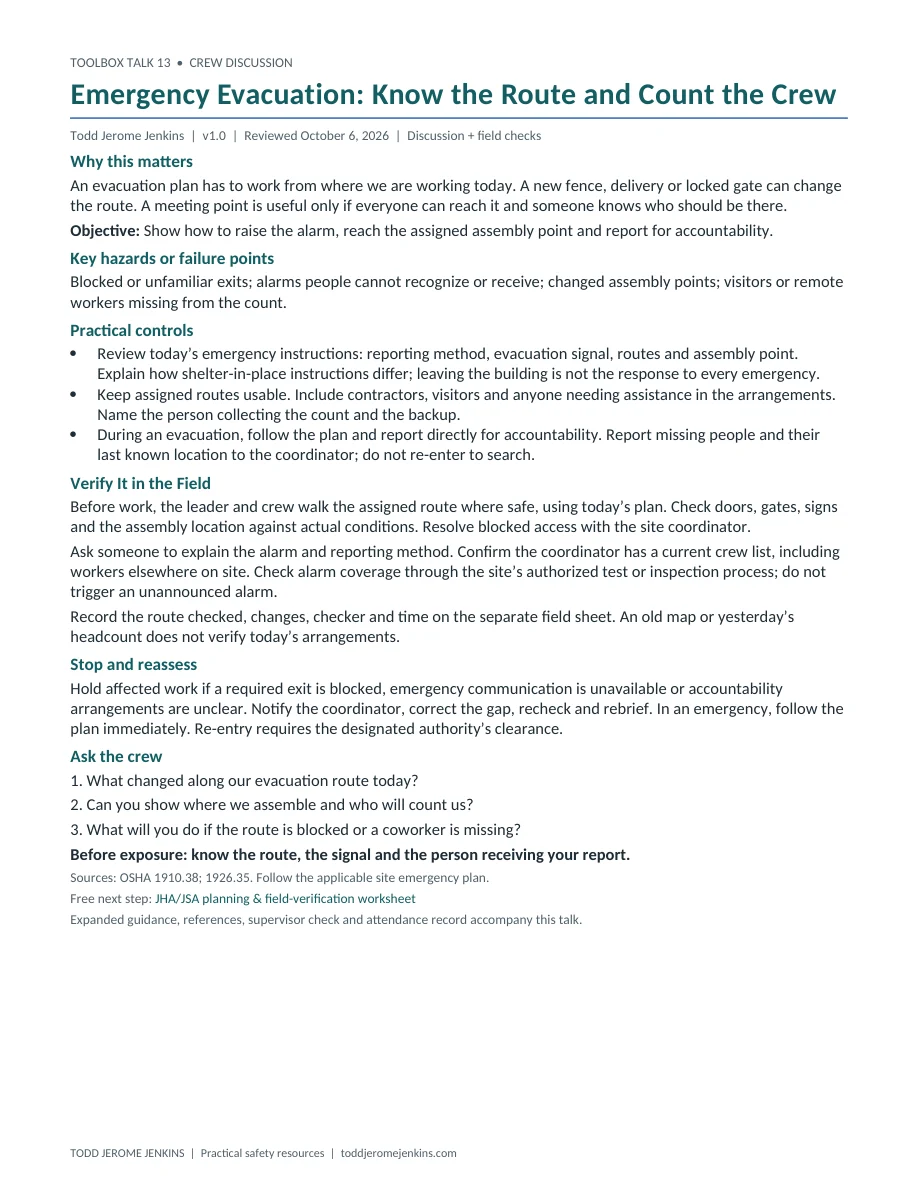
A 5–10 minute crew discussion, plus the time needed for field verification. All six downloads are free without a required signup.
Why this matters
An evacuation plan has to work from where we are working today. A new fence, delivery or locked gate can change the route. A meeting point is useful only if everyone can reach it and someone knows who should be there.
Learning objective: Show how to raise the alarm, reach the assigned assembly point and report for accountability.
Key hazards or failure points
Blocked or unfamiliar exits; alarms people cannot recognize or receive; changed assembly points; visitors or remote workers missing from the count.
Practical controls
- Review today’s emergency instructions: reporting method, evacuation signal, routes and assembly point. Explain how shelter-in-place instructions differ; leaving the building is not the response to every emergency.
- Keep assigned routes usable. Include contractors, visitors and anyone needing assistance in the arrangements. Name the person collecting the count and the backup.
- During an evacuation, follow the plan and report directly for accountability. Report missing people and their last known location to the coordinator; do not re-enter to search.
Verify It in the Field
Before work, the leader and crew walk the assigned route where safe, using today’s plan. Check doors, gates, signs and the assembly location against actual conditions. Resolve blocked access with the site coordinator.
Ask someone to explain the alarm and reporting method. Confirm the coordinator has a current crew list, including workers elsewhere on site. Check alarm coverage through the site’s authorized test or inspection process; do not trigger an unannounced alarm.
Record the route checked, changes, checker and time on the separate field sheet. An old map or yesterday’s headcount does not verify today’s arrangements.
Use the separate field check to record the source and criterion, safe method, checker, actual result and time. Mark VERIFIED, HOLD/NOT VERIFIED, or N/A with a reason. Check every required control; the examples below do not clear the whole task.
| Control | Safe verification | Evidence to record |
|---|---|---|
| Exit route | Walk the assigned route before exposure; compare it with the current plan. | Route and endpoint checked; obstruction or access problem recorded and resolved. |
| Emergency communication | Use the authorized alarm test or inspection record and ask workers what the signal means. | Coverage and meaning confirmed for today’s work area; unresolved locations held. |
| Accountability | Compare today’s deployment with the coordinator’s list and reporting assignments. | Named counter and backup, remote locations and visitor arrangements confirmed. |
Stop and reassess
Hold affected work if a required exit is blocked, emergency communication is unavailable or accountability arrangements are unclear. Notify the coordinator, correct the gap, recheck and rebrief. In an emergency, follow the plan immediately. Re-entry requires the designated authority’s clearance.
Crew discussion questions
- What changed along our evacuation route today?
- Can you show where we assemble and who will count us?
- What will you do if the route is blocked or a coworker is missing?
Before exposure: know the route, the signal and the person receiving your report.
A situation to discuss
Illustrative situation: a delivery is staged beside yesterday’s assembly point, and two crew members have moved to another floor. The leader checks the actual route and updates the accountability arrangements before work. Neither change would be found by collecting signatures alone.
Leader preparation and practical detail
Make the plan usable from the work location
Ask workers to describe their first action from the place they will actually work. Include changes between shifts, temporary partitions, access gates and mobile work areas. If the route or reporting instruction is unclear, the coordinator needs to resolve it before the crew relies on it. Do not invent an alternate route during this discussion.
Account for people without creating another exposure
Assign who supplies each crew’s status and who receives it. Decide how visitors, contractors and people away from the main work area are included. A missing person report should contain useful information, such as their last known work location, without sending an unassigned coworker back inside. Keep completed rosters private.
Use drills and checks for different purposes
A route walk can reveal a locked gate. It cannot establish that an alarm reaches a noisy enclosure or that an assistance arrangement works. Use the responsible site team’s planned tests and drills to check those functions, and follow up on gaps workers identify. This toolbox discussion does not replace emergency training.
Short supervisor field check
- Current emergency plan matches today’s work area, routes and assembly location.
- Assigned routes and gates checked in the field; defects resolved.
- Alarm/reporting coverage confirmed through the authorized process.
- Coordinator and backup have current crew, visitor and assistance arrangements.
- Crew explains accountability, missing-person reporting and re-entry authority.
Use the separate form to document evidence, restrictions, corrective-action owner, recheck and required restart approval. An unresolved required control means hold the affected work. Missing evidence is not a pass. Complete all task-specific inspections and permits.
Attendance and follow-through
The separate attendance sheet records participants, language support, questions, actions and late-arrival rebriefs. Attendance does not establish competence or prove controls function. Keep completed records private under the employer’s procedures.
Technical scope and references
OSHA 1910.38 applies when a standard in Part 1910 requires an emergency action plan; 1926.35 addresses plans required by a particular construction standard. Where those sections apply, employers with 10 or fewer employees may communicate the plan orally. Ten employees is not a universal trigger requiring a plan. This talk supports implementation of the applicable plan; it is not a complete plan or an assessment of every emergency. [1], [2]
References checked October 6, 2026. Apply the jurisdiction, task, employer program and equipment instructions that govern the work. No site-specific manual, permit, engineering determination or product SDS has been approved by this general resource.
- OSHA 29 CFR 1910.38 — Emergency action plans — General industry; applies when another Part 1910 standard requires an EAP.
- OSHA 29 CFR 1926.35 — Employee emergency action plans — Construction; plans required by a particular OSHA standard.
Connect this discussion to your JHA/JSA
Use How to Conduct a Job Safety Analysis to connect today’s work steps, hazards and controls. Revisit Pre-Job JHA/JSA: What Changed Today? whenever conditions change.
Related Todd Jerome Jenkins video: Job Safety Analysis: A Basic Overview.
Put one check into practice
Download the free JHA/JSA planning and field-verification worksheet. For today’s task, record an important control, its source and the evidence needed before exposure. Complete the remaining required checks through your task plan.
Continue the crew discussion
- Pre-Job JHA/JSA: What Changed Today?
- Fire Extinguishers: Know When to Evacuate
- Severe Weather: Know When and Where to Shelter