Download the talk and separate crew records
Free to download without an account. Each PDF is one page. Use the Word version to adapt the record to your task and approved procedures.
Supervisor field check
Download supervisor field check (PDF, 1 page)Editable supervisor field check (Word)Preview the one-page crew talk
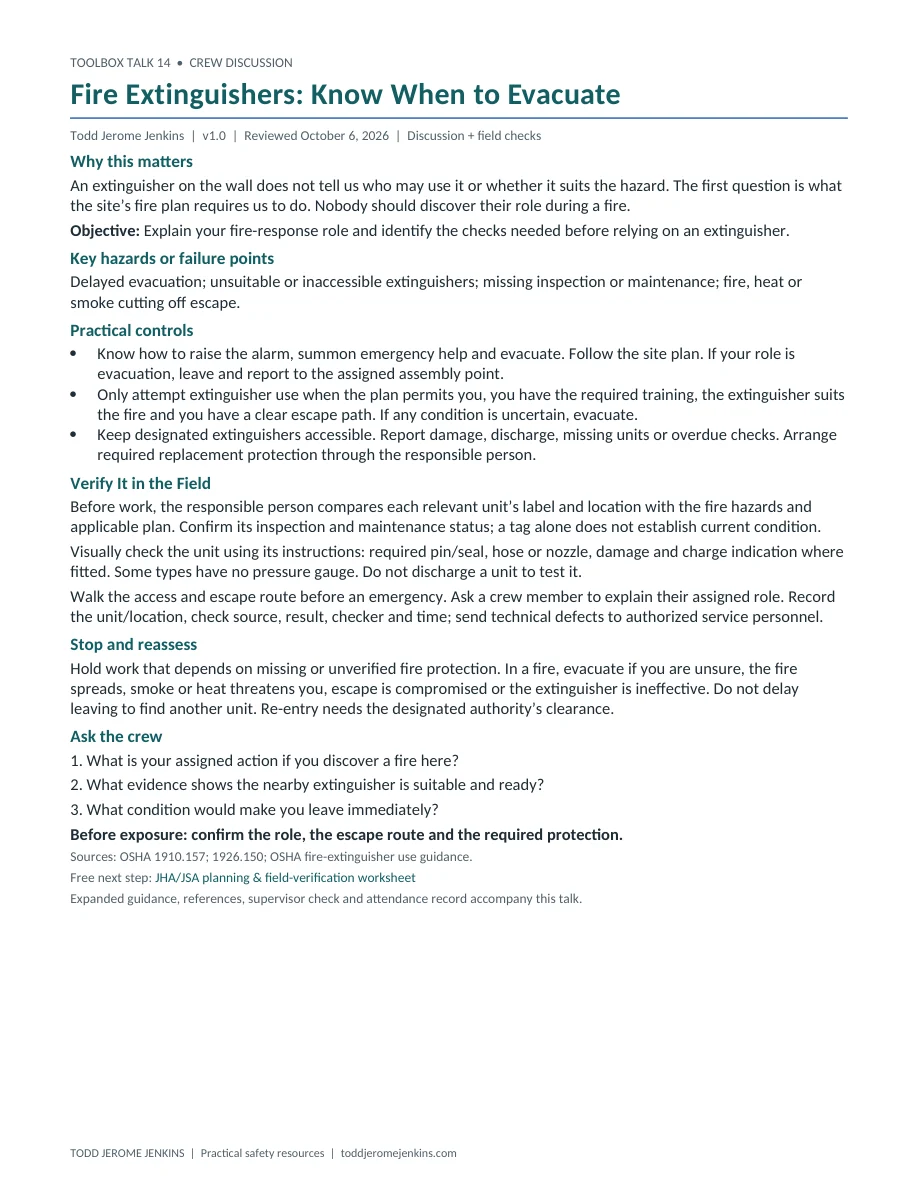
A 5–10 minute crew discussion, plus the time needed for field verification. All six downloads are free without a required signup.
Why this matters
An extinguisher on the wall does not tell us who may use it or whether it suits the hazard. The first question is what the site’s fire plan requires us to do. Nobody should discover their role during a fire.
Learning objective: Explain your fire-response role and identify the checks needed before relying on an extinguisher.
Key hazards or failure points
Delayed evacuation; unsuitable or inaccessible extinguishers; missing inspection or maintenance; fire, heat or smoke cutting off escape.
Practical controls
- Know how to raise the alarm, summon emergency help and evacuate. Follow the site plan. If your role is evacuation, leave and report to the assigned assembly point.
- Only attempt extinguisher use when the plan permits you, you have the required training, the extinguisher suits the fire and you have a clear escape path. If any condition is uncertain, evacuate.
- Keep designated extinguishers accessible. Report damage, discharge, missing units or overdue checks. Arrange required replacement protection through the responsible person.
Verify It in the Field
Before work, the responsible person compares each relevant unit’s label and location with the fire hazards and applicable plan. Confirm its inspection and maintenance status; a tag alone does not establish current condition.
Visually check the unit using its instructions: required pin/seal, hose or nozzle, damage and charge indication where fitted. Some types have no pressure gauge. Do not discharge a unit to test it.
Walk the access and escape route before an emergency. Ask a crew member to explain their assigned role. Record the unit/location, check source, result, checker and time; send technical defects to authorized service personnel.
Use the separate field check to record the source and criterion, safe method, checker, actual result and time. Mark VERIFIED, HOLD/NOT VERIFIED, or N/A with a reason. Check every required control; the examples below do not clear the whole task.
| Control | Safe verification | Evidence to record |
|---|---|---|
| Assigned response | Compare the fire plan, assigned duties and training record; ask for a teach-back. | Each person can state their role and how to raise the alarm. |
| Suitable equipment | Match unit identification and label to the fire-program selection. | Correct unit/location documented; unclear selection referred to the responsible person. |
| Ready access | Observe access and visual condition using the unit’s instructions. | Clear approach and escape route; condition and inspection status recorded. |
Stop and reassess
Hold work that depends on missing or unverified fire protection. In a fire, evacuate if you are unsure, the fire spreads, smoke or heat threatens you, escape is compromised or the extinguisher is ineffective. Do not delay leaving to find another unit. Re-entry needs the designated authority’s clearance.
Crew discussion questions
- What is your assigned action if you discover a fire here?
- What evidence shows the nearby extinguisher is suitable and ready?
- What condition would make you leave immediately?
Before exposure: confirm the role, the escape route and the required protection.
A situation to discuss
Illustrative situation: material is moved into a work area that previously held only tools. The existing extinguisher remains in place. Before work resumes, the responsible person checks whether the changed fire hazards affect selection and placement, and confirms who evacuates and who, if anyone, is trained and assigned to use it.
Leader preparation and practical detail
Set the response before discussing technique
A short talk about pulling a pin cannot establish that someone is prepared to fight a fire. Start with the employer’s chosen response, the employee’s assigned duties and the required education or training. Review how emergency services will be contacted without delaying evacuation. [1], [2]
Check function, access and suitability separately
A unit may look intact but be the wrong type for the anticipated fire. Another may be suitable but blocked by stored material. Treat these as separate checks. Use the actual label, manufacturer instructions and the person responsible for the fire program to resolve uncertainty. This resource deliberately supplies no universal pressure reading, travel distance or maintenance interval.
Do not turn a toolbox talk into a live fire exercise
Use the installed equipment only for safe identification and visual review. Discharge demonstrations belong in a planned training activity with appropriate equipment and controls. A crew discussion neither authorizes firefighting nor certifies readiness for a particular fire.
Short supervisor field check
- Site fire policy and each worker’s response role are understood.
- Required education/training and designated users confirmed.
- Relevant extinguisher type, rating and placement checked against the applicable plan.
- Access, visual condition and required inspection/maintenance status verified.
- Alarm, emergency call, evacuation route and re-entry authority confirmed.
Use the separate form to document evidence, restrictions, corrective-action owner, recheck and required restart approval. An unresolved required control means hold the affected work. Missing evidence is not a pass. Complete all task-specific inspections and permits.
Attendance and follow-through
The separate attendance sheet records participants, language support, questions, actions and late-arrival rebriefs. Attendance does not establish competence or prove controls function. Keep completed records private under the employer’s procedures.
Technical scope and references
For general industry, 1910.157 has different provisions for employee-use, designated-user and evacuation policies; do not mix their exceptions. Its education and designated-user training provisions differ. Construction fire protection is addressed by 1926.150 and other applicable provisions, with separate distribution and inspection requirements. Identify the industry, hazard and local fire requirements before setting criteria. [1], [2], [3]
References checked October 6, 2026. Apply the jurisdiction, task, employer program and equipment instructions that govern the work. No site-specific manual, permit, engineering determination or product SDS has been approved by this general resource.
- OSHA 29 CFR 1910.157 — Portable fire extinguishers — General industry; policy-dependent scope and exceptions.
- OSHA eTool — Fire Extinguisher Use — Guidance on trained response, clear escape and evacuation; not a training course.
- OSHA 29 CFR 1926.150 — Fire protection — Construction and demolition; separate criteria from general industry.
Connect this discussion to your JHA/JSA
Use How to Conduct a Job Safety Analysis to connect today’s work steps, hazards and controls. Revisit Pre-Job JHA/JSA: What Changed Today? whenever conditions change.
Related Todd Jerome Jenkins video: Job Safety Analysis: A Basic Overview.
Related published crew resources: Hazard Communication: Labels, SDS & the Task.
Put one check into practice
Download the free JHA/JSA planning and field-verification worksheet. For today’s task, record an important control, its source and the evidence needed before exposure. Complete the remaining required checks through your task plan.