Download the talk and separate crew records
Free to download without an account. Each PDF is one page. Use the Word version to adapt the record to your task and approved procedures.
Supervisor field check
Download supervisor field check (PDF, 1 page)Editable supervisor field check (Word)Preview the one-page crew talk
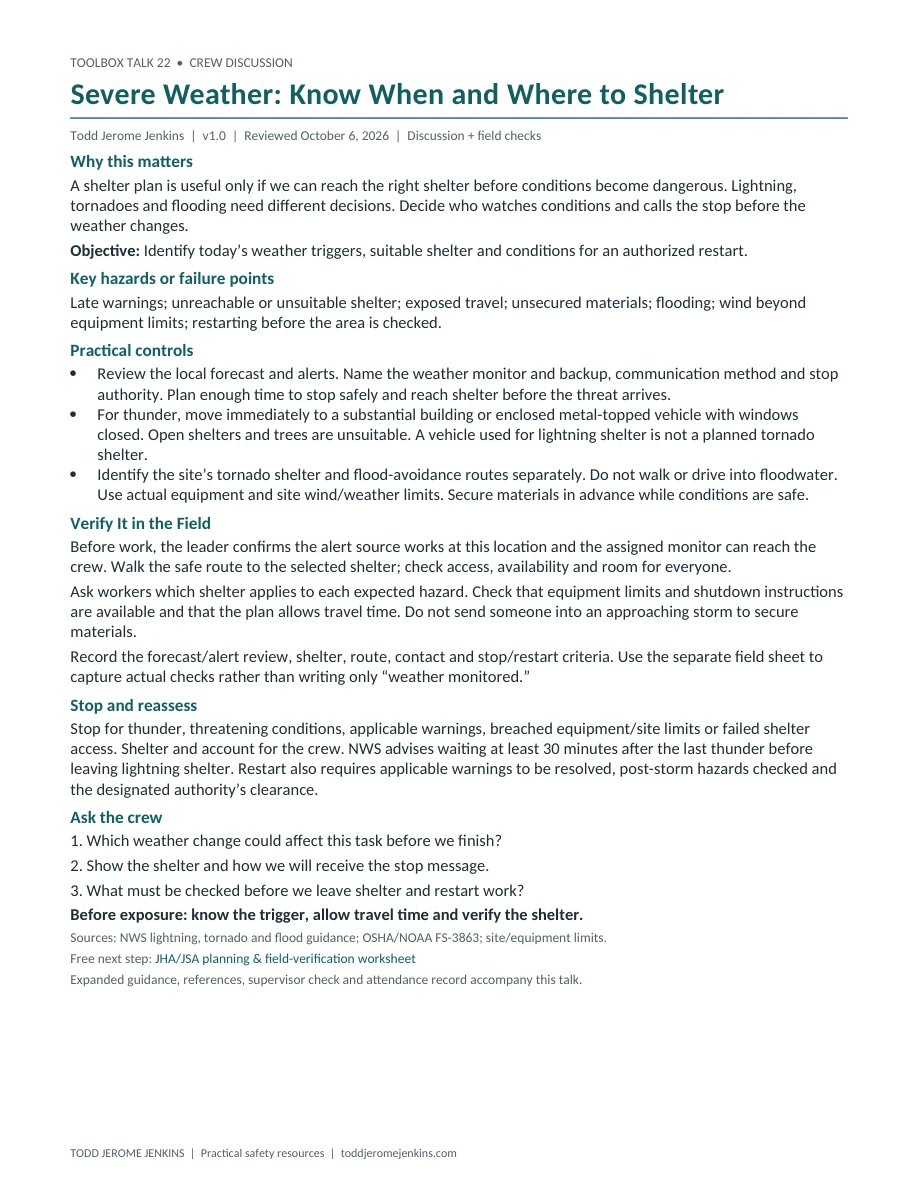
A 5–10 minute crew discussion, plus the time needed for field verification. All six downloads are free without a required signup.
Why this matters
A shelter plan is useful only if we can reach the right shelter before conditions become dangerous. Lightning, tornadoes and flooding need different decisions. Decide who watches conditions and calls the stop before the weather changes.
Learning objective: Identify today’s weather triggers, suitable shelter and conditions for an authorized restart.
Key hazards or failure points
Late warnings; unreachable or unsuitable shelter; exposed travel; unsecured materials; flooding; wind beyond equipment limits; restarting before the area is checked.
Practical controls
- Review the local forecast and alerts. Name the weather monitor and backup, communication method and stop authority. Plan enough time to stop safely and reach shelter before the threat arrives.
- For thunder, move immediately to a substantial building or enclosed metal-topped vehicle with windows closed. Open shelters and trees are unsuitable. A vehicle used for lightning shelter is not a planned tornado shelter.
- Identify the site’s tornado shelter and flood-avoidance routes separately. Do not walk or drive into floodwater. Use actual equipment and site wind/weather limits. Secure materials in advance while conditions are safe.
Verify It in the Field
Before work, the leader confirms the alert source works at this location and the assigned monitor can reach the crew. Walk the safe route to the selected shelter; check access, availability and room for everyone.
Ask workers which shelter applies to each expected hazard. Check that equipment limits and shutdown instructions are available and that the plan allows travel time. Do not send someone into an approaching storm to secure materials.
Record the forecast/alert review, shelter, route, contact and stop/restart criteria. Use the separate field sheet to capture actual checks rather than writing only “weather monitored.”
Use the separate field check to record the source and criterion, safe method, checker, actual result and time. Mark VERIFIED, HOLD/NOT VERIFIED, or N/A with a reason. Check every required control; the examples below do not clear the whole task.
| Control | Safe verification | Evidence to record |
|---|---|---|
| Alert communication | Confirm the selected information source and safe test of crew contact. | Monitor, backup and actual communication result recorded. |
| Shelter access | Walk the route before hazardous weather and confirm hazard-appropriate shelter availability. | Location, access, capacity and travel arrangements confirmed. |
| Restart decision | Apply weather guidance, current warnings and the site’s post-event inspection requirements. | Inspection results and designated restart clearance recorded before affected work. |
Stop and reassess
Stop for thunder, threatening conditions, applicable warnings, breached equipment/site limits or failed shelter access. Shelter and account for the crew. NWS advises waiting at least 30 minutes after the last thunder before leaving lightning shelter. Restart also requires applicable warnings to be resolved, post-storm hazards checked and the designated authority’s clearance.
Crew discussion questions
- Which weather change could affect this task before we finish?
- Show the shelter and how we will receive the stop message.
- What must be checked before we leave shelter and restart work?
Before exposure: know the trigger, allow travel time and verify the shelter.
A situation to discuss
Illustrative situation: the planned lightning shelter is a locked building at the far end of the site. A route walk finds the access problem before weather arrives. The leader arranges usable shelter and adjusts the work plan rather than waiting for thunder to test the arrangement.
Leader preparation and practical detail
Choose shelter for the hazard
For lightning, NWS identifies a substantial building with electrical wiring or plumbing, or an enclosed metal-topped vehicle with windows up. For tornadoes, use the designated tornado shelter; a basement or a small interior room on the lowest floor of a sturdy building, away from windows, may be part of the site plan. A lightning shelter choice is not automatically appropriate for tornadoes or flooding. [1], [2]
A forecast is an input to an action plan
Agree who monitors updates, who has a backup when the monitor is occupied and how all work groups receive the instruction. Account for the time needed to stop the task and get people to shelter. Device notifications can support the plan; they are not a reason to ignore thunder or a threatening change visible at the work location. [4]
Restart includes the workplace
After sheltering, check for changed access, damaged electrical equipment, unstable material and other storm effects before affected work resumes. Appropriate competent or authorized people must inspect conditions within their responsibility. The lightning waiting period is one condition; it does not establish that flooded or damaged work areas are safe. [1], [3]
Short supervisor field check
- Current local weather information reviewed; monitor and backup assigned.
- Stop message and crew contact verified at actual work locations.
- Hazard-appropriate shelter, access, capacity and route confirmed.
- Task/equipment limits and time for safe shutdown/travel addressed.
- Accountability, post-weather checks and restart authority understood.
Use the separate form to document evidence, restrictions, corrective-action owner, recheck and required restart approval. An unresolved required control means hold the affected work. Missing evidence is not a pass. Complete all task-specific inspections and permits.
Attendance and follow-through
The separate attendance sheet records participants, language support, questions, actions and late-arrival rebriefs. Attendance does not establish competence or prove controls function. Keep completed records private under the employer’s procedures.
Technical scope and references
NWS advice is weather-safety guidance. The 30-minute period applies to lightning after the last thunder; it is not a universal waiting period for tornadoes, flooding or high winds. OSHA/NOAA FS-3863 is a 2016 fact sheet used for planning principles, excluding dated statistics. Equipment wind limits, stabilization methods and inspection criteria must come from the applicable instructions and site requirements. [1], [2], [3], [4]
References checked October 6, 2026. Apply the jurisdiction, task, employer program and equipment instructions that govern the work. No site-specific manual, permit, engineering determination or product SDS has been approved by this general resource.
- National Weather Service — Lightning Tips — Weather-safety guidance, including shelter and at least 30 minutes after last thunder.
- National Weather Service — Basic Tornado Safety Rules — Weather-safety guidance; separate tornado shelter decision.
- National Weather Service — Turn Around Don’t Drown — Weather-safety guidance; avoid walking/driving into floodwater.
- OSHA/NOAA FS-3863 — Lightning Safety When Working Outdoors — May 2016 guidance; dated injury statistics excluded.
Connect this discussion to your JHA/JSA
Use How to Conduct a Job Safety Analysis to connect today’s work steps, hazards and controls. Revisit Pre-Job JHA/JSA: What Changed Today? whenever conditions change.
Related Todd Jerome Jenkins video: Job Safety Analysis: A Basic Overview.
Related published crew resources: Heat: Conditions Change, Controls Change.
Put one check into practice
Download the free JHA/JSA planning and field-verification worksheet. For today’s task, record an important control, its source and the evidence needed before exposure. Complete the remaining required checks through your task plan.