Download the talk and separate crew records
Free to download without an account. Each PDF is one page. Use the Word version to adapt the record to your task and approved procedures.
Supervisor field check
Download supervisor field check (PDF, 1 page)Editable supervisor field check (Word)Preview the one-page crew talk
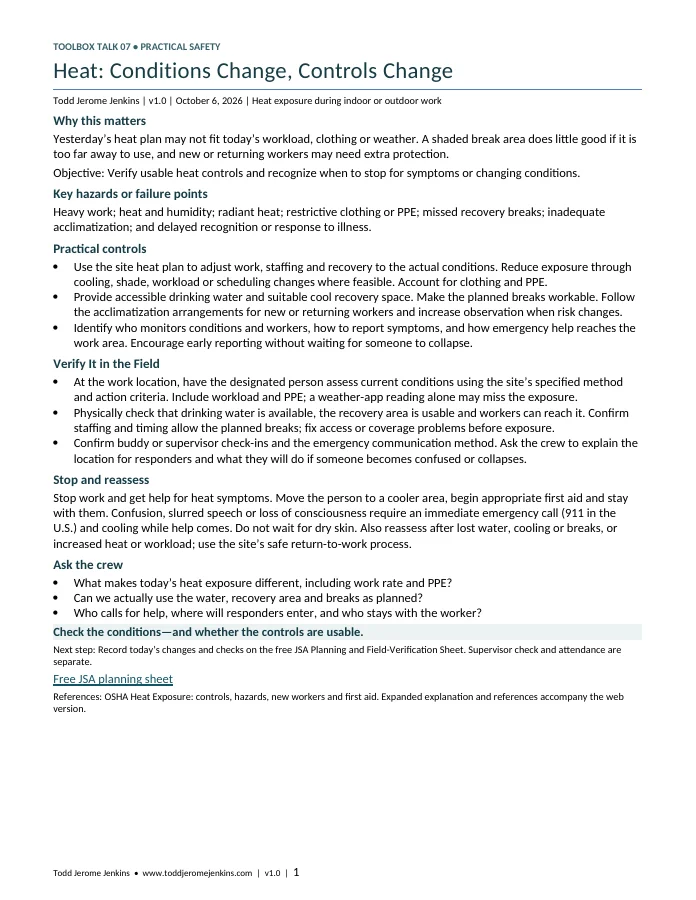
One-page crew talk, with separate supervisor and attendance sheets. Plan a 5–10 minute discussion and allow the time needed for field verification. All downloads are free; no account is required.
Learning objective
Verify usable heat controls and recognize when to stop for symptoms or changing conditions.
Start with today’s work
Illustrative scenario: The weather is unchanged, but the crew moves from light setup work to heavy carrying in protective clothing. The break schedule has not changed. Reassess the exposure before that phase: work rate and clothing can increase heat strain even when the forecast looks the same. Confirm that relief staffing and the recovery space support the revised plan.
Key hazards or failure points
Heavy work; heat and humidity; radiant heat; restrictive clothing or PPE; missed recovery breaks; inadequate acclimatization; and delayed recognition or response to illness.
Practical controls
- Use the site heat plan to adjust work, staffing and recovery to the actual conditions. Reduce exposure through cooling, shade, workload or scheduling changes where feasible. Account for clothing and PPE.
- Provide accessible drinking water and suitable cool recovery space. Make the planned breaks workable. Follow the acclimatization arrangements for new or returning workers and increase observation when risk changes.
- Identify who monitors conditions and workers, how to report symptoms, and how emergency help reaches the work area. Encourage early reporting without waiting for someone to collapse.
Verify It in the Field
- At the work location, have the designated person assess current conditions using the site’s specified method and action criteria. Include workload and PPE; a weather-app reading alone may miss the exposure.
- Physically check that drinking water is available, the recovery area is usable and workers can reach it. Confirm staffing and timing allow the planned breaks; fix access or coverage problems before exposure.
- Confirm buddy or supervisor check-ins and the emergency communication method. Ask the crew to explain the location for responders and what they will do if someone becomes confused or collapses.
For each required control, identify the acceptance source and safe check method, assign a person with the required competence and authority, and record the actual result and time. Use VERIFIED, HOLD/NOT VERIFIED, or N/A with a reason. A checkmark alone does not demonstrate that protection works.
| Control | Safe verification | Criterion, evidence and response |
|---|---|---|
| Exposure assessment | Designated person reviews actual work conditions with the specified assessment method, including clothing and workload. | Site heat plan, applicable jurisdictional rules and assessment guidance. Record location, time, method and action decision. |
| Usable controls | Visit the water and recovery locations and confirm workers can take the planned breaks. | Site heat plan. Record supply, access and staffing gaps; change the task or hold exposure if controls cannot be used. |
| Emergency readiness | Confirm emergency location, communication and cooling arrangements without delaying real care or making a test emergency call. | Site emergency plan and OSHA heat first-aid guidance. Record roles and access; severe symptoms mean immediate emergency response. |
These are examples, not a complete task inspection. Check all required controls. Do not enter danger, defeat a safeguard or improvise a test. If the criterion, method or result is uncertain, hold affected work and get the appropriate technical help. No actual equipment model, product SDS or site permit was supplied for these examples; use the documents for your task.
Leader preparation and explanation
Assess the actual exposure
OSHA’s heat guidance considers environmental conditions together with workload, clothing and worker factors. Heat index can be a screening aid; it is not interchangeable with a workplace WBGT assessment. Use the method, instrument instructions and action criteria selected by the responsible person for the site. This resource does not invent a universal temperature or work/rest limit.
Make recovery practical
Water and recovery space must be where workers can use them. Check supply, access, shade or cooling, and the coverage needed to take breaks. New and returning workers may need a planned progression of heat exposure and closer observation. Ask what might prevent someone from stopping for water or reporting symptoms, then resolve the obstacle.
Treat severe symptoms as an emergency
Confusion, slurred speech or loss of consciousness can indicate a life-threatening heat emergency. Call emergency services immediately, begin cooling using the emergency plan and stay with the person. Sweating does not rule out heat stroke. Do not send an ill person away alone or wait for a temperature measurement before getting help.
Keep legal status separate from guidance
As checked on October 6, 2026, OSHA’s federal heat rulemaking page described a proposed rule, not a final nationwide heat standard. State-plan and other applicable requirements may differ. The employer must establish the current requirements for the work location; this talk does not adopt proposed federal trigger temperatures as law.
Stop and reassess
Stop work and get help for heat symptoms. Move the person to a cooler area, begin appropriate first aid and stay with them. Confusion, slurred speech or loss of consciousness require an immediate emergency call (911 in the U.S.) and cooling while help comes. Do not wait for dry skin. Also reassess after lost water, cooling or breaks, or increased heat or workload; use the site’s safe return-to-work process.
When conditions change, return to Pre-Job JHA/JSA: What Changed Today? and revise the affected task plan with the crew.
Three crew discussion questions
- What makes today’s heat exposure different, including work rate and PPE?
- Can we actually use the water, recovery area and breaks as planned?
- Who calls for help, where will responders enter, and who stays with the worker?
Short supervisor field check
- Assessment reflects current work-area conditions, workload and clothing/PPE.
- Applicable action criteria and monitoring method are identified in the site heat plan.
- Water and cool recovery space are available, accessible and usable.
- Break coverage, acclimatization and worker monitoring arrangements are in place.
- Emergency communication, location, cooling response and responder access are confirmed.
Use the separate supervisor sheet to record the task and change, JHA/JSA revision, acceptance source, safe method, verifier, actual result, unresolved items, corrective action, recheck and required restart authorization. Link specialist inspection records rather than copying private or unnecessary details.
Attendance and follow-through
Use the separate attendance sheet for participant names, roles and acknowledgment, meeting details, concerns, actions and rebriefs. Attendance is not proof of competence, functioning controls or permission to work. Keep completed records under the employer’s privacy and recordkeeping procedures; never post completed sign-in sheets publicly.
Related JHA/JSA resource and existing video
How to Conduct a Job Safety Analysis connects the task steps, hazards and controls. For related background, see What Is the Hierarchy of Controls?.
Related crew discussions
One next step
Use the free JSA Planning and Field-Verification Sheet to record today’s changes and checks with the crew.
Sources and references
Sources reviewed October 6, 2026. Apply each regulation’s industry and activity scope, and current state or local requirements where applicable. Guidance is identified separately. This discussion resource supports preparation; it does not replace task procedures, required training, permits or specialist decisions.
- OSHA — Heat Exposure: Control Measures — Engineering and work-practice controls, water, recovery and emergency preparation.
- OSHA — Heat Hazard Recognition — Environmental conditions, workload, clothing and assessment methods.
- OSHA — Protecting New Workers — Acclimatization and increased protection for new or returning workers.
- OSHA — Heat-Related Illnesses and First Aid — Early response, emergency symptoms, cooling and staying with an ill worker.
- OSHA — Heat Rulemaking — Status check only: federal proposal, not a final rule on the page reviewed.