Download the free toolbox talk
The one-page talk, editable Word version, and guidance below are open to everyone. No account required.
One-page toolbox talk
Download one-page toolbox talk (PDF, 1 page)Editable one-page toolbox talk (Word)Preview the one-page toolbox talk
Supporting documents
Included with free Safety & Systems membership.
Supervisor field check
A separate check to verify conditions and controls before work. Includes a one-page PDF and editable Word file.
Attendance sheet
A separate sign-in sheet to record the crew discussion. Includes a one-page PDF and editable Word file.
Need the crew records? Join free to use these supporting documents and the Safety & Systems Academy. No payment details. Email updates are optional.
Get supporting documents — free membershipAlready a member? Use the same link to sign in.
Hazard-based toolbox talk 4 of 52, with a practical HOP exercise.
Plan a 5–10 minute toolbox discussion, plus time to verify the actual controls. The one-page toolbox talk and editable Word version are public. Separate supervisor and attendance records are included with free Safety & Systems membership.
Why this matters
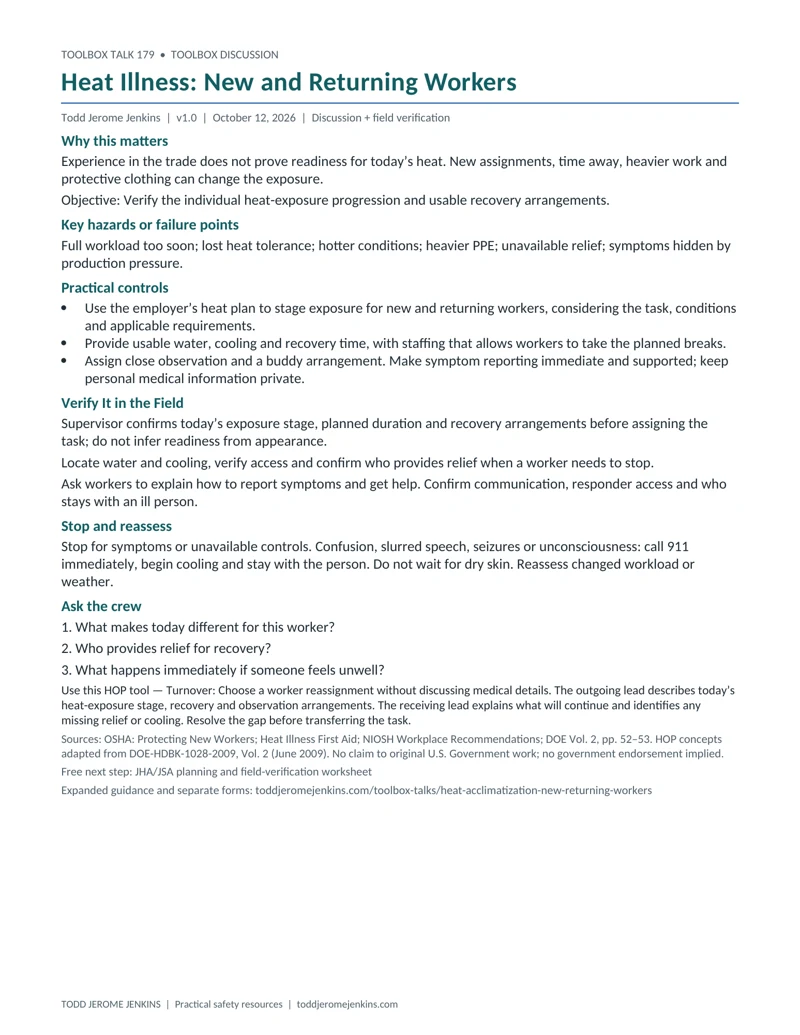
Experience in the trade does not prove readiness for today’s heat. New assignments, time away, heavier work and protective clothing can change the exposure.
Learning objective
Verify the individual heat-exposure progression and usable recovery arrangements.
Key hazards or failure points
Full workload too soon; lost heat tolerance; hotter conditions; heavier PPE; unavailable relief; symptoms hidden by production pressure.
Practical controls
- Use the employer’s heat plan to stage exposure for new and returning workers, considering the task, conditions and applicable requirements.
- Provide usable water, cooling and recovery time, with staffing that allows workers to take the planned breaks.
- Assign close observation and a buddy arrangement. Make symptom reporting immediate and supported; keep personal medical information private.
Verify It in the Field
- Supervisor confirms today’s exposure stage, planned duration and recovery arrangements before assigning the task; do not infer readiness from appearance.
- Locate water and cooling, verify access and confirm who provides relief when a worker needs to stop.
- Ask workers to explain how to report symptoms and get help. Confirm communication, responder access and who stays with an ill person.
Stop and reassess
Stop for symptoms or unavailable controls. Confusion, slurred speech, seizures or unconsciousness: call 911 immediately, begin cooling and stay with the person. Do not wait for dry skin. Reassess changed workload or weather.
Crew discussion questions
- What makes today different for this worker?
- Who provides relief for recovery?
- What happens immediately if someone feels unwell?
For each required control, record its acceptance source and criterion, safe verification method, responsible verifier, actual result and time. Mark VERIFIED, HOLD/NOT VERIFIED, or N/A with a reason. Complete all required inspections; never enter danger or improvise a test to fill out a form.
Use this HOP tool
Turnover
Choose a worker reassignment without discussing medical details. The outgoing lead describes today’s heat-exposure stage, recovery and observation arrangements. The receiving lead explains what will continue and identifies any missing relief or cooling. Resolve the gap before transferring the task.
This exercise supports hazard identification or control verification. It does not replace safeguards, required training, specialist decisions or work authorization.
Leader preparation and practical detail
Plan progression; do not infer tolerance
OSHA guidance includes new activities, warmer weather and return after a week or more away among situations needing additional protection. The employer’s plan should address the actual heat load and the worker’s return, with appropriate professional advice. A fit appearance or experience in the trade is not evidence of heat tolerance.
Identify guidance honestly
NIOSH recommends gradual exposure over 7–14 days. Its new-worker schedule starts at no more than 20 percent of usual heat-work duration, increasing by no more than 20 percent daily; it gives a different progression for experienced workers. These are guidance, not a universal legal schedule or guarantee of safety. Apply current jurisdictional requirements and the site assessment.
Transfer the plan between supervisors
During a reassignment or shift handoff, communicate the worker’s approved work arrangements, completed exposure and next recovery, without circulating medical details. The receiving supervisor confirms relief and observation are actually available. Anyone showing symptoms stops exposure and receives help; severe neurological signs require an emergency response and cooling.
Short supervisor field check
- Exposure stage confirmed
- Workload and PPE reviewed
- Water and cooling usable
- Buddy and relief assigned
- Emergency response understood
Use the separate sheet to document evidence, unresolved restrictions, correction owner, recheck and required release authority. Rebrief affected workers. This record does not replace specialist inspections, permits or engineering determinations.
Attendance and follow-through
Use the separate attendance record for participants, roles, questions, actions and late-arrival rebriefs. Attendance does not prove competence, functioning controls or authorization. Keep completed records private under employer procedures.
Source acknowledgment
HOP concepts are adapted from DOE-HDBK-1028-2009, Human Performance Improvement Handbook, Volume 2 (June 2009). Todd Jerome Jenkins makes no claim to authorship or copyright ownership of original U.S. Government work. The explanations and exercises are original adaptations; no endorsement by DOE or the U.S. Government is implied. Third-party material credited in the handbook retains its separate ownership.
HOP source: Volume 2/VOLUME 2 TURNOVER.pdf; Printed pp. 52–53. The handbook supplies concepts; task-specific technical references are listed below.
Technical scope and references
Technical sources inspected October 9, 2026; resource edition October 12, 2026. Apply current jurisdictional requirements, the actual task procedure, manufacturer instructions, permits and required competent or qualified decisions. This resource supplies no equipment-specific acceptance criteria.
- OSHA — Protecting New Workers — Acclimatization and close observation guidance.
- NIOSH — Workplace Recommendations — Acclimatization schedules, control and recovery guidance.
- OSHA — Heat-Related Illnesses and First Aid — Emergency signs and immediate response.
- DOE-HDBK-1028-2009 Volume 2 — Turnover — Printed pp. 52–53; historical HOP tool basis, adapted exercise.
Connect this discussion to your JHA/JSA
Use the JHA/JSA planning and field-verification worksheet to connect this discussion to the actual task, controls and responsible people.
Related Todd Jerome Jenkins articles: How to Conduct a Job Safety Analysis and What Is Human and Organizational Performance?.
Related toolbox talks
- Heat: Conditions Change, Controls Change
- New to the Job: Show the Work Before You Start
- Work Turnover: Transfer the State, Not Just the Story
Continue the hazard series
Put one verification into practice
Record today’s change and evidence using the free JHA/JSA planning and field-verification worksheet.