Download the talk and separate crew records
Free to download without an account. Each PDF is one page. Use the Word version to adapt the record to your task and approved procedures.
Supervisor field check
Download supervisor field check (PDF, 1 page)Editable supervisor field check (Word)Preview the one-page crew talk
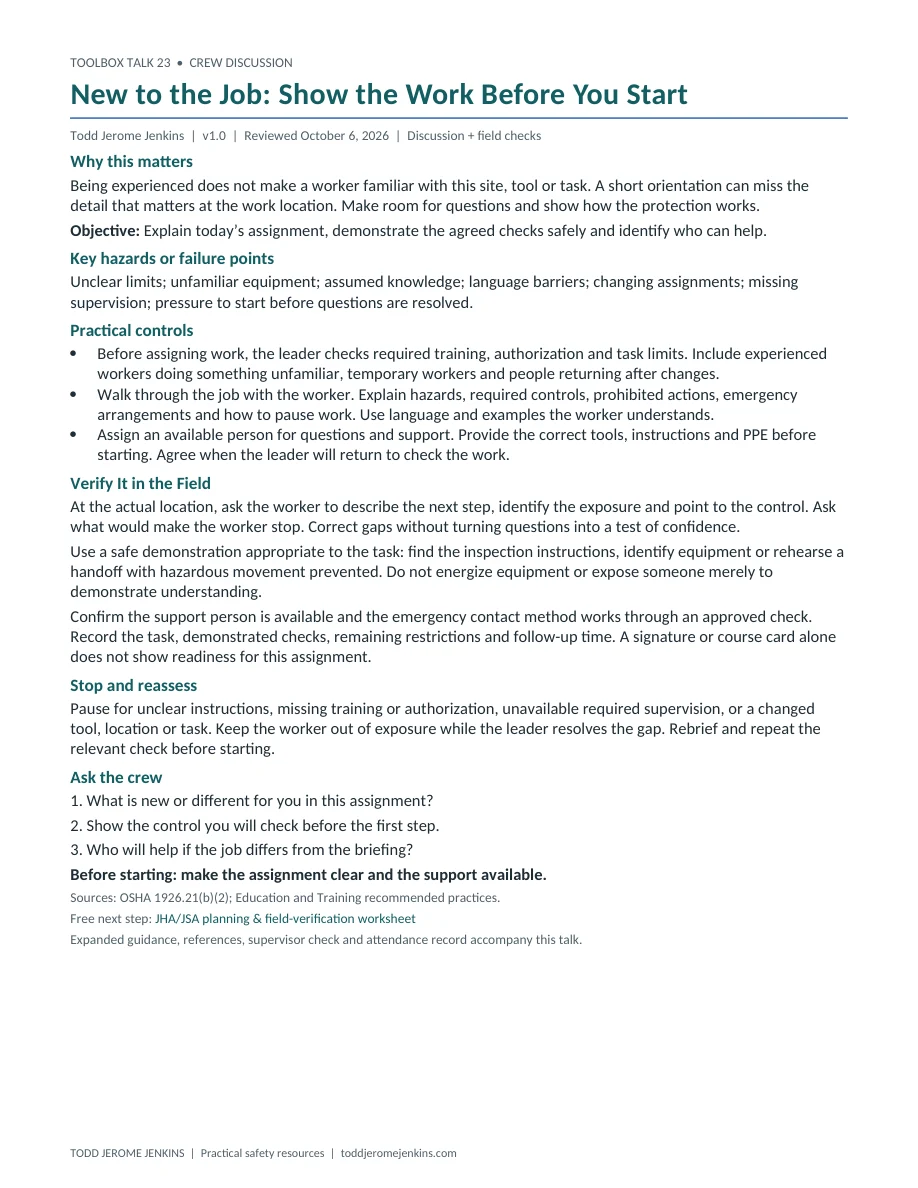
A 5–10 minute crew discussion, plus the time needed for field verification. All six downloads are free without a required signup.
Why this matters
Being experienced does not make a worker familiar with this site, tool or task. A short orientation can miss the detail that matters at the work location. Make room for questions and show how the protection works.
Learning objective: Explain today’s assignment, demonstrate the agreed checks safely and identify who can help.
Key hazards or failure points
Unclear limits; unfamiliar equipment; assumed knowledge; language barriers; changing assignments; missing supervision; pressure to start before questions are resolved.
Practical controls
- Before assigning work, the leader checks required training, authorization and task limits. Include experienced workers doing something unfamiliar, temporary workers and people returning after changes.
- Walk through the job with the worker. Explain hazards, required controls, prohibited actions, emergency arrangements and how to pause work. Use language and examples the worker understands.
- Assign an available person for questions and support. Provide the correct tools, instructions and PPE before starting. Agree when the leader will return to check the work.
Verify It in the Field
At the actual location, ask the worker to describe the next step, identify the exposure and point to the control. Ask what would make the worker stop. Correct gaps without turning questions into a test of confidence.
Use a safe demonstration appropriate to the task: find the inspection instructions, identify equipment or rehearse a handoff with hazardous movement prevented. Do not energize equipment or expose someone merely to demonstrate understanding.
Confirm the support person is available and the emergency contact method works through an approved check. Record the task, demonstrated checks, remaining restrictions and follow-up time. A signature or course card alone does not show readiness for this assignment.
Use the separate field check to record the source and criterion, safe method, checker, actual result and time. Mark VERIFIED, HOLD/NOT VERIFIED, or N/A with a reason. Check every required control; the examples below do not clear the whole task.
| Control | Safe verification | Evidence to record |
|---|---|---|
| Clear assignment | Ask the worker to identify the task, equipment and limits at the work location. | Task and restrictions recorded; unresolved steps held. |
| Usable protection | Use an approved, nonexposing demonstration of a required check. | What was demonstrated, by whom and what still needs instruction. |
| Available support | Confirm the named support person and agreed contact method before assignment. | Contact result, follow-up time and work to hold if support is unavailable. |
Stop and reassess
Pause for unclear instructions, missing training or authorization, unavailable required supervision, or a changed tool, location or task. Keep the worker out of exposure while the leader resolves the gap. Rebrief and repeat the relevant check before starting.
Crew discussion questions
- What is new or different for you in this assignment?
- Show the control you will check before the first step.
- Who will help if the job differs from the briefing?
Before starting: make the assignment clear and the support available.
A situation to discuss
Illustrative situation: an experienced worker joins a crew using a different tool model. The leader does not assume that previous experience covers its controls. They review the actual instructions and complete the appropriate safe demonstration before the worker is assigned the task.
Leader preparation and practical detail
Check readiness at the point of work
Use a brief conversation to reveal gaps in the assignment. Ask the worker to locate the exact tool, explain the next action and identify the protection for that action. A fluent explanation is only one piece of evidence. Required practical training, evaluations, licenses, authorizations and supervision still apply to the particular work.
Make the briefing understandable
OSHA’s construction rule requires instruction about relevant hazards and applicable regulations. Its recommended practices also emphasize understandable language, opportunities for questions and added training when assignments or conditions change. Use an interpreter or another suitable communication method when needed, and verify meaning rather than asking only whether everyone understands. [1], [2]
Close the support gap
A name on the assignment sheet is of little use if that person is unavailable. Agree how to reach support and which work must wait if support is lost. At the follow-up, ask what differed from the briefing and whether the provided tools and controls were usable. Treat an unresolved gap as a planning issue requiring action, not a reason to tell someone to figure it out.
Short supervisor field check
- Assignment, limits and required training/authorization checked.
- Worker explains key hazards and identifies actual controls.
- Safe demonstration completed; gaps and restrictions recorded.
- Support person and emergency communication confirmed.
- Follow-up time, reassessment triggers and work to hold agreed.
Use the separate form to document evidence, restrictions, corrective-action owner, recheck and required restart approval. An unresolved required control means hold the affected work. Missing evidence is not a pass. Complete all task-specific inspections and permits.
Attendance and follow-through
The separate attendance sheet records participants, language support, questions, actions and late-arrival rebriefs. Attendance does not establish competence or prove controls function. Keep completed records private under the employer’s procedures.
Technical scope and references
This is a briefing and readiness check, not an operator qualification or a substitute for task-specific training. OSHA 1926.21 applies to construction; other industries and particular equipment have their own training provisions. OSHA’s safety-management recommended practices are guidance. [1], [2]
References checked October 6, 2026. Apply the jurisdiction, task, employer program and equipment instructions that govern the work. No site-specific manual, permit, engineering determination or product SDS has been approved by this general resource.
- OSHA 29 CFR 1926.21 — Safety training and education — Construction: paragraph (b)(2) instruction about hazards and applicable regulations.
- OSHA — Education and Training — Recommended practices: understandable instruction, task changes and worker questions. Guidance, not a standalone training standard.
Connect this discussion to your JHA/JSA
Use How to Conduct a Job Safety Analysis to connect today’s work steps, hazards and controls. Revisit Pre-Job JHA/JSA: What Changed Today? whenever conditions change.
Related Todd Jerome Jenkins video: Job Safety Analysis: A Basic Overview.
Related published crew resources: Hand Tools: Condition, Selection & Line of Fire.
Put one check into practice
Download the free JHA/JSA planning and field-verification worksheet. For today’s task, record an important control, its source and the evidence needed before exposure. Complete the remaining required checks through your task plan.