Download the talk and separate crew records
Free to download without an account. Each PDF is one page. Use the Word version to adapt the record to your task and approved procedures.
Supervisor field check
Download supervisor field check (PDF, 1 page)Editable supervisor field check (Word)Preview the one-page crew talk
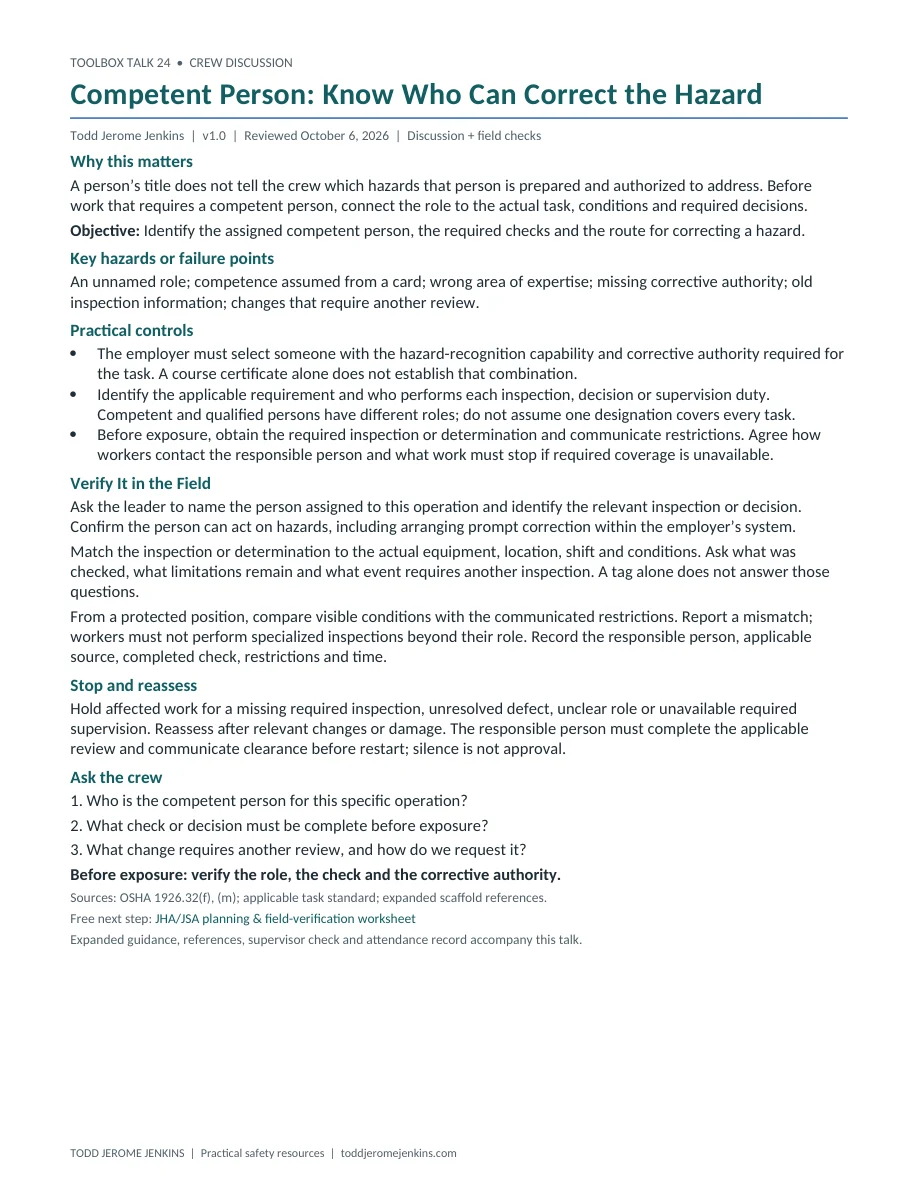
A 5–10 minute crew discussion, plus the time needed for field verification. All six downloads are free without a required signup.
Why this matters
A person’s title does not tell the crew which hazards that person is prepared and authorized to address. Before work that requires a competent person, connect the role to the actual task, conditions and required decisions.
Learning objective: Identify the assigned competent person, the required checks and the route for correcting a hazard.
Key hazards or failure points
An unnamed role; competence assumed from a card; wrong area of expertise; missing corrective authority; old inspection information; changes that require another review.
Practical controls
- The employer must select someone with the hazard-recognition capability and corrective authority required for the task. A course certificate alone does not establish that combination.
- Identify the applicable requirement and who performs each inspection, decision or supervision duty. Competent and qualified persons have different roles; do not assume one designation covers every task.
- Before exposure, obtain the required inspection or determination and communicate restrictions. Agree how workers contact the responsible person and what work must stop if required coverage is unavailable.
Verify It in the Field
Ask the leader to name the person assigned to this operation and identify the relevant inspection or decision. Confirm the person can act on hazards, including arranging prompt correction within the employer’s system.
Match the inspection or determination to the actual equipment, location, shift and conditions. Ask what was checked, what limitations remain and what event requires another inspection. A tag alone does not answer those questions.
From a protected position, compare visible conditions with the communicated restrictions. Report a mismatch; workers must not perform specialized inspections beyond their role. Record the responsible person, applicable source, completed check, restrictions and time.
Use the separate field check to record the source and criterion, safe method, checker, actual result and time. Mark VERIFIED, HOLD/NOT VERIFIED, or N/A with a reason. Check every required control; the examples below do not clear the whole task.
| Control | Safe verification | Evidence to record |
|---|---|---|
| Assigned role | Leader confirms the person, operation and required capability/authority. | Name, role scope and source requirement recorded. |
| Current decision | Match the completed inspection or determination to the actual setup and conditions. | Check date/time, equipment or area, restrictions and unresolved items. |
| Reinspection trigger | Discuss an actual change or damage scenario without creating exposure. | Crew identifies the hold point and whom to contact before restart. |
Stop and reassess
Hold affected work for a missing required inspection, unresolved defect, unclear role or unavailable required supervision. Reassess after relevant changes or damage. The responsible person must complete the applicable review and communicate clearance before restart; silence is not approval.
Crew discussion questions
- Who is the competent person for this specific operation?
- What check or decision must be complete before exposure?
- What change requires another review, and how do we request it?
Before exposure: verify the role, the check and the corrective authority.
A situation to discuss
Illustrative situation: a crew returns to a scaffold after another activity may have damaged it. Yesterday’s inspection is not the decision needed for the changed condition. The crew holds access and asks the assigned competent person to complete the required inspection before use.
Leader preparation and practical detail
Assign a task, not a universal badge
The construction definition combines the ability to recognize relevant hazards with authority to correct them promptly. The employer needs evidence that the person meets the role for this work. Training and experience can support that determination, but a familiar job title or certificate does not answer the authority question. [1]
Keep scaffold responsibilities distinct
For scaffolds, 1926.451(a)(6) assigns design to a qualified person. Paragraph (f)(3) requires competent-person visible-defect inspections before each shift and after events that could affect structural integrity. Under 1926.454, user training and training for erection or related activities have different instructor-role provisions. These are examples of why the exact task standard matters. [2], [3]
Make the decision usable by the crew
A useful briefing identifies what equipment or area was evaluated, the permitted activity and the restrictions that remain. Ask who will take over if the assigned person leaves and what work will be held until the required role is covered. This does not mean every competent-person provision universally requires continuous on-site presence; determine the actual duty in the applicable standard.
Short supervisor field check
- Applicable task standard and required role identified.
- Employer’s assignment, capability and corrective authority confirmed.
- Required inspection/decision matches current equipment and conditions.
- Restrictions, unresolved items and required coverage communicated.
- Change triggers and contact/restart process understood.
Use the separate form to document evidence, restrictions, corrective-action owner, recheck and required restart approval. An unresolved required control means hold the affected work. Missing evidence is not a pass. Complete all task-specific inspections and permits.
Attendance and follow-through
The separate attendance sheet records participants, language support, questions, actions and late-arrival rebriefs. Attendance does not establish competence or prove controls function. Keep completed records private under the employer’s procedures.
Technical scope and references
Focus: construction terminology and pre-job coordination. This resource does not appoint or qualify anyone. A competent person, qualified person, professional engineer or other authorized role may be needed depending on the standard. Use the actual task provision to establish duties, timing and required presence. [1], [2], [3]
References checked October 6, 2026. Apply the jurisdiction, task, employer program and equipment instructions that govern the work. No site-specific manual, permit, engineering determination or product SDS has been approved by this general resource.
- OSHA 29 CFR 1926.32 — Definitions — Construction: competent person (f), qualified (m); roles depend on the actual task provision.
- OSHA 29 CFR 1926.451 — Scaffold general requirements — Scaffold design (a)(6), inspection (f)(3), and related task duties.
- OSHA 29 CFR 1926.454 — Scaffold training requirements — User training in (a), erection and related activity training in (b), retraining in (c).
Connect this discussion to your JHA/JSA
Use How to Conduct a Job Safety Analysis to connect today’s work steps, hazards and controls. Revisit Pre-Job JHA/JSA: What Changed Today? whenever conditions change.
Related Todd Jerome Jenkins article: What Is an OSHA Competent Person? Knowledge, Authority, and Responsibility.
Related Todd Jerome Jenkins video: Does Training Make You an OSHA Competent Person?.
Related published crew resources: Fall Prevention: Verify the Controls.
Put one check into practice
Download the free JHA/JSA planning and field-verification worksheet. For today’s task, record an important control, its source and the evidence needed before exposure. Complete the remaining required checks through your task plan.