Download the talk and separate crew records
Free to download without an account. Each PDF is one page. Use the Word version to adapt the record to your task and approved procedures.
Supervisor field check
Download supervisor field check (PDF, 1 page)Editable supervisor field check (Word)Preview the one-page crew talk
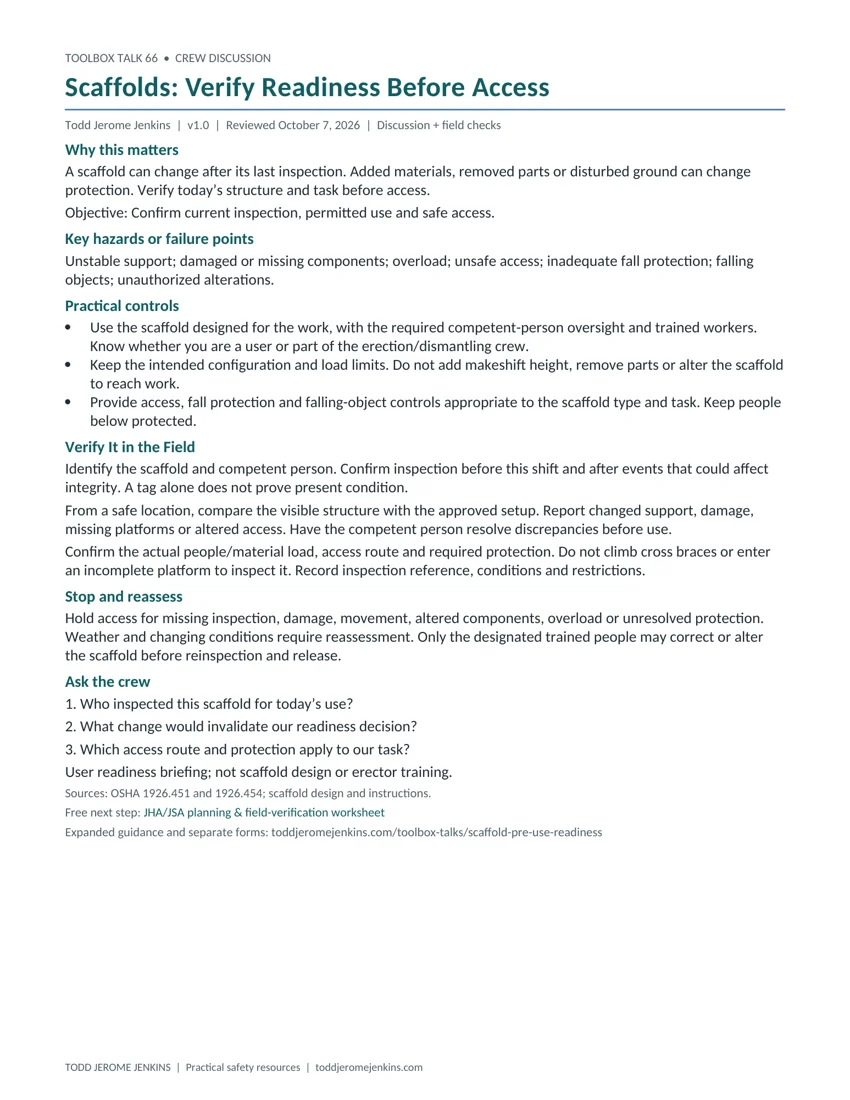
A 5–10 minute crew discussion, plus the time needed for field verification. All six downloads are free without a required signup.
Why this matters
A scaffold can change after its last inspection. Added materials, removed parts or disturbed ground can change protection. Verify today’s structure and task before access.
Learning objective: Confirm current inspection, permitted use and safe access.
Key hazards or failure points
Unstable support; damaged or missing components; overload; unsafe access; inadequate fall protection; falling objects; unauthorized alterations.
Practical controls
- Use the scaffold designed for the work, with the required competent-person oversight and trained workers. Know whether you are a user or part of the erection/dismantling crew.
- Keep the intended configuration and load limits. Do not add makeshift height, remove parts or alter the scaffold to reach work.
- Provide access, fall protection and falling-object controls appropriate to the scaffold type and task. Keep people below protected.
Verify It in the Field
Identify the scaffold and competent person. Confirm inspection before this shift and after events that could affect integrity. A tag alone does not prove present condition.
From a safe location, compare the visible structure with the approved setup. Report changed support, damage, missing platforms or altered access. Have the competent person resolve discrepancies before use.
Confirm the actual people/material load, access route and required protection. Do not climb cross braces or enter an incomplete platform to inspect it. Record inspection reference, conditions and restrictions.
Use the separate field check to record the acceptance source and criterion, safe method, checker, actual result and time. Mark VERIFIED, HOLD/NOT VERIFIED, or N/A with a reason. A checkmark alone is not evidence that protection works. Complete all required task checks; do not enter danger or improvise a test.
| Control | Safe verification | Evidence |
|---|---|---|
| Current inspection | Match the competent-person inspection to the scaffold and shift. | Inspector, time, scope and restrictions. |
| Unchanged configuration | Observe safely and report discrepancies. | Changed component or support and disposition. |
| Permitted use | Compare load, access and protection with the approved arrangement. | Design/instruction reference and resolved task limits. |
Stop and reassess
Hold access for missing inspection, damage, movement, altered components, overload or unresolved protection. Weather and changing conditions require reassessment. Only the designated trained people may correct or alter the scaffold before reinspection and release.
Crew discussion questions
- Who inspected this scaffold for today’s use?
- What change would invalidate our readiness decision?
- Which access route and protection apply to our task?
A situation to discuss
Illustrative situation: a green tag remains in place, but material delivery has damaged an access component. The crew holds access and contacts the competent person. The tag is not accepted as evidence that the changed structure is ready.
Leader preparation and practical detail
Distinguish users from erectors
Scaffold use, erection, alteration and dismantling involve different tasks and training. The competent-person determination for supported-scaffold erector/dismantler fall protection is not a general exemption for users. Match the worker’s role and scaffold type to the applicable requirements. [1, 2]
Inspect the actual structure
OSHA requires competent-person inspection before each work shift and after occurrences that could affect structural integrity. A status tag can help communicate a decision, but it does not replace that inspection or resolve a subsequent change. Users should report discrepancies from a safe position. [1]
Control material changes
Ask where materials will be placed and how they affect the design and rated load. Delivery pressures must not turn a work platform into unplanned storage. The competent person and required design authority resolve configuration and load questions; the crew does not test capacity by adding weight. [1]
Short supervisor field check
- Actual scaffold and competent person identified.
- Required current inspection confirmed.
- Support and components match the intended setup.
- Load, access and required protections verified.
- Changes and alteration authority understood.
Record unresolved items, restrictions, correction owner, recheck result and required restart authorization. Reference permits and specialist inspections rather than treating this form as a replacement. Rebrief workers affected by a change.
Attendance and follow-through
Use the separate attendance sheet for participants, discussion concerns, actions and late-arrival rebriefs. Attendance does not establish competence, verify controls or authorize work. Keep completed records private under the employer’s recordkeeping procedures.
Technical scope and references
Construction scaffolds under Subpart L. Supported, suspended and other types have different requirements. This talk does not establish design capacity, qualify an erector or supply a universal fall-protection configuration. [1, 2]
References reviewed October 7, 2026. Apply the industry, activity and jurisdiction that govern the work. No actual site permit, equipment manual, exposure assessment or engineering determination was supplied for this general discussion.
- OSHA 1926.451 — Scaffolds — Design, capacity, access, use, inspection and fall protection.
- OSHA 1926.454 — Training requirements — Training by scaffold role and retraining requirements.
Connect this discussion to your JHA/JSA
Use How to Conduct a Job Safety Analysis to connect task steps, hazards and controls. Revisit Pre-Job JHA/JSA: What Changed Today? when conditions change.
Work through the related Scaffold Erection and Dismantling JHA, then adapt its assumptions to the actual work.
Related crew discussions
- Fall Prevention: Verify the Controls
- Competent Person: Know Who Can Correct the Hazard
- Barricades: What Does This Boundary Keep Out?
- Pre-Job JHA/JSA: What Changed Today?
Put one check into practice
Use the free JHA/JSA planning and field-verification worksheet to record today’s changes, important controls and the evidence needed before exposure.