Download the talk and separate crew records
Free to download without an account. Each PDF is one page. Use the Word version to adapt the record to your task and approved procedures.
Supervisor field check
Download supervisor field check (PDF, 1 page)Editable supervisor field check (Word)Preview the one-page crew talk
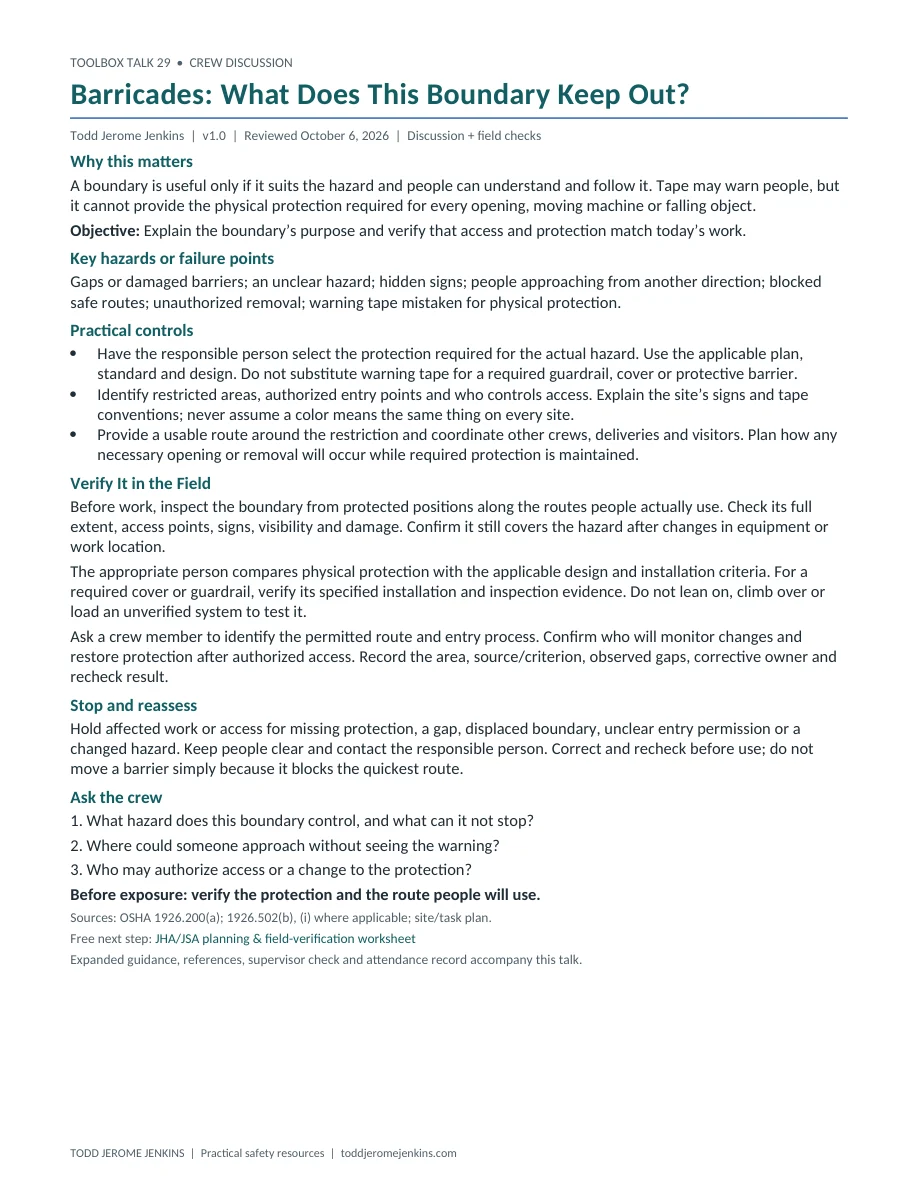
A 5–10 minute crew discussion, plus the time needed for field verification. All six downloads are free without a required signup.
Why this matters
A boundary is useful only if it suits the hazard and people can understand and follow it. Tape may warn people, but it cannot provide the physical protection required for every opening, moving machine or falling object.
Learning objective: Explain the boundary’s purpose and verify that access and protection match today’s work.
Key hazards or failure points
Gaps or damaged barriers; an unclear hazard; hidden signs; people approaching from another direction; blocked safe routes; unauthorized removal; warning tape mistaken for physical protection.
Practical controls
- Have the responsible person select the protection required for the actual hazard. Use the applicable plan, standard and design. Do not substitute warning tape for a required guardrail, cover or protective barrier.
- Identify restricted areas, authorized entry points and who controls access. Explain the site’s signs and tape conventions; never assume a color means the same thing on every site.
- Provide a usable route around the restriction and coordinate other crews, deliveries and visitors. Plan how any necessary opening or removal will occur while required protection is maintained.
Verify It in the Field
Before work, inspect the boundary from protected positions along the routes people actually use. Check its full extent, access points, signs, visibility and damage. Confirm it still covers the hazard after changes in equipment or work location.
The appropriate person compares physical protection with the applicable design and installation criteria. For a required cover or guardrail, verify its specified installation and inspection evidence. Do not lean on, climb over or load an unverified system to test it.
Ask a crew member to identify the permitted route and entry process. Confirm who will monitor changes and restore protection after authorized access. Record the area, source/criterion, observed gaps, corrective owner and recheck result.
Use the separate field check to record the source and criterion, safe method, checker, actual result and time. Mark VERIFIED, HOLD/NOT VERIFIED, or N/A with a reason. Check every required control; the examples below do not clear the whole task.
| Control | Safe verification | Evidence to record |
|---|---|---|
| Complete boundary | Observe the entire restriction from safe access points. | Extent, entry points, damage and gaps documented. |
| Suitable protection | Appropriate person checks the selected system to the required plan/design. | Source and inspection findings; warnings not credited as structural protection. |
| Usable access | Have a crew member explain the permitted route and entry authorization. | Route available; authorized changes and restoration responsibilities clear. |
Stop and reassess
Hold affected work or access for missing protection, a gap, displaced boundary, unclear entry permission or a changed hazard. Keep people clear and contact the responsible person. Correct and recheck before use; do not move a barrier simply because it blocks the quickest route.
Crew discussion questions
- What hazard does this boundary control, and what can it not stop?
- Where could someone approach without seeing the warning?
- Who may authorize access or a change to the protection?
Before exposure: verify the protection and the route people will use.
A situation to discuss
Illustrative situation: stored materials block the normal walkway and create a shortcut behind a barricade. The crew stops the affected movement and gets a usable route established. Adding another sign does not resolve an access layout that sends people toward the hazard.
Leader preparation and practical detail
Define the boundary’s function
Ask whether the arrangement warns, restricts entry or physically prevents contact. These functions are different. A lightweight warning device cannot be credited with the capacity of a designed protective system. Establish the actual control required for the task before selecting the device.
Check the approach as well as the work area
Inspect from the routes used by other trades, delivery personnel and visitors, while remaining protected. Consider a person who has not attended this briefing. OSHA 1926.200(a) requires covered signs and symbols to remain visible during work and to be removed or covered when the hazard is gone. Site-specific access information must still be clear. [1]
Use the correct physical-protection criteria
Construction guardrails and covers have requirements in 1926.502(b) and (i), including relevant strength and installation provisions. The responsible person must apply the correct criteria and safe inspection method. This talk deliberately supplies no universal distance, tape-color rule or improvised load test. Roadway traffic control needs its own approved arrangement; use the separate work-zone resource. [2]
Short supervisor field check
- Hazard and required boundary/protection function identified.
- Entire extent, visibility, condition and access points checked safely.
- Physical system verified against applicable design/installation criteria.
- Alternate route and authorized entry/change process usable.
- Monitoring, correction and restoration/recheck assigned.
Use the separate form to document evidence, restrictions, corrective-action owner, recheck and required restart approval. An unresolved required control means hold the affected work. Missing evidence is not a pass. Complete all task-specific inspections and permits.
Attendance and follow-through
The separate attendance sheet records participants, language support, questions, actions and late-arrival rebriefs. Attendance does not establish competence or prove controls function. Keep completed records private under the employer’s procedures.
Technical scope and references
Focus: worksite boundaries and access. It is not a traffic-control design, fall-protection design or permission to enter an exclusion area. Different hazards require different systems. OSHA references cited here are construction provisions; apply the requirements for the actual operation and jurisdiction. [1], [2]
References checked October 6, 2026. Apply the jurisdiction, task, employer program and equipment instructions that govern the work. No site-specific manual, permit, engineering determination or product SDS has been approved by this general resource.
- OSHA 29 CFR 1926.200 — Accident prevention signs and tags — Construction sign visibility in (a); specialized traffic-control provisions have their own scope.
- OSHA 29 CFR 1926.502 — Fall protection systems criteria and practices — Construction guardrail (b) and cover (i) criteria where these systems are required.
Connect this discussion to your JHA/JSA
Use How to Conduct a Job Safety Analysis to connect today’s work steps, hazards and controls. Revisit Pre-Job JHA/JSA: What Changed Today? whenever conditions change.
Related Todd Jerome Jenkins video: What Is the Hierarchy of Controls? | Workplace Safety Explained.
Related published crew resources: Line of Fire: Swing Radius & Suspended Loads; Fall Prevention: Verify the Controls.
Put one check into practice
Download the free JHA/JSA planning and field-verification worksheet. For today’s task, record an important control, its source and the evidence needed before exposure. Complete the remaining required checks through your task plan.