Download the talk and separate crew records
Free to download without an account. Each PDF is one page. Use the Word version to adapt the record to your task and approved procedures.
Supervisor field check
Download supervisor field check (PDF, 1 page)Editable supervisor field check (Word)Preview the one-page crew talk
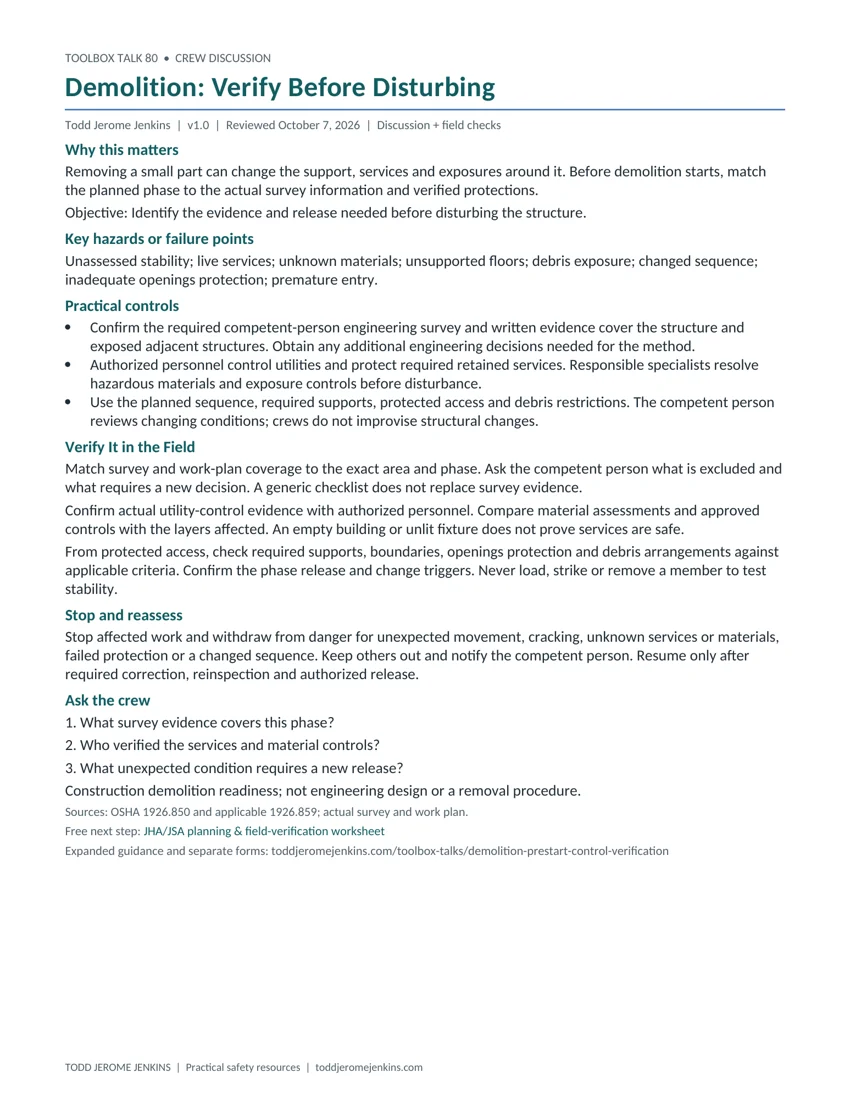
A 5–10 minute crew discussion, plus the time needed for field verification. All six downloads are free without a required signup.
Why this matters
Removing a small part can change the support, services and exposures around it. Before demolition starts, match the planned phase to the actual survey information and verified protections.
Learning objective: Identify the evidence and release needed before disturbing the structure.
Key hazards or failure points
Unassessed stability; live services; unknown materials; unsupported floors; debris exposure; changed sequence; inadequate openings protection; premature entry.
Practical controls
- Confirm the required competent-person engineering survey and written evidence cover the structure and exposed adjacent structures. Obtain any additional engineering decisions needed for the method.
- Authorized personnel control utilities and protect required retained services. Responsible specialists resolve hazardous materials and exposure controls before disturbance.
- Use the planned sequence, required supports, protected access and debris restrictions. The competent person reviews changing conditions; crews do not improvise structural changes.
Verify It in the Field
Match survey and work-plan coverage to the exact area and phase. Ask the competent person what is excluded and what requires a new decision. A generic checklist does not replace survey evidence.
Confirm actual utility-control evidence with authorized personnel. Compare material assessments and approved controls with the layers affected. An empty building or unlit fixture does not prove services are safe.
From protected access, check required supports, boundaries, openings protection and debris arrangements against applicable criteria. Confirm the phase release and change triggers. Never load, strike or remove a member to test stability.
Use the separate field check to record the acceptance source and criterion, safe method, checker, actual result and time. Mark VERIFIED, HOLD/NOT VERIFIED, or N/A with a reason. A checkmark alone is not evidence that protection works. Complete all required task checks; do not enter danger or improvise a test.
| Control | Safe verification | Evidence |
|---|---|---|
| Covered phase | Compare actual area and activity with survey and work documents. | Survey reference, limits and competent-person decision. |
| Controlled services | Authorized personnel confirm prescribed utility-control evidence. | Service identity, verification reference and retained-service protection. |
| Released work area | Inspect required protections safely and confirm phase authorization. | Findings, restrictions, responsible release and change triggers. |
Stop and reassess
Stop affected work and withdraw from danger for unexpected movement, cracking, unknown services or materials, failed protection or a changed sequence. Keep others out and notify the competent person. Resume only after required correction, reinspection and authorized release.
Crew discussion questions
- What survey evidence covers this phase?
- Who verified the services and material controls?
- What unexpected condition requires a new release?
A situation to discuss
Illustrative situation: opening a planned nonstructural partition reveals an unidentified service and a different wall construction. The crew stops disturbance and keeps the area protected while the responsible people reassess the survey and task plan. The original release does not cover the surprise automatically.
Leader preparation and practical detail
Use the existing JHA as a planning aid
The linked demolition JHA is a worked example for selective interior partition removal. Use it to organize task steps and field checks, then match it to this structure and phase. It cannot substitute for the competent-person engineering survey and written evidence required by 1926.850(a), or any additional engineering needed for actual conditions. [1]
Resolve services and contents before disturbance
Section 1926.850 addresses utility notification and control, including protection or relocation of necessary retained services, and assessment of hazardous contents. Have appropriately authorized people provide the actual verification. Unknown insulation, coatings or services require assessment under applicable specialist requirements rather than a trial cut or casual sample. [1]
Reassess as the structure changes
For mechanical demolition, 1926.859(g) requires continuing competent-person inspections for developing hazards and prohibits work in affected hazardous areas until effective correction. Other demolition methods have their applicable requirements. Phase changes should trigger the relevant review, renewed restrictions and a crew rebrief before the next disturbance. This discussion sets no structural capacity, exclusion radius or removal sequence. [2]
Short supervisor field check
- Survey evidence matches area, phase and adjacent exposure.
- Required specialist decisions and sequence current.
- Utility controls and retained services verified.
- Materials, supports, access and debris protection checked.
- Competent-person review and phase release established.
Record unresolved items, restrictions, correction owner, recheck result and required restart authorization. Reference permits and specialist inspections rather than treating this form as a replacement. Rebrief workers affected by a change.
Attendance and follow-through
Use the separate attendance sheet for participants, discussion concerns, actions and late-arrival rebriefs. Attendance does not establish competence, verify controls or authorize work. Keep completed records private under the employer’s recordkeeping procedures.
Technical scope and references
Construction prestart and changed-condition demolition checks under Subpart T. Mechanical demolition has additional requirements, including 1926.859. This briefing is not structural design, asbestos or lead abatement training, a utility-isolation procedure or explosive-demolition authorization. [1, 2]
References reviewed October 7, 2026. Apply the industry, activity and jurisdiction that govern the work. No actual site permit, equipment manual, exposure assessment or engineering determination was supplied for this general discussion.
- OSHA 1926.850 — Preparatory operations — Engineering survey, utility arrangements, hazardous contents and preparatory protection.
- OSHA 1926.859 — Mechanical demolition — Method-specific provisions, including continuing competent-person inspection.
Connect this discussion to your JHA/JSA
Use How to Conduct a Job Safety Analysis to connect task steps, hazards and controls. Revisit Pre-Job JHA/JSA: What Changed Today? when conditions change.
Work through the related Demolition JHA: Selective Interior Partition Removal, then adapt its assumptions to the actual work.
Related crew discussions
- Fall Prevention: Verify the Controls
- Electrical & Extension-Cord Checks
- Silica: Verify Dust Controls Before Cutting
- Competent Person: Know Who Can Correct the Hazard
- Barricades: What Does This Boundary Keep Out?
- Site-Specific Safety Plan: Check the Interfaces Today
- Asbestos: Verify Before You Disturb the Material
- Lead: Check Controls Before Disturbing Material
Put one check into practice
Use the free JHA/JSA planning and field-verification worksheet to record today’s changes, important controls and the evidence needed before exposure.