Download the talk and separate crew records
Free to download without an account. Each PDF is one page. Use the Word version to adapt the record to your task and approved procedures.
Supervisor field check
Download supervisor field check (PDF, 1 page)Editable supervisor field check (Word)Preview the one-page crew talk
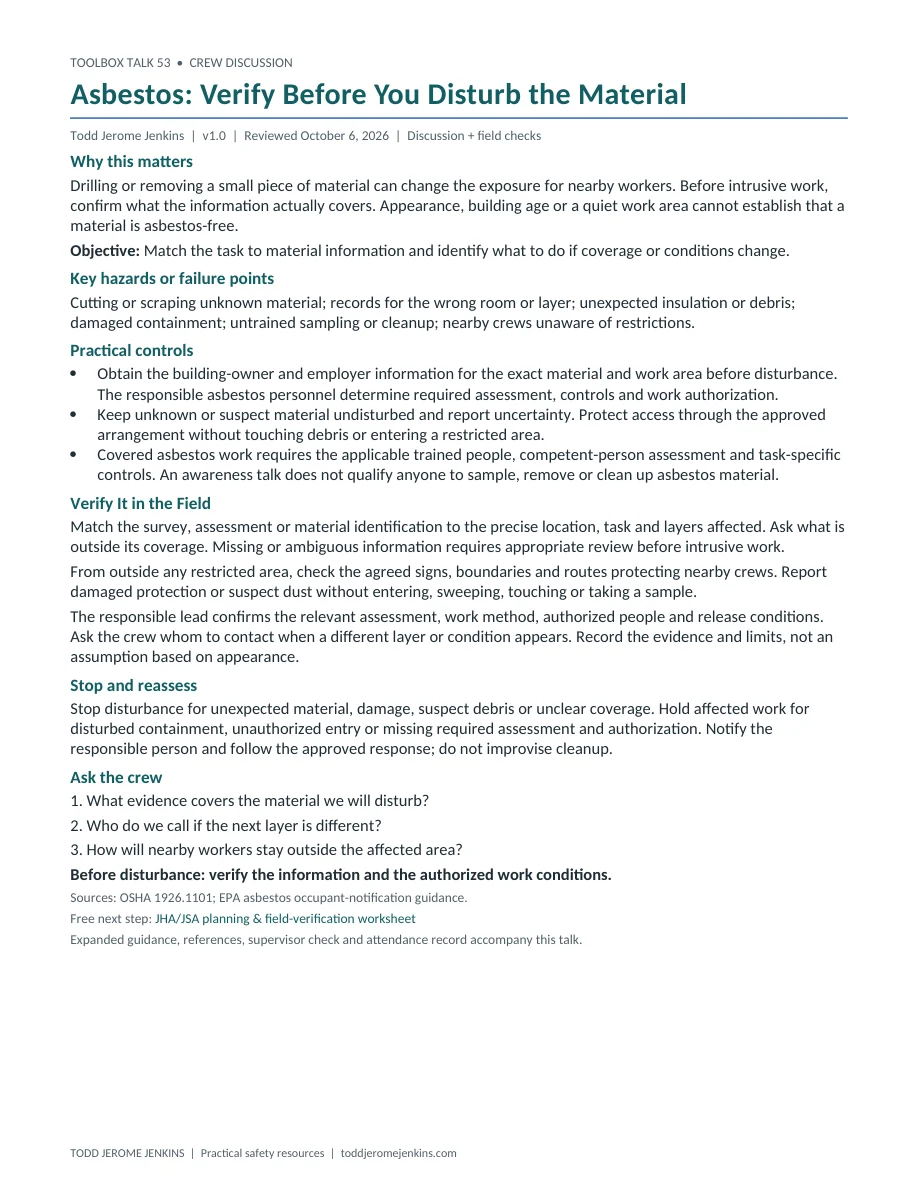
A 5–10 minute crew discussion, plus the time needed for field verification. All six downloads are free without a required signup.
Why this matters
Drilling or removing a small piece of material can change the exposure for nearby workers. Before intrusive work, confirm what the information actually covers. Appearance, building age or a quiet work area cannot establish that a material is asbestos-free.
Learning objective: Match the task to material information and identify what to do if coverage or conditions change.
Key hazards or failure points
Cutting or scraping unknown material; records for the wrong room or layer; unexpected insulation or debris; damaged containment; untrained sampling or cleanup; nearby crews unaware of restrictions.
Practical controls
- Obtain the building-owner and employer information for the exact material and work area before disturbance. The responsible asbestos personnel determine required assessment, controls and work authorization.
- Keep unknown or suspect material undisturbed and report uncertainty. Protect access through the approved arrangement without touching debris or entering a restricted area.
- Covered asbestos work requires the applicable trained people, competent-person assessment and task-specific controls. An awareness talk does not qualify anyone to sample, remove or clean up asbestos material.
Verify It in the Field
Match the survey, assessment or material identification to the precise location, task and layers affected. Ask what is outside its coverage. Missing or ambiguous information requires appropriate review before intrusive work.
From outside any restricted area, check the agreed signs, boundaries and routes protecting nearby crews. Report damaged protection or suspect dust without entering, sweeping, touching or taking a sample.
The responsible lead confirms the relevant assessment, work method, authorized people and release conditions. Ask the crew whom to contact when a different layer or condition appears. Record the evidence and limits, not an assumption based on appearance.
Use the separate field check to record the source and criterion, safe method, checker, actual result and time. Mark VERIFIED, HOLD/NOT VERIFIED, or N/A with a reason. Check every required control; the examples below do not clear the whole task.
| Control | Safe verification | Evidence to record |
|---|---|---|
| Correct material coverage | Responsible lead matches exact location/layers/task with the assessment. | Record, scope, unresolved area and decision owner. |
| Protected boundaries | Observe agreed restrictions from outside the area. | Boundary condition and nearby crew communication. |
| Authorized release | Confirm required specialist decisions and work conditions. | Assessment, authorization and change triggers. |
Stop and reassess
Stop disturbance for unexpected material, damage, suspect debris or unclear coverage. Hold affected work for disturbed containment, unauthorized entry or missing required assessment and authorization. Notify the responsible person and follow the approved response; do not improvise cleanup.
Crew discussion questions
- What evidence covers the material we will disturb?
- Who do we call if the next layer is different?
- How will nearby workers stay outside the affected area?
Before disturbance: verify the information and the authorized work conditions.
A situation to discuss
Illustrative situation: the survey covers a wall finish, but the planned work exposes another layer not clearly addressed. The crew stops intrusive work and asks the responsible asbestos personnel to resolve coverage. It does not drill a trial hole or collect a sample to settle the question.
Leader preparation and practical detail
Match the information to the disturbance
Construction asbestos requirements address covered activities, including certain renovation, repair and maintenance work. Building-owner and employer information must be connected to the material and task. A report about another area or only the surface layer may not answer the current question. The responsible specialist resolves what assessment and controls are required. [1]
Awareness does not authorize asbestos work
Work classes, exposure assessment, regulated areas, training and control requirements vary with the covered operation. A generic mask, fan or ordinary vacuum is not a universal asbestos control. The competent-person role for asbestos has specialized requirements; an unrelated course card or this briefing does not establish those qualifications. [1]
Protect the surrounding work
EPA occupant guidance emphasizes information about asbestos-containing material and reporting damage or disturbance. Tell nearby crews how restrictions affect access and whom to contact about changes. Absence of visible dust does not establish absence of airborne fibers, and a visual observation cannot replace required assessment or release procedures. [1], [2]
Short supervisor field check
- Exact task and materials matched to information.
- Unknown or suspect material kept undisturbed.
- Responsible asbestos personnel and authorization identified.
- Boundaries and adjacent-work protection checked safely.
- Change triggers and required release understood.
Use the separate form to document evidence, restrictions, corrective-action owner, recheck and required restart approval. An unresolved required control means hold the affected work. Missing evidence is not a pass. Complete all task-specific inspections and permits.
Attendance and follow-through
The separate attendance sheet records participants, language support, questions, actions and late-arrival rebriefs. Attendance does not establish competence or prove controls function. Keep completed records private under the employer’s procedures.
Technical scope and references
This is before-disturbance awareness, not an asbestos sampling, abatement, cleanup or clearance procedure. OSHA 1926.1101 applies to covered construction work; other work and jurisdictions have additional or different rules. Use the actual asbestos program and qualified professional decisions. [1], [2]
References checked October 6, 2026. Apply the jurisdiction, task, employer program and equipment instructions that govern the work. No site-specific manual, permit, engineering determination or product SDS has been approved by this general resource.
- OSHA 29 CFR 1926.1101 — Asbestos — Reviewed relevant (a),(b),(d),(e),(f),(k) text; not all1726lines or every appendix. Awareness briefing only, no abatement/cleanup authorization.
- EPA — Occupant Notification in Buildings Containing Asbestos — Building-owner/occupant guidance; current page updated Jan21,2026. No field identification by sight or sampling by untrained crew.
Connect this discussion to your JHA/JSA
Use How to Conduct a Job Safety Analysis to connect today’s work steps, hazards and controls. Revisit Pre-Job JHA/JSA: What Changed Today? whenever conditions change.
Related Todd Jerome Jenkins article: What Is an OSHA Competent Person?.
Related Todd Jerome Jenkins video: Does Training Make You an OSHA Competent Person?.
Related published crew resources: Respiratory Hazards: Know What You’re Breathing; Hazard Communication: Labels, SDS & the Task; Competent Person: Know Who Can Correct the Hazard; Barricades: What Does This Boundary Keep Out?.
Put one check into practice
Download the free JHA/JSA planning and field-verification worksheet. For today’s task, record an important control, its source and the evidence needed before exposure. Complete the remaining required checks through your task plan.