Download the free toolbox talk
The one-page talk, editable Word version, and guidance below are open to everyone. No account required.
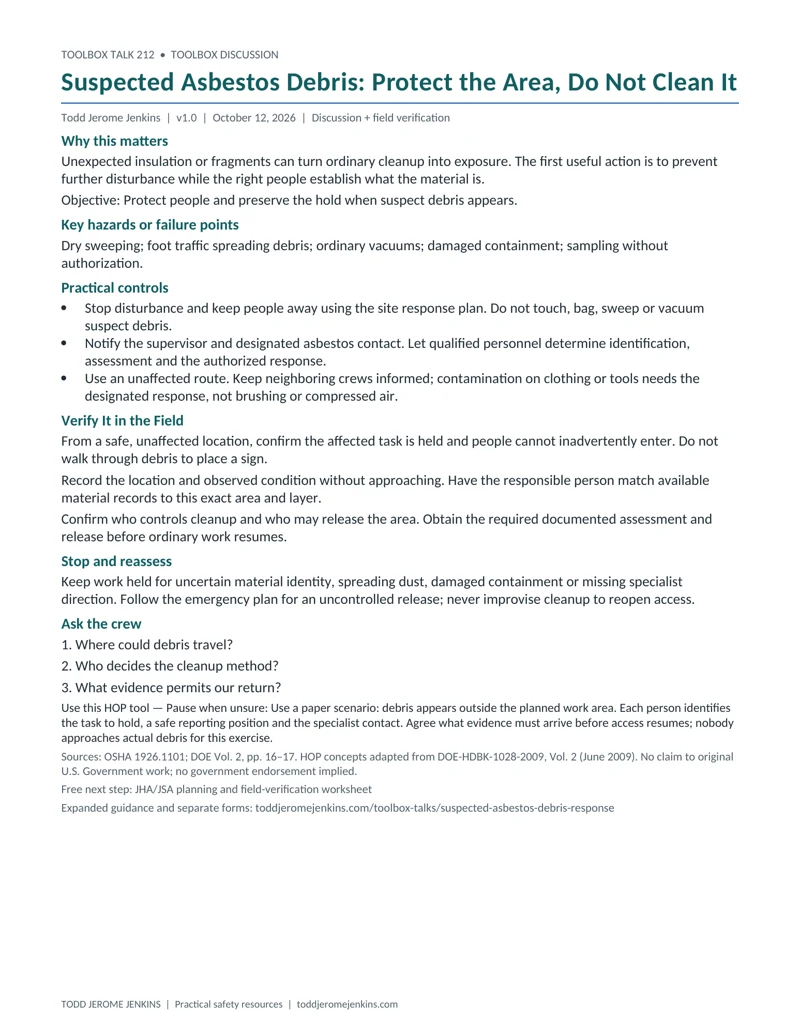
One-page toolbox talk
Download one-page toolbox talk (PDF, 1 page)Editable one-page toolbox talk (Word)Preview the one-page toolbox talk
Supporting documents
Included with free Safety & Systems membership.
Supervisor field check
A separate check to verify conditions and controls before work. Includes a one-page PDF and editable Word file.
Attendance sheet
A separate sign-in sheet to record the crew discussion. Includes a one-page PDF and editable Word file.
Need the crew records? Join free to use these supporting documents and the Safety & Systems Academy. No payment details. Email updates are optional.
Get supporting documents — free membershipAlready a member? Use the same link to sign in.
Hazard-based toolbox talk 37 of 52, with a practical HOP exercise.
Plan a 5–10 minute toolbox discussion, plus time to verify the actual controls. The one-page toolbox talk and editable Word version are public. Separate supervisor and attendance records are included with free Safety & Systems membership.
Why this matters
Unexpected insulation or fragments can turn ordinary cleanup into exposure. The first useful action is to prevent further disturbance while the right people establish what the material is.
Learning objective
Protect people and preserve the hold when suspect debris appears.
Key hazards or failure points
Dry sweeping; foot traffic spreading debris; ordinary vacuums; damaged containment; sampling without authorization.
Practical controls
- Stop disturbance and keep people away using the site response plan. Do not touch, bag, sweep or vacuum suspect debris.
- Notify the supervisor and designated asbestos contact. Let qualified personnel determine identification, assessment and the authorized response.
- Use an unaffected route. Keep neighboring crews informed; contamination on clothing or tools needs the designated response, not brushing or compressed air.
Verify It in the Field
- From a safe, unaffected location, confirm the affected task is held and people cannot inadvertently enter. Do not walk through debris to place a sign.
- Record the location and observed condition without approaching. Have the responsible person match available material records to this exact area and layer.
- Confirm who controls cleanup and who may release the area. Obtain the required documented assessment and release before ordinary work resumes.
Stop and reassess
Keep work held for uncertain material identity, spreading dust, damaged containment or missing specialist direction. Follow the emergency plan for an uncontrolled release; never improvise cleanup to reopen access.
Crew discussion questions
- Where could debris travel?
- Who decides the cleanup method?
- What evidence permits our return?
For each required control, record its acceptance source and criterion, safe verification method, responsible verifier, actual result and time. Mark VERIFIED, HOLD/NOT VERIFIED, or N/A with a reason. Complete all required inspections; never enter danger or improvise a test to fill out a form.
Use this HOP tool
Pause when unsure
Use a paper scenario: debris appears outside the planned work area. Each person identifies the task to hold, a safe reporting position and the specialist contact. Agree what evidence must arrive before access resumes; nobody approaches actual debris for this exercise.
This exercise supports hazard identification or control verification. It does not replace safeguards, required training, specialist decisions or work authorization.
Leader preparation and practical detail
Treat discovery as a new task
Illustrative situation: a cleaner finds fragments beneath damaged pipe insulation. The assignment was ordinary housekeeping; it did not authorize asbestos cleanup. Hold the cleaning task and report the precise location from safety. The supervisor arranges a protected alternative route and specialist help. The useful record is the discovery, affected work and response owner—not an unsupported declaration that the debris is harmless.
Apply the asbestos work scope
Construction asbestos requirements in 1926.1101 include covered spill cleanup and housekeeping. The competent person has asbestos-specific responsibilities and training; general supervisory authority alone does not establish that qualification. The applicable work class, assessment, controls, training and decontamination arrangements must be determined before cleanup. Do not give an ordinary cleaner a vacuum and treat the equipment label as authorization.
Verify the boundary and the release
A strip of tape documents neither material identity nor completed remediation. Ask the responsible asbestos personnel what restrictions apply to adjacent crews and what evidence is required before access returns. Record the decision source and limits. This briefing sets no universal clearance sample, concentration or waiting period. If debris or damaged containment appears outside the protected area, hold the newly affected work and request reassessment.
Short supervisor field check
- Disturbance stopped
- Access protected safely
- Asbestos contact notified
- Affected crews informed
- Required release documented
Use the separate sheet to document evidence, unresolved restrictions, correction owner, recheck and required release authority. Rebrief affected workers. This record does not replace specialist inspections, permits or engineering determinations.
Attendance and follow-through
Use the separate attendance record for participants, roles, questions, actions and late-arrival rebriefs. Attendance does not prove competence, functioning controls or authorization. Keep completed records private under employer procedures.
Source acknowledgment
HOP concepts are adapted from DOE-HDBK-1028-2009, Human Performance Improvement Handbook, Volume 2 (June 2009). Todd Jerome Jenkins makes no claim to authorship or copyright ownership of original U.S. Government work. The explanations and exercises are original adaptations; no endorsement by DOE or the U.S. Government is implied. Third-party material credited in the handbook retains its separate ownership.
HOP source: Volume 2/VOLUME 2 PAUSE WHEN UNSURE.pdf; Printed pp. 16–17. The handbook supplies concepts; task-specific technical references are listed below.
Technical scope and references
Technical sources inspected October 12, 2026; resource edition October 12, 2026. Apply current jurisdictional requirements, the actual task procedure, manufacturer instructions, permits and required competent or qualified decisions. This resource supplies no equipment-specific acceptance criteria.
- OSHA 29 CFR 1926.1101 — Construction asbestos: scope, assessment, regulated areas, work practices, information and competent-person duties.
- DOE-HDBK-1028-2009 Volume 2 — Pause when unsure — Printed pp. 16–17; historical HOP guidance adapted into an original exercise.
Connect this discussion to your JHA/JSA
Use the JHA/JSA planning and field-verification worksheet to connect this discussion to the actual task, controls and responsible people.
Related Todd Jerome Jenkins articles: How to Conduct a Job Safety Analysis and What Is Human and Organizational Performance?.
Related toolbox talks
- Asbestos: Verify Before You Disturb the Material
- Pause When Unsure: Make the Restart Clear
- Demolition: Verify Before Disturbing
Continue the hazard series
- Lead Workwear: Verify the Dirty-to-Clean Handoff
- Respirator Seal Problems: Resolve the Leak Before Exposure
Put one verification into practice
Record today’s change and evidence using the free JHA/JSA planning and field-verification worksheet.