Download the free crew talk
The one-page talk, editable Word version, and guidance below are open to everyone. No account required.
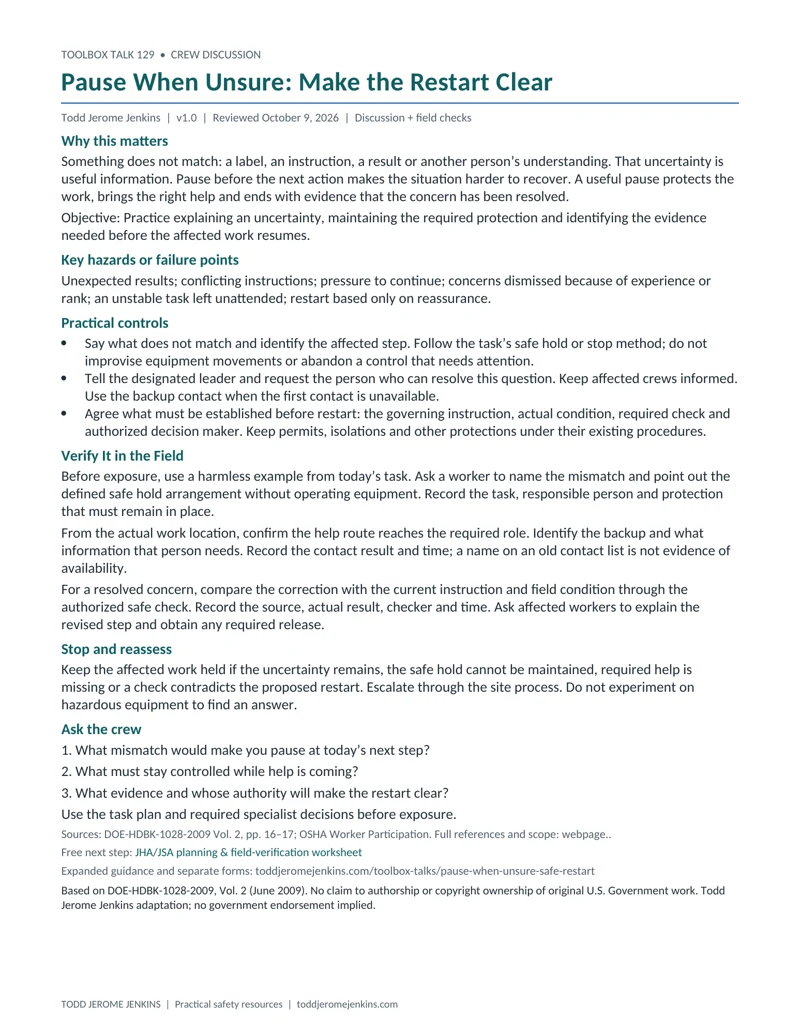
Preview the one-page crew talk
Supporting documents
Included with free Safety & Systems membership.
Supervisor field check
A separate check to verify conditions and controls before work. Includes a one-page PDF and editable Word file.
Attendance sheet
A separate sign-in sheet to record the crew discussion. Includes a one-page PDF and editable Word file.
Need the crew records? Join free to use these supporting documents and the Safety & Systems Academy. No payment details. Email updates are optional.
Get supporting documents — free membershipAlready a member? Use the same link to sign in.
Human Performance weekly series: lesson 6 of 52.
A 5–10 minute crew discussion, plus time to verify the actual controls. The crew talk and Word version are public. Separate supervisor and attendance records are included with free Safety & Systems membership.
Why this matters
Something does not match: a label, an instruction, a result or another person’s understanding. That uncertainty is useful information. Pause before the next action makes the situation harder to recover. A useful pause protects the work, brings the right help and ends with evidence that the concern has been resolved.
Learning objective
Practice explaining an uncertainty, maintaining the required protection and identifying the evidence needed before the affected work resumes.
Key hazards or failure points
Unexpected results; conflicting instructions; pressure to continue; concerns dismissed because of experience or rank; an unstable task left unattended; restart based only on reassurance.
Practical controls
- Say what does not match and identify the affected step. Follow the task’s safe hold or stop method; do not improvise equipment movements or abandon a control that needs attention.
- Tell the designated leader and request the person who can resolve this question. Keep affected crews informed. Use the backup contact when the first contact is unavailable.
- Agree what must be established before restart: the governing instruction, actual condition, required check and authorized decision maker. Keep permits, isolations and other protections under their existing procedures.
Verify It in the Field
- Before exposure, use a harmless example from today’s task. Ask a worker to name the mismatch and point out the defined safe hold arrangement without operating equipment. Record the task, responsible person and protection that must remain in place.
- From the actual work location, confirm the help route reaches the required role. Identify the backup and what information that person needs. Record the contact result and time; a name on an old contact list is not evidence of availability.
- For a resolved concern, compare the correction with the current instruction and field condition through the authorized safe check. Record the source, actual result, checker and time. Ask affected workers to explain the revised step and obtain any required release.
Stop and reassess
Keep the affected work held if the uncertainty remains, the safe hold cannot be maintained, required help is missing or a check contradicts the proposed restart. Escalate through the site process. Do not experiment on hazardous equipment to find an answer.
Crew discussion questions
- What mismatch would make you pause at today’s next step?
- What must stay controlled while help is coming?
- What evidence and whose authority will make the restart clear?
For each required control, record its acceptance source and criterion, safe verification method, responsible checker, actual result and time. Use VERIFIED, HOLD/NOT VERIFIED, or N/A with a reason. A tick alone is not evidence. Complete all applicable task inspections; do not enter danger or improvise a test to fill out a form.
Leader preparation and practical detail
A missing instruction is a work problem
Illustrative situation: a replacement component has a different identifier from the work package. The worker pauses before installation. The leader keeps the affected step held and obtains an authorized clarification rather than asking the most experienced person to choose by appearance. The resolution identifies the correct component, records the document basis and communicates the change to everyone using that instruction. The learning point is the quality of the resolution, not whether the worker sounded confident when raising it.
A pause needs a maintained safe condition
Illustrative situation: a crew notices an unexpected response while a task still requires active monitoring. “Everyone stop” is incomplete if it leaves that responsibility unassigned. The task’s approved abnormal-condition or hold procedure determines who maintains control, who contacts help and how people remain protected. Discuss this before the critical step. This talk does not supply a shutdown sequence or authorize an untrained worker to manipulate equipment; the employer must provide the applicable method and capable people.
Close the uncertainty with evidence
Illustrative situation: the supervisor returns with an explanation, but the observed condition still differs from the approved instruction. Keep the affected work held and involve the required technical authority. Record the question, decision basis, safe verification result and restart restrictions. OSHA’s worker-participation recommendations support responding to concerns and involving workers in solutions. The site’s pause-work process should be usable without retaliation; this resource does not define an unlimited legal right to refuse every assignment.
Short supervisor field check
- Worker’s concern captured as a specific task, condition or unanswered question.
- Defined hold method and continuing control responsibilities confirmed.
- Correct technical help and backup reached for this shift.
- Actual correction checked against the governing source, with result and time recorded.
- Affected workers rebriefed and required restart approval obtained.
Confirm the relevant trained/authorized people, unresolved items, interim protection, correction owner and recheck. Record required release authority and rebrief anyone affected. The separate sheet supports these records; it does not replace a specialist inspection, permit or engineering determination.
Attendance and follow-through
Use the separate attendance sheet for participants, roles, discussion concerns, actions and late-arrival rebriefs. Attendance is not proof of competence, functioning controls or authorization to work. Keep completed records private under employer procedures.
Source acknowledgment
This resource draws on the U.S. Department of Energy’s DOE-HDBK-1028-2009, Human Performance Improvement Handbook, Volume 2 (June 2009). Todd Jerome Jenkins makes no claim of authorship or copyright ownership in the original U.S. Government work. New explanations, examples, exercises and layouts are Todd Jerome Jenkins adaptations. No endorsement by DOE or the U.S. Government is implied. Third-party material credited in the handbook remains attributed to its source; this notice does not claim rights in that material.
Source excerpt: Volume 2/VOLUME 2 PAUSE WHEN UNSURE.pdf; Printed pp. 16, 17. The June 2009 handbook supplies concepts; this lesson uses original explanations and exercises.
Technical scope and references
References reviewed October 9, 2026. DOE human-performance tools and OSHA recommended practices support preparation and discussion; they do not establish universal technical acceptance criteria. Apply the current task procedure, manufacturer instructions, permit and required competent or qualified decisions. A successful exercise does not replace required training, technical verification or work authorization.
- DOE-HDBK-1028-2009, Volume 2 — Pause When Unsure, printed pp. 16–17 — June 2009 illustrative guidance, not a current technical acceptance standard. Used for recognizing uncertainty and seeking help; old error-probability figures omitted.
- OSHA Recommended Practices — Worker Participation — Current program guidance on responding to concerns, temporary suspension requests and worker input; not a task-specific shutdown or restart procedure.
- HSE — Procedures — UK regulator guidance on usable procedures and the limitations of procedural controls; not a U.S. legal requirement.
Connect this discussion to your JHA/JSA
Use the JHA/JSA planning and field-verification worksheet to record the actual task steps, hazards, responsible roles and controls. No task-specific worked example is linked for this topic yet. Return to What Changed Today? when the plan or conditions change.
Related Todd Jerome Jenkins articles: How to Conduct a Job Safety Analysis and What Is Human and Organizational Performance?.
Related crew discussions
Continue the weekly series
- Lesson 5: Self-Checking: Confirm the Item, Action and Result
- Lesson 7: Three-Way Communication: Close the Loop Before Acting
Put one check into practice
Use the free JHA/JSA planning and field-verification worksheet to record today’s change, the required protection and the evidence needed before exposure.