Download the talk and separate crew records
Free to download without an account. Each PDF is one page. Use the Word version to adapt the record to your task and approved procedures.
Supervisor field check
Download supervisor field check (PDF, 1 page)Editable supervisor field check (Word)Preview the one-page crew talk
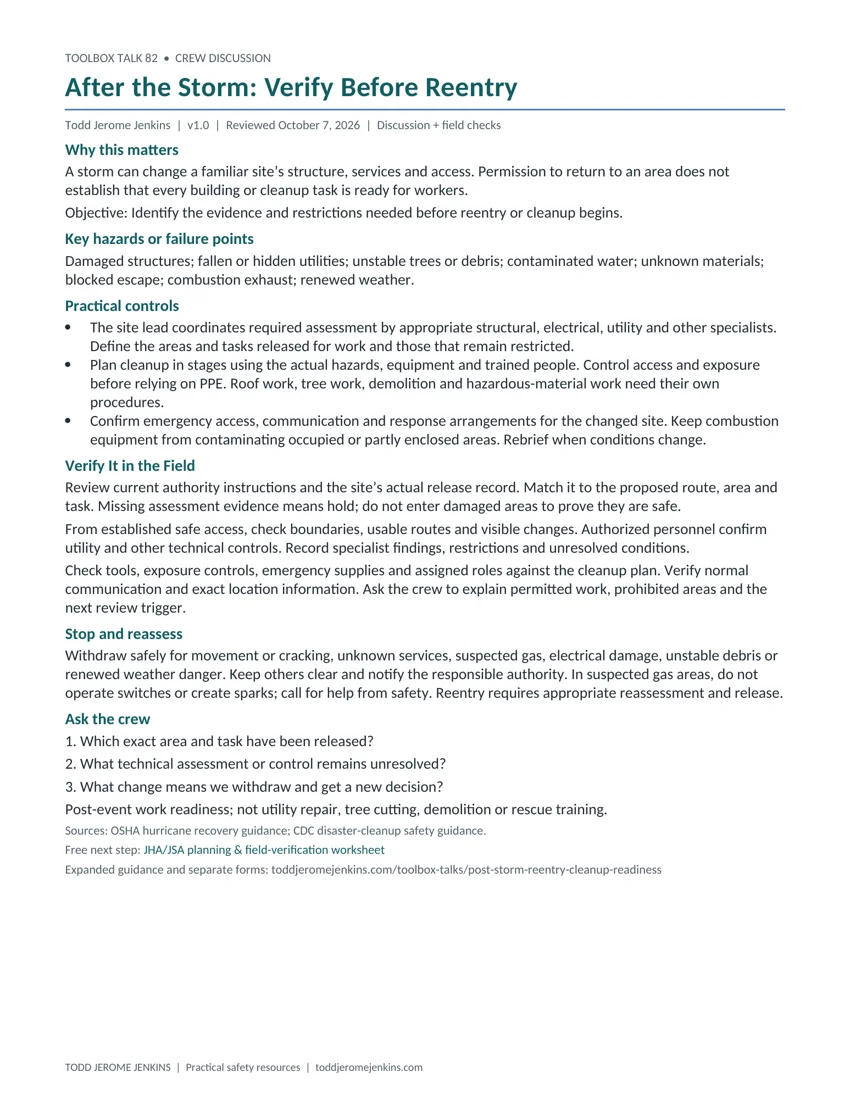
A 5–10 minute crew discussion, plus the time needed for field verification. All six downloads are free without a required signup.
Why this matters
A storm can change a familiar site’s structure, services and access. Permission to return to an area does not establish that every building or cleanup task is ready for workers.
Learning objective: Identify the evidence and restrictions needed before reentry or cleanup begins.
Key hazards or failure points
Damaged structures; fallen or hidden utilities; unstable trees or debris; contaminated water; unknown materials; blocked escape; combustion exhaust; renewed weather.
Practical controls
- The site lead coordinates required assessment by appropriate structural, electrical, utility and other specialists. Define the areas and tasks released for work and those that remain restricted.
- Plan cleanup in stages using the actual hazards, equipment and trained people. Control access and exposure before relying on PPE. Roof work, tree work, demolition and hazardous-material work need their own procedures.
- Confirm emergency access, communication and response arrangements for the changed site. Keep combustion equipment from contaminating occupied or partly enclosed areas. Rebrief when conditions change.
Verify It in the Field
Review current authority instructions and the site’s actual release record. Match it to the proposed route, area and task. Missing assessment evidence means hold; do not enter damaged areas to prove they are safe.
From established safe access, check boundaries, usable routes and visible changes. Authorized personnel confirm utility and other technical controls. Record specialist findings, restrictions and unresolved conditions.
Check tools, exposure controls, emergency supplies and assigned roles against the cleanup plan. Verify normal communication and exact location information. Ask the crew to explain permitted work, prohibited areas and the next review trigger.
Use the separate field check to record the acceptance source and criterion, safe method, checker, actual result and time. Mark VERIFIED, HOLD/NOT VERIFIED, or N/A with a reason. A checkmark alone is not evidence that protection works. Complete all required task checks; do not enter danger or improvise a test.
| Control | Safe verification | Evidence |
|---|---|---|
| Scoped release | Compare proposed work with actual assessment and authorization. | Area, task, release reference and restrictions. |
| Verified technical controls | Responsible specialists confirm their prescribed checks. | Utility/structure or exposure evidence, verifier and unresolved limits. |
| Ready cleanup stage | Check safe routes, equipment and communication before deployment. | Actual findings, covered roles, escape route and change trigger. |
Stop and reassess
Withdraw safely for movement or cracking, unknown services, suspected gas, electrical damage, unstable debris or renewed weather danger. Keep others clear and notify the responsible authority. In suspected gas areas, do not operate switches or create sparks; call for help from safety. Reentry requires appropriate reassessment and release.
Crew discussion questions
- Which exact area and task have been released?
- What technical assessment or control remains unresolved?
- What change means we withdraw and get a new decision?
A situation to discuss
Illustrative situation: local officials reopen the road, but a workplace has storm-damaged electrical equipment and an unassessed roof. The employer permits only the specifically assessed outdoor task and keeps the building restricted until the necessary specialists complete their review.
Leader preparation and practical detail
Release the task as well as the area
OSHA’s hurricane recovery guidance emphasizes evaluating actual worksite and task hazards. Use a staged release that identifies what can be done, where and under which controls. A general community reopening announcement does not replace the employer’s assessment. The site lead coordinates specialists; a quick crew walkaround cannot certify structural or electrical safety. [1, 2]
Keep observations outside the danger
CDC cleanup guidance warns about damaged buildings, gas, electrical hazards and dangerous materials. Observe only from established safe access, then escalate uncertainty. Do not enter floodwater, climb a damaged structure or move debris to improve the inspection. Household cleanup guidance does not authorize workplace utility restoration, roof work or specialist remediation. [3]
Rebuild the controls for changed work
A cleanup assignment can introduce a different tool, exposure or emergency access problem. Use the task assessment to select controls, required monitoring and appropriate trained personnel. Respirators, if needed, belong within the applicable program. Record what was checked and any remaining restrictions, and revisit the release when the work area or conditions change. [2]
Short supervisor field check
- Current authority directions and scoped release reviewed.
- Required specialist assessments and controls confirmed.
- Safe access, restrictions and escape physically checked.
- Task equipment, exposure controls and response ready.
- Crew understands permitted work and reassessment triggers.
Record unresolved items, restrictions, correction owner, recheck result and required restart authorization. Reference permits and specialist inspections rather than treating this form as a replacement. Rebrief workers affected by a change.
Attendance and follow-through
Use the separate attendance sheet for participants, discussion concerns, actions and late-arrival rebriefs. Attendance does not establish competence, verify controls or authorize work. Keep completed records private under the employer’s recordkeeping procedures.
Technical scope and references
Post-storm workplace assessment and staged cleanup readiness. OSHA recovery guidance supports planning but is not a new universal standard. CDC guidance supports hazard recognition; household repair instructions are not imported into this briefing. Applicable work rules, specialist decisions and emergency directions govern. [1–3]
References reviewed October 7, 2026. Apply the industry, activity and jurisdiction that govern the work. No actual site permit, equipment manual, exposure assessment or engineering determination was supplied for this general discussion.
- OSHA — Hurricane response and recovery eTool — Purpose and limits of task-based recovery planning; historical hurricane context is not used as current statistics.
- OSHA — General recommendations for response and recovery — Worksite evaluation, exposure controls, emergency arrangements and task-specific requirements.
- CDC — Safety guidelines during cleanup — Recognition of damaged-building, gas, electrical, combustion and material hazards.
Connect this discussion to your JHA/JSA
Use How to Conduct a Job Safety Analysis to connect task steps, hazards and controls. Revisit Pre-Job JHA/JSA: What Changed Today? when conditions change.
Related crew discussions
- Pre-Job JHA/JSA: What Changed Today?
- Electrical & Extension-Cord Checks
- Severe Weather: Know When and Where to Shelter
- Competent Person: Know Who Can Correct the Hazard
- Emergency Readiness: Can We Reach Supplies and Call for Help?
- Building Safety: Report the Defect and Protect the Area
- Incident Response: Protect People and Call for Help
- Carbon Monoxide: Keep Exhaust Out of the Work
- Demolition: Verify Before Disturbing
Put one check into practice
Use the free JHA/JSA planning and field-verification worksheet to record today’s changes, important controls and the evidence needed before exposure.