Download the talk and separate crew records
Free to download without an account. Each PDF is one page. Use the Word version to adapt the record to your task and approved procedures.
Supervisor field check
Download supervisor field check (PDF, 1 page)Editable supervisor field check (Word)Preview the one-page crew talk
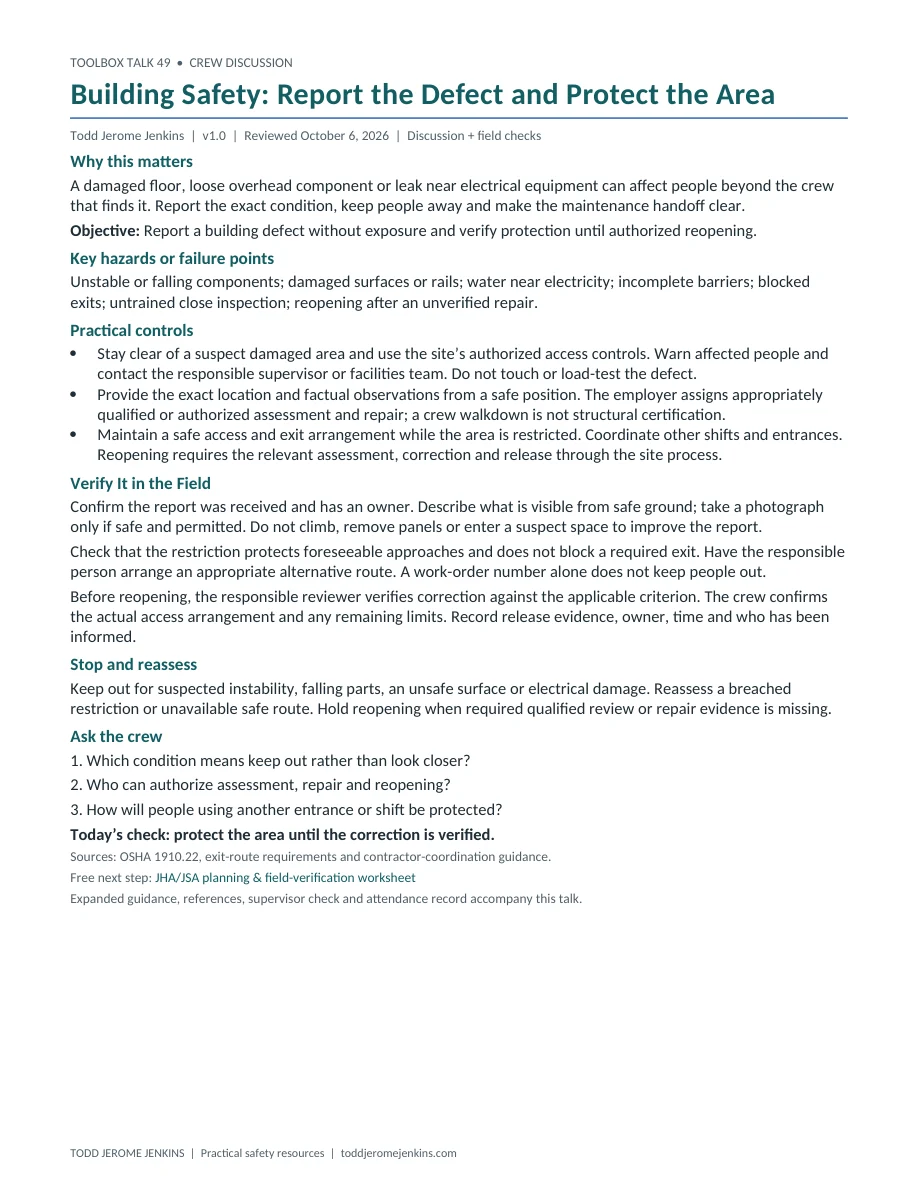
A 5–10 minute crew discussion, plus the time needed for field verification. All six downloads are free without a required signup.
Why this matters
A damaged floor, loose overhead component or leak near electrical equipment can affect people beyond the crew that finds it. Report the exact condition, keep people away and make the maintenance handoff clear.
Learning objective: Report a building defect without exposure and verify protection until authorized reopening.
Key hazards or failure points
Unstable or falling components; damaged surfaces or rails; water near electricity; incomplete barriers; blocked exits; untrained close inspection; reopening after an unverified repair.
Practical controls
- Stay clear of a suspect damaged area and use the site’s authorized access controls. Warn affected people and contact the responsible supervisor or facilities team. Do not touch or load-test the defect.
- Provide the exact location and factual observations from a safe position. The employer assigns appropriately qualified or authorized assessment and repair; a crew walkdown is not structural certification.
- Maintain a safe access and exit arrangement while the area is restricted. Coordinate other shifts and entrances. Reopening requires the relevant assessment, correction and release through the site process.
Verify It in the Field
Confirm the report was received and has an owner. Describe what is visible from safe ground; take a photograph only if safe and permitted. Do not climb, remove panels or enter a suspect space to improve the report.
Check that the restriction protects foreseeable approaches and does not block a required exit. Have the responsible person arrange an appropriate alternative route. A work-order number alone does not keep people out.
Before reopening, the responsible reviewer verifies correction against the applicable criterion. The crew confirms the actual access arrangement and any remaining limits. Record release evidence, owner, time and who has been informed.
Use the separate field check to record the source and criterion, safe method, checker, actual result and time. Mark VERIFIED, HOLD/NOT VERIFIED, or N/A with a reason. Check every required control; the examples below do not clear the whole task.
| Control | Safe verification | Evidence to record |
|---|---|---|
| Received report | Confirm exact location and observed condition with the responsible contact. | Report, owner and response. |
| Effective restriction | Check protected approaches and approved alternative access safely. | Boundary and route findings. |
| Authorized reopening | Reviewer checks repair/inspection evidence against governing criteria. | Evidence, release authority, time and communication. |
Stop and reassess
Keep out for suspected instability, falling parts, an unsafe surface or electrical damage. Reassess a breached restriction or unavailable safe route. Hold reopening when required qualified review or repair evidence is missing.
Crew discussion questions
- Which condition means keep out rather than look closer?
- Who can authorize assessment, repair and reopening?
- How will people using another entrance or shift be protected?
Today’s check: protect the area until the correction is verified.
A situation to discuss
Illustrative situation: a leak leaves damage above a busy walkway. The crew reports it from a safe position and restricts the affected area through the site process. Facilities obtains the necessary assessment and safe alternative access. Nobody pushes or removes the damaged material as a test.
Leader preparation and practical detail
Observation is different from technical assessment
Workers can identify and report a condition without deciding that a structure or electrical system is safe. Record the location, time and visible change, then involve the person with the relevant expertise. A competent-person designation in one trade does not establish every structural or electrical qualification.
Protect the route during the repair
General-industry walking-working-surface rules address safe condition, inspection and correction; repairs involving structural integrity require qualified supervision. Keep the affected surface out of use or guarded as required until correction. Coordinate repair work so it does not create a new access or exit hazard for occupants. [1], [2]
Close the maintenance handoff
The finding, temporary protection, repair and reopening may involve different people. Name each handoff and confirm who checks the final condition. Before removing restrictions, communicate any changed route or remaining limitation to people on later shifts and other employers who use the area. [3]
Short supervisor field check
- Safe observation and received report documented.
- Affected area protected.
- Alternative access and required exits maintained.
- Appropriate technical assessment assigned.
- Reopening evidence verified and communicated.
Use the separate form to document evidence, restrictions, corrective-action owner, recheck and required restart approval. An unresolved required control means hold the affected work. Missing evidence is not a pass. Complete all task-specific inspections and permits.
Attendance and follow-through
The separate attendance sheet records participants, language support, questions, actions and late-arrival rebriefs. Attendance does not establish competence or prove controls function. Keep completed records private under the employer’s procedures.
Technical scope and references
This is reporting and access-control guidance, not a building inspection or structural/electrical assessment. OSHA 1910.22 applies to general-industry walking-working surfaces. Other operations and building/fire requirements may differ. Use appropriate professional decisions and employer procedures. [1], [2], [3]
References checked October 6, 2026. Apply the jurisdiction, task, employer program and equipment instructions that govern the work. No site-specific manual, permit, engineering determination or product SDS has been approved by this general resource.
- OSHA 29 CFR 1910.22 — Walking-working surfaces — General industry walking-working surfaces; not building structural certification.
- OSHA 29 CFR 1910.37 — Exit route maintenance — General industry. Technical inspection and local building/fire code requirements also need appropriate authority.
- OSHA Recommended Practices — Communication and Coordination — Recommended practices for multiemployer/staffing arrangements, not a claim every job requires a document titled SSSP.
Connect this discussion to your JHA/JSA
Use How to Conduct a Job Safety Analysis to connect today’s work steps, hazards and controls. Revisit Pre-Job JHA/JSA: What Changed Today? whenever conditions change.
Related Todd Jerome Jenkins article: What Is an OSHA Competent Person?.
Related Todd Jerome Jenkins video: What Is an OSHA Competent Person?.
Related published crew resources: Electrical & Extension-Cord Checks; Housekeeping Is a Control; Emergency Evacuation: Know the Route and Count the Crew; Barricades: What Does This Boundary Keep Out?.
Put one check into practice
Download the free JHA/JSA planning and field-verification worksheet. For today’s task, record an important control, its source and the evidence needed before exposure. Complete the remaining required checks through your task plan.