Download the talk and separate crew records
Free to download without an account. Each PDF is one page. Use the Word version to adapt the record to your task and approved procedures.
Supervisor field check
Download supervisor field check (PDF, 1 page)Editable supervisor field check (Word)Preview the one-page crew talk
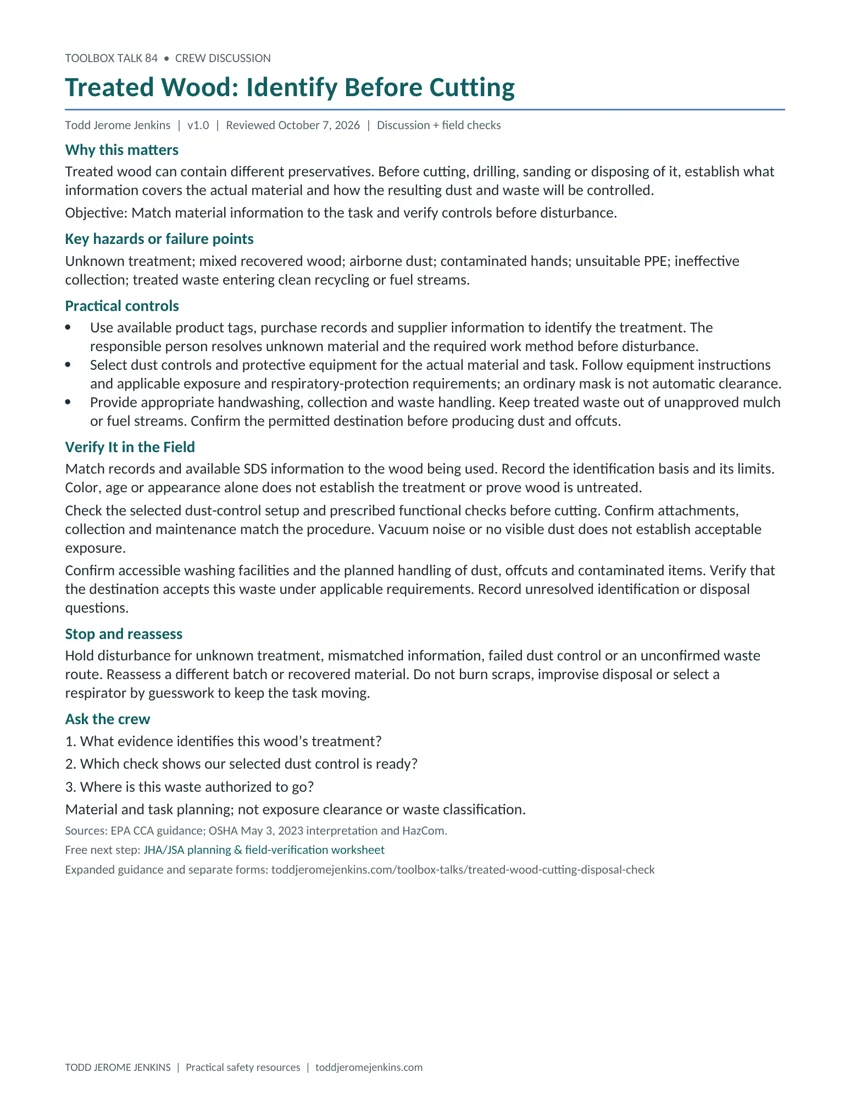
A 5–10 minute crew discussion, plus the time needed for field verification. All six downloads are free without a required signup.
Why this matters
Treated wood can contain different preservatives. Before cutting, drilling, sanding or disposing of it, establish what information covers the actual material and how the resulting dust and waste will be controlled.
Learning objective: Match material information to the task and verify controls before disturbance.
Key hazards or failure points
Unknown treatment; mixed recovered wood; airborne dust; contaminated hands; unsuitable PPE; ineffective collection; treated waste entering clean recycling or fuel streams.
Practical controls
- Use available product tags, purchase records and supplier information to identify the treatment. The responsible person resolves unknown material and the required work method before disturbance.
- Select dust controls and protective equipment for the actual material and task. Follow equipment instructions and applicable exposure and respiratory-protection requirements; an ordinary mask is not automatic clearance.
- Provide appropriate handwashing, collection and waste handling. Keep treated waste out of unapproved mulch or fuel streams. Confirm the permitted destination before producing dust and offcuts.
Verify It in the Field
Match records and available SDS information to the wood being used. Record the identification basis and its limits. Color, age or appearance alone does not establish the treatment or prove wood is untreated.
Check the selected dust-control setup and prescribed functional checks before cutting. Confirm attachments, collection and maintenance match the procedure. Vacuum noise or no visible dust does not establish acceptable exposure.
Confirm accessible washing facilities and the planned handling of dust, offcuts and contaminated items. Verify that the destination accepts this waste under applicable requirements. Record unresolved identification or disposal questions.
Use the separate field check to record the acceptance source and criterion, safe method, checker, actual result and time. Mark VERIFIED, HOLD/NOT VERIFIED, or N/A with a reason. A checkmark alone is not evidence that protection works. Complete all required task checks; do not enter danger or improvise a test.
| Control | Safe verification | Evidence |
|---|---|---|
| Known material | Compare tags and records with actual batch or recovered material. | Treatment basis, information gaps and responsible decision. |
| Ready dust controls | Complete equipment-specific inspection and prescribed check. | Equipment, attachment, result and required exposure-assessment reference. |
| Accepted waste route | Responsible person verifies classification and destination requirements. | Waste stream, acceptance basis, segregation and unresolved limits. |
Stop and reassess
Hold disturbance for unknown treatment, mismatched information, failed dust control or an unconfirmed waste route. Reassess a different batch or recovered material. Do not burn scraps, improvise disposal or select a respirator by guesswork to keep the task moving.
Crew discussion questions
- What evidence identifies this wood’s treatment?
- Which check shows our selected dust control is ready?
- Where is this waste authorized to go?
A situation to discuss
Illustrative situation: recovered boards are mixed with new tagged lumber. The crew separates the unknown material and holds cutting while the responsible person resolves its hazards and waste route. The newer boards’ paperwork is not used to clear the whole pile.
Leader preparation and practical detail
Identify the treatment without assumptions
EPA identifies CCA as one wood preservative and describes alternatives. A date, green tint or familiar use cannot identify a particular board reliably. Match supplier and project information to the actual material; when records are missing, obtain the appropriate assessment and protective work decision before disturbance. Existing CCA-treated structures do not automatically require removal under EPA’s guidance. [1]
Do not confuse an exclusion with no hazard
OSHA’s May 3, 2023 interpretation explains that the inorganic-arsenic standard’s treated-wood exclusion does not eliminate Hazard Communication duties. It also addresses potential hexavalent-chromium requirements depending on circumstances. The limited wood exemption in HazCom does not broadly exempt treated wood or dust-generating work. Have the responsible safety personnel determine the applicable exposure controls; this page does not certify a particular product or process. [2, 3]
Resolve disposal for the generator and location
EPA distinguishes household disposal advice from nonhousehold waste responsibilities and notes state and local requirements. Contractor waste cannot automatically follow advice aimed at a homeowner. Confirm the waste determination and receiving facility’s acceptance before mixing dust and offcuts with other material. Do not use treated wood as casual fuel or send CCA-treated material to mulch. [1]
Short supervisor field check
- Material information matches actual wood and task.
- Uncertainty resolved by responsible personnel.
- Dust controls pass prescribed readiness checks.
- Hygiene and assessed protective arrangements usable.
- Waste stream and accepted destination confirmed.
Record unresolved items, restrictions, correction owner, recheck result and required restart authorization. Reference permits and specialist inspections rather than treating this form as a replacement. Rebrief workers affected by a change.
Attendance and follow-through
Use the separate attendance sheet for participants, discussion concerns, actions and late-arrival rebriefs. Attendance does not establish competence, verify controls or authorize work. Keep completed records private under the employer’s recordkeeping procedures.
Technical scope and references
Planning for treated-wood disturbance and disposal. EPA’s overview is not occupational respirator selection or a blanket contractor-disposal approval. Actual preservative, work process, exposure assessment and jurisdiction govern; no product SDS or local disposal rule was supplied for this general resource. [1–3]
References reviewed October 7, 2026. Apply the industry, activity and jurisdiction that govern the work. No actual site permit, equipment manual, exposure assessment or engineering determination was supplied for this general discussion.
- EPA — Chromated arsenicals (CCA) — Preservative background and disposal distinctions; alternatives to CCA exist.
- OSHA — May 3, 2023 treated-wood interpretation — HazCom and potential chromium requirements; arsenic-standard exclusion is not a general exemption.
- OSHA 1910.1200 — Hazard communication — Scope, including the limited wood exemption in paragraph (b)(6)(iv).
Connect this discussion to your JHA/JSA
Use How to Conduct a Job Safety Analysis to connect task steps, hazards and controls. Revisit Pre-Job JHA/JSA: What Changed Today? when conditions change.
Related Todd Jerome Jenkins video: What Is a Safety Data Sheet and How Do You Read It?.
Related crew discussions
- Respiratory Hazards: Know What You’re Breathing
- Eye & Face Protection
- Housekeeping Is a Control
- Hazard Communication: Labels, SDS & the Task
- Hand Protection: Match the Glove to the Task
- Powered Tools: Check the Tool, Guard and Accessory
Put one check into practice
Use the free JHA/JSA planning and field-verification worksheet to record today’s changes, important controls and the evidence needed before exposure.