Download the talk and separate crew records
Free to download without an account. Each PDF is one page. Use the Word version to adapt the record to your task and approved procedures.
Supervisor field check
Download supervisor field check (PDF, 1 page)Editable supervisor field check (Word)Preview the one-page crew talk
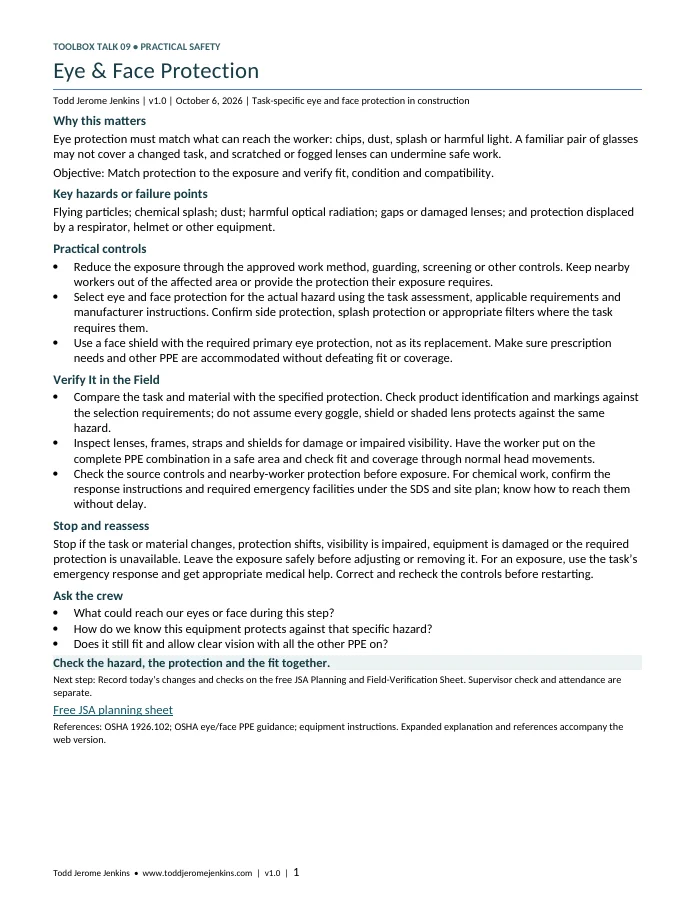
One-page crew talk, with separate supervisor and attendance sheets. Plan a 5–10 minute discussion and allow the time needed for field verification. All downloads are free; no account is required.
Learning objective
Match protection to the exposure and verify fit, condition and compatibility.
Start with today’s work
Illustrative scenario: A worker changes from handling intact material to grinding it. A face shield is available, but the worker removes safety glasses because the combined fit is uncomfortable. Stop and resolve the fit with suitable compatible equipment. The shield does not replace the required primary eye protection, and discomfort is useful information about a control that may not remain in use.
Key hazards or failure points
Flying particles; chemical splash; dust; harmful optical radiation; gaps or damaged lenses; and protection displaced by a respirator, helmet or other equipment.
Practical controls
- Reduce the exposure through the approved work method, guarding, screening or other controls. Keep nearby workers out of the affected area or provide the protection their exposure requires.
- Select eye and face protection for the actual hazard using the task assessment, applicable requirements and manufacturer instructions. Confirm side protection, splash protection or appropriate filters where the task requires them.
- Use a face shield with the required primary eye protection, not as its replacement. Make sure prescription needs and other PPE are accommodated without defeating fit or coverage.
Verify It in the Field
- Compare the task and material with the specified protection. Check product identification and markings against the selection requirements; do not assume every goggle, shield or shaded lens protects against the same hazard.
- Inspect lenses, frames, straps and shields for damage or impaired visibility. Have the worker put on the complete PPE combination in a safe area and check fit and coverage through normal head movements.
- Check the source controls and nearby-worker protection before exposure. For chemical work, confirm the response instructions and required emergency facilities under the SDS and site plan; know how to reach them without delay.
For each required control, identify the acceptance source and safe check method, assign a person with the required competence and authority, and record the actual result and time. Use VERIFIED, HOLD/NOT VERIFIED, or N/A with a reason. A checkmark alone does not demonstrate that protection works.
| Control | Safe verification | Criterion, evidence and response |
|---|---|---|
| Hazard match | Compare selected product identification and protection features with the task assessment and applicable requirements. | 1926.102, assessment and manufacturer instructions. Record selection basis; missing or mismatched protection means HOLD. |
| Fit and visibility | Worker dons all required PPE in a safe area; inspect condition and observe normal movement for gaps, displacement or obscured vision. | Product instructions and task procedure. Record defects or fit issues; correct before exposure. |
| Surrounding exposure | Check guards/screens and other workers’ locations; verify required response facilities for chemical work. | JHA/JSA, SDS and site emergency procedure. Record the arrangements and any unresolved access issue. |
These are examples, not a complete task inspection. Check all required controls. Do not enter danger, defeat a safeguard or improvise a test. If the criterion, method or result is uncertain, hold affected work and get the appropriate technical help. No actual equipment model, product SDS or site permit was supplied for these examples; use the documents for your task.
Leader preparation and explanation
Selection starts with the exposure
OSHA 1926.102 addresses appropriate protection for eye and face hazards, including flying particles, chemicals and harmful light. Side protection and suitable optical filters have specific applications. Use the applicable assessment and product instructions; this page does not assign a universal lens shade or claim every marked product covers every hazard.
Check the whole combination
Prescription glasses, respirators, helmets and hearing protection can affect fit. Put on the actual combination before exposure and check whether movement shifts the lenses or shield. Ordinary prescription eyewear should not be assumed to meet the task’s protective requirements. Resolve fogging or discomfort with the appropriate equipment or work conditions, not by removing protection in the hazard area.
Keep the source control in the discussion
Eye protection is one part of the task plan. Guards, screens, splash control and separation may also be required. Confirm those controls before relying on PPE. OSHA’s impact-hazard guidance advises primary eye protection beneath a face shield. Specialty tasks such as welding and laser work require their own selection criteria and technical review.
Stop and reassess
Stop if the task or material changes, protection shifts, visibility is impaired, equipment is damaged or the required protection is unavailable. Leave the exposure safely before adjusting or removing it. For an exposure, use the task’s emergency response and get appropriate medical help. Correct and recheck the controls before restarting.
When conditions change, return to Pre-Job JHA/JSA: What Changed Today? and revise the affected task plan with the crew.
Three crew discussion questions
- What could reach our eyes or face during this step?
- How do we know this equipment protects against that specific hazard?
- Does it still fit and allow clear vision with all the other PPE on?
Short supervisor field check
- Task assessment covers particles, dust, splash and harmful light as applicable.
- Source controls and protection of nearby workers are in place.
- Selected eye/face protection and markings match the required hazard protection.
- Condition, visibility, prescription needs and compatibility are verified with all PPE worn.
- Exposure response and required emergency facilities are identified and accessible.
Use the separate supervisor sheet to record the task and change, JHA/JSA revision, acceptance source, safe method, verifier, actual result, unresolved items, corrective action, recheck and required restart authorization. Link specialist inspection records rather than copying private or unnecessary details.
Attendance and follow-through
Use the separate attendance sheet for participant names, roles and acknowledgment, meeting details, concerns, actions and rebriefs. Attendance is not proof of competence, functioning controls or permission to work. Keep completed records under the employer’s privacy and recordkeeping procedures; never post completed sign-in sheets publicly.
Related JHA/JSA resource and existing video
How to Conduct a Job Safety Analysis connects the task steps, hazards and controls. For related background, see What Is PPE and How Do You Choose It?.
Related crew discussions
One next step
Use the free JSA Planning and Field-Verification Sheet to record today’s changes and checks with the crew.
Sources and references
Sources reviewed October 6, 2026. Apply each regulation’s industry and activity scope, and current state or local requirements where applicable. Guidance is identified separately. This discussion resource supports preparation; it does not replace task procedures, required training, permits or specialist decisions.
- OSHA 29 CFR 1926.102 — Construction eye/face protection selection, side protection, prescription accommodation, fit, identification and optical filters.
- OSHA — Hurricane eMatrix: Impact Hazard to Eyes and Face — Limited use: guidance to wear primary eye protection with a face shield. Disaster-specific portions are not applied to unrelated work.