Download the talk and separate crew records
Free to download without an account. Each PDF is one page. Use the Word version to adapt the record to your task and approved procedures.
Supervisor field check
Download supervisor field check (PDF, 1 page)Editable supervisor field check (Word)Preview the one-page crew talk
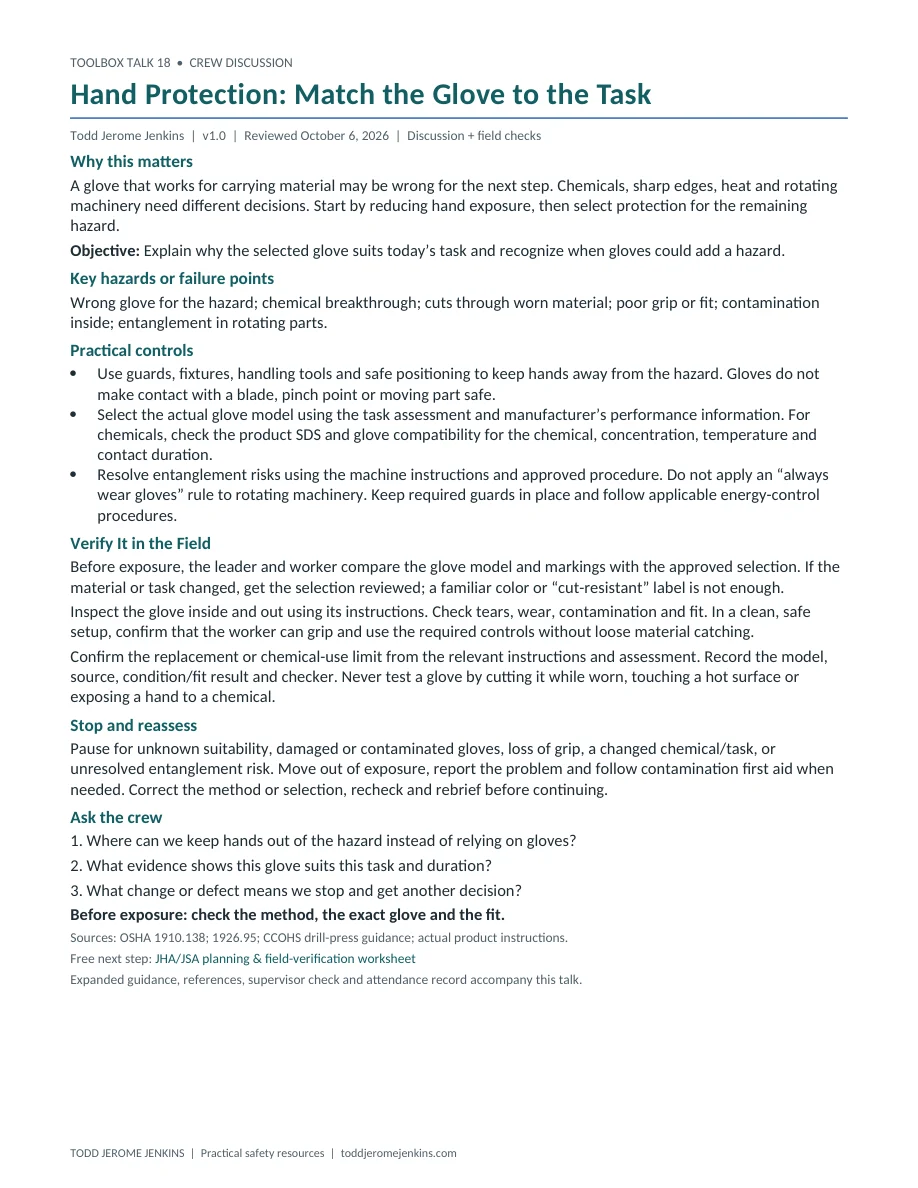
A 5–10 minute crew discussion, plus the time needed for field verification. All six downloads are free without a required signup.
Why this matters
A glove that works for carrying material may be wrong for the next step. Chemicals, sharp edges, heat and rotating machinery need different decisions. Start by reducing hand exposure, then select protection for the remaining hazard.
Learning objective: Explain why the selected glove suits today’s task and recognize when gloves could add a hazard.
Key hazards or failure points
Wrong glove for the hazard; chemical breakthrough; cuts through worn material; poor grip or fit; contamination inside; entanglement in rotating parts.
Practical controls
- Use guards, fixtures, handling tools and safe positioning to keep hands away from the hazard. Gloves do not make contact with a blade, pinch point or moving part safe.
- Select the actual glove model using the task assessment and manufacturer’s performance information. For chemicals, check the product SDS and glove compatibility for the chemical, concentration, temperature and contact duration.
- Resolve entanglement risks using the machine instructions and approved procedure. Do not apply an “always wear gloves” rule to rotating machinery. Keep required guards in place and follow applicable energy-control procedures.
Verify It in the Field
Before exposure, the leader and worker compare the glove model and markings with the approved selection. If the material or task changed, get the selection reviewed; a familiar color or “cut-resistant” label is not enough.
Inspect the glove inside and out using its instructions. Check tears, wear, contamination and fit. In a clean, safe setup, confirm that the worker can grip and use the required controls without loose material catching.
Confirm the replacement or chemical-use limit from the relevant instructions and assessment. Record the model, source, condition/fit result and checker. Never test a glove by cutting it while worn, touching a hot surface or exposing a hand to a chemical.
Use the separate field check to record the source and criterion, safe method, checker, actual result and time. Mark VERIFIED, HOLD/NOT VERIFIED, or N/A with a reason. Check every required control; the examples below do not clear the whole task.
| Control | Safe verification | Evidence to record |
|---|---|---|
| Suitable model | Compare glove identification with the documented task and supplier selection. | Model and approved use recorded; unknown compatibility held for review. |
| Usable fit | Inspect and perform a clean, nonhazardous grip/control demonstration. | No relevant damage, contamination, loose fit or loss of required dexterity. |
| Safe method | Review the task’s guards, hand position and entanglement restrictions. | Method prevents contact; glove decision is consistent with actual machine instructions. |
Stop and reassess
Pause for unknown suitability, damaged or contaminated gloves, loss of grip, a changed chemical/task, or unresolved entanglement risk. Move out of exposure, report the problem and follow contamination first aid when needed. Correct the method or selection, recheck and rebrief before continuing.
Crew discussion questions
- Where can we keep hands out of the hazard instead of relying on gloves?
- What evidence shows this glove suits this task and duration?
- What change or defect means we stop and get another decision?
Before exposure: check the method, the exact glove and the fit.
A situation to discuss
Illustrative situation: a worker finishes handling rough material and begins using a different chemical product. The same gloves are still intact. The leader checks suitability for the new product and contact conditions before use; a glove’s good physical condition does not establish chemical resistance.
Leader preparation and practical detail
Selection is specific to the operation
List the exposure that remains after guards, fixtures or handling aids are used. Then identify the exact glove, not just its generic material. Chemical compatibility and mechanical protection are different questions. Supplier performance data must be interpreted for the actual conditions; this talk provides no universal change-out time. [1]
Gloves can introduce an entanglement hazard
Consider the task step in context. CCOHS specifically advises against gloves while operating a drill press. Use the equipment’s instructions and approved method to determine the arrangement for the actual machine. Removing a glove does not authorize reaching into moving machinery, bypassing a guard or clearing a jam without required isolation. [3]
Make replacement easy enough to use
Ask where a worker gets another suitable pair and what happens if the available size does not fit. Keep replacements where they can be reached without returning through exposure. A worker should be able to report poor grip, irritation or contamination without being told to finish the task first.
Short supervisor field check
- Task and remaining hand hazards identified after stronger controls.
- Exact glove model matched to task and documented selection.
- Chemical conditions and replacement/use limits verified where relevant.
- Condition, fit, grip and compatibility with the method checked safely.
- Entanglement restrictions, replacement supply and stop response understood.
Use the separate form to document evidence, restrictions, corrective-action owner, recheck and required restart approval. An unresolved required control means hold the affected work. Missing evidence is not a pass. Complete all task-specific inspections and permits.
Attendance and follow-through
The separate attendance sheet records participants, language support, questions, actions and late-arrival rebriefs. Attendance does not establish competence or prove controls function. Keep completed records private under the employer’s procedures.
Technical scope and references
OSHA 1910.138 addresses general-industry hand-protection selection based on hazards, conditions and duration. Construction PPE is addressed by 1926.95, including proper fit. CCOHS drill-press advice is Canadian safety guidance, cited for a specific entanglement example rather than as a U.S. legal requirement. Electrical insulating gloves and other specialized PPE need their own selection, inspection and testing requirements. [1], [2], [3]
References checked October 6, 2026. Apply the jurisdiction, task, employer program and equipment instructions that govern the work. No site-specific manual, permit, engineering determination or product SDS has been approved by this general resource.
- OSHA 29 CFR 1910.138 — Hand protection — General industry; selection based on task, conditions, hazards and duration.
- OSHA 29 CFR 1926.95 — Criteria for personal protective equipment — Construction; selection must ensure proper fit for each affected employee.
- CCOHS — Metalworking Machines: Drill Presses — Canadian guidance; drill-press example, not U.S. law or a universal glove rule.
Connect this discussion to your JHA/JSA
Use How to Conduct a Job Safety Analysis to connect today’s work steps, hazards and controls. Revisit Pre-Job JHA/JSA: What Changed Today? whenever conditions change.
Related Todd Jerome Jenkins video: What Is PPE and How Do You Choose It?.
Related published crew resources: Hand Tools: Condition, Selection & Line of Fire; Hazard Communication: Labels, SDS & the Task; Eye & Face Protection.
Put one check into practice
Download the free JHA/JSA planning and field-verification worksheet. For today’s task, record an important control, its source and the evidence needed before exposure. Complete the remaining required checks through your task plan.