Download the free crew talk
The one-page talk, editable Word version, and guidance below are open to everyone. No account required.
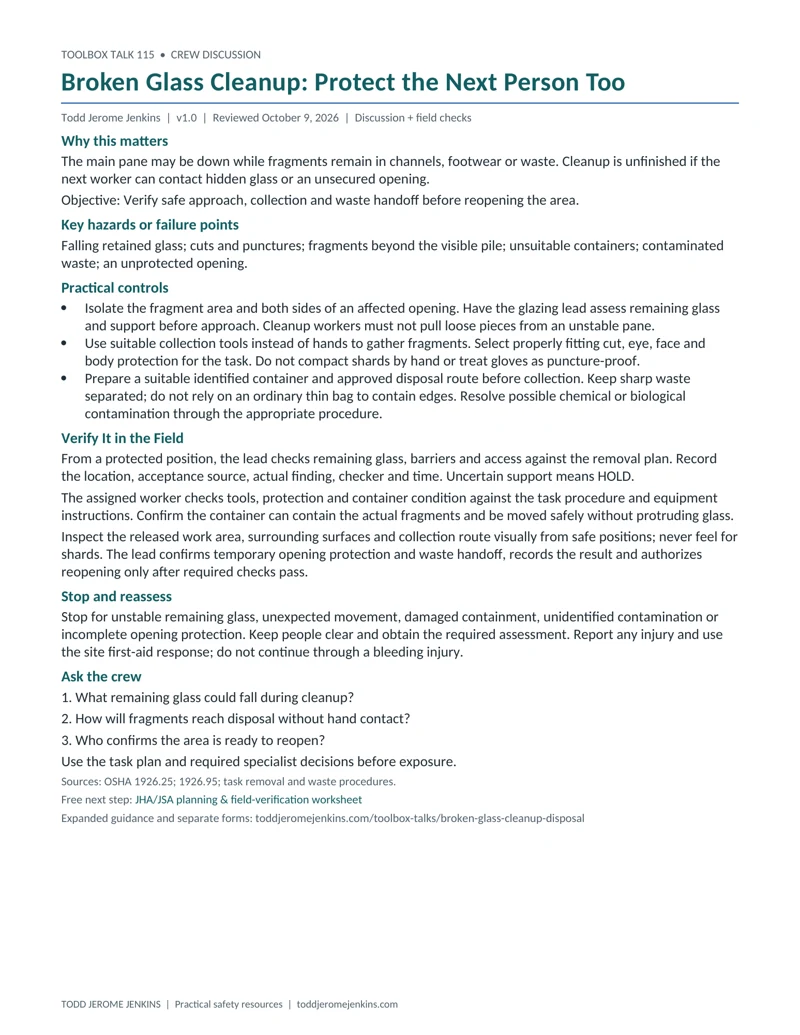
Preview the one-page crew talk
Supporting documents
Included with free Safety & Systems membership.
Supervisor field check
A separate check to verify conditions and controls before work. Includes a one-page PDF and editable Word file.
Attendance sheet
A separate sign-in sheet to record the crew discussion. Includes a one-page PDF and editable Word file.
Need the crew records? Join free to use these supporting documents and the Safety & Systems Academy. No payment details. Email updates are optional.
Get supporting documents — free membershipAlready a member? Use the same link to sign in.
A 5–10 minute crew discussion, plus time to verify the actual controls. The crew talk and Word version are public. Separate supervisor and attendance records are included with free Safety & Systems membership.
Why this matters
The main pane may be down while fragments remain in channels, footwear or waste. Cleanup is unfinished if the next worker can contact hidden glass or an unsecured opening.
Learning objective
Verify safe approach, collection and waste handoff before reopening the area.
Key hazards or failure points
Falling retained glass; cuts and punctures; fragments beyond the visible pile; unsuitable containers; contaminated waste; an unprotected opening.
Practical controls
- Isolate the fragment area and both sides of an affected opening. Have the glazing lead assess remaining glass and support before approach. Cleanup workers must not pull loose pieces from an unstable pane.
- Use suitable collection tools instead of hands to gather fragments. Select properly fitting cut, eye, face and body protection for the task. Do not compact shards by hand or treat gloves as puncture-proof.
- Prepare a suitable identified container and approved disposal route before collection. Keep sharp waste separated; do not rely on an ordinary thin bag to contain edges. Resolve possible chemical or biological contamination through the appropriate procedure.
Verify It in the Field
- From a protected position, the lead checks remaining glass, barriers and access against the removal plan. Record the location, acceptance source, actual finding, checker and time. Uncertain support means HOLD.
- The assigned worker checks tools, protection and container condition against the task procedure and equipment instructions. Confirm the container can contain the actual fragments and be moved safely without protruding glass.
- Inspect the released work area, surrounding surfaces and collection route visually from safe positions; never feel for shards. The lead confirms temporary opening protection and waste handoff, records the result and authorizes reopening only after required checks pass.
Stop and reassess
Stop for unstable remaining glass, unexpected movement, damaged containment, unidentified contamination or incomplete opening protection. Keep people clear and obtain the required assessment. Report any injury and use the site first-aid response; do not continue through a bleeding injury.
Crew discussion questions
- What remaining glass could fall during cleanup?
- How will fragments reach disposal without hand contact?
- Who confirms the area is ready to reopen?
For each required control, record its acceptance source and criterion, safe verification method, responsible checker, actual result and time. Use VERIFIED, HOLD/NOT VERIFIED, or N/A with a reason. A tick alone is not evidence. Complete all applicable task inspections; do not enter danger or improvise a test to fill out a form.
Leader preparation and practical detail
Separate cleanup from damaged-pane removal
The related JHA addresses an assessed ground-level storefront removal with both sides isolated. This briefing focuses on collection and handoff after a safe removal method is established. It does not authorize elevated glass removal, unstable framing recovery or emergency work in an occupied route. Do not ask a cleanup worker to discover retained support by touching or shaking the glass.
Choose collection equipment for this waste
Use tools that keep hands clear while controlling the fragment, such as suitable tongs, scoops or a brush and collection pan for small clean fragments. The Iowa EHS source supports mechanical collection in laboratory work; only that prevention principle is used here. Its institutional sharps-container and medical instructions are not construction requirements. Dust, coatings or contamination may change the method; do not disperse unknown residue with compressed air or improvised sweeping.
Verify containment through the whole handoff
The employer’s waste procedure, applicable disposal rules and actual container instructions establish suitability, handling limits, closure and identification. Check the container before use and again before movement; prevent exposed edges and overloading. Do not invent a universal container wall thickness, fill percentage or glass recycling permission. Confirm who receives the waste and how the receiving worker will recognize the hazard.
Record evidence before release
Assign the glazing lead the remaining-glass and opening assessment; assign trained cleanup personnel the collection checks. For each control, record its acceptance source, safe check, actual result and time. Mark unresolved items HOLD/NOT VERIFIED with a correction owner. Reinspect the affected area after correction and before authorized release. Attendance and a clean-looking floor do not establish that channels, adjacent surfaces or the opening are safe.
Short supervisor field check
- Remaining glass assessed.
- Fragment area and opening isolated.
- Tools and protection suitable.
- Container and destination confirmed.
- Final inspection and release recorded.
Confirm the relevant trained/authorized people, unresolved items, interim protection, correction owner and recheck. Record required release authority and rebrief anyone affected. The separate sheet supports these records; it does not replace a specialist inspection, permit or engineering determination.
Attendance and follow-through
Use the separate attendance sheet for participants, roles, discussion concerns, actions and late-arrival rebriefs. Attendance is not proof of competence, functioning controls or authorization to work. Keep completed records private under employer procedures.
Technical scope and references
Reviewed October 9, 2026 for construction crew preparation. Apply the actual task, jurisdiction and relevant standard provisions. Manufacturer sources below are reference examples, not approval of your equipment. No site-specific design, permit, exposure assessment, product SDS or current model manual was supplied; obtain the applicable documents before work. This discussion does not replace required training.
- OSHA 1926.25 — Construction housekeeping, waste collection and disposal; no universal broken-glass container specification.
- OSHA 1926.95(a), (c) — Suitable, maintained and properly fitting construction PPE.
- University of Iowa EHS — Sharps Injury Prevention — Institutional laboratory guidance; mechanical collection of fragments only informs this construction briefing. Its laboratory disposal and medical procedures are not adopted.
Connect this discussion to your JHA/JSA
Use the related worked JHA/JSA/AHA example to prepare task steps, hazards and controls. Return to What Changed Today? when the plan or conditions change.
Related Todd Jerome Jenkins article: How to Conduct a Job Safety Analysis.
Related crew discussions
Put one check into practice
Use the free JHA/JSA planning and field-verification worksheet to record today’s change, the required protection and the evidence needed before exposure.