Download the free toolbox talk
The one-page talk, editable Word version, and guidance below are open to everyone. No account required.
One-page toolbox talk
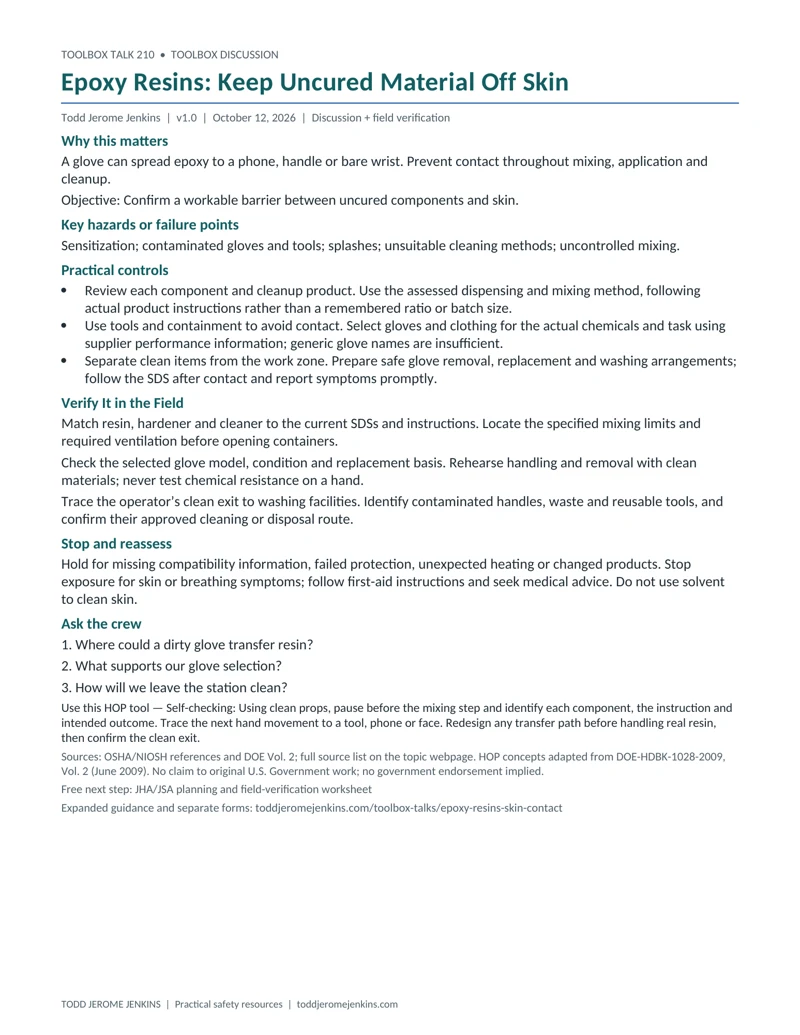
Download one-page toolbox talk (PDF, 1 page)Editable one-page toolbox talk (Word)Preview the one-page toolbox talk
Supporting documents
Included with free Safety & Systems membership.
Supervisor field check
A separate check to verify conditions and controls before work. Includes a one-page PDF and editable Word file.
Attendance sheet
A separate sign-in sheet to record the crew discussion. Includes a one-page PDF and editable Word file.
Need the crew records? Join free to use these supporting documents and the Safety & Systems Academy. No payment details. Email updates are optional.
Get supporting documents — free membershipAlready a member? Use the same link to sign in.
Hazard-based toolbox talk 35 of 52, with a practical HOP exercise.
Plan a 5–10 minute toolbox discussion, plus time to verify the actual controls. The one-page toolbox talk and editable Word version are public. Separate supervisor and attendance records are included with free Safety & Systems membership.
Why this matters
A glove can spread epoxy to a phone, handle or bare wrist. Prevent contact throughout mixing, application and cleanup.
Learning objective
Confirm a workable barrier between uncured components and skin.
Key hazards or failure points
Sensitization; contaminated gloves and tools; splashes; unsuitable cleaning methods; uncontrolled mixing.
Practical controls
- Review each component and cleanup product. Use the assessed dispensing and mixing method, following actual product instructions rather than a remembered ratio or batch size.
- Use tools and containment to avoid contact. Select gloves and clothing for the actual chemicals and task using supplier performance information; generic glove names are insufficient.
- Separate clean items from the work zone. Prepare safe glove removal, replacement and washing arrangements; follow the SDS after contact and report symptoms promptly.
Verify It in the Field
- Match resin, hardener and cleaner to the current SDSs and instructions. Locate the specified mixing limits and required ventilation before opening containers.
- Check the selected glove model, condition and replacement basis. Rehearse handling and removal with clean materials; never test chemical resistance on a hand.
- Trace the operator’s clean exit to washing facilities. Identify contaminated handles, waste and reusable tools, and confirm their approved cleaning or disposal route.
Stop and reassess
Hold for missing compatibility information, failed protection, unexpected heating or changed products. Stop exposure for skin or breathing symptoms; follow first-aid instructions and seek medical advice. Do not use solvent to clean skin.
Crew discussion questions
- Where could a dirty glove transfer resin?
- What supports our glove selection?
- How will we leave the station clean?
For each required control, record its acceptance source and criterion, safe verification method, responsible verifier, actual result and time. Mark VERIFIED, HOLD/NOT VERIFIED, or N/A with a reason. Complete all required inspections; never enter danger or improvise a test to fill out a form.
Use this HOP tool
Self-checking
Using clean props, pause before the mixing step and identify each component, the instruction and intended outcome. Trace the next hand movement to a tool, phone or face. Redesign any transfer path before handling real resin, then confirm the clean exit.
This exercise supports hazard identification or control verification. It does not replace safeguards, required training, specialist decisions or work authorization.
Leader preparation and practical detail
Study the hand movements
Illustrative situation: the worker keeps gloves on while answering a phone, then touches that phone after removing them. A glove did not prevent this indirect exposure. Before work, identify which handles and controls belong in the dirty area and provide a usable way to communicate without contaminating personal items. Practice with clean props only.
Control contact before adding PPE
NIOSH recommends preventing skin exposure through elimination, substitution and engineering controls before depending on protective equipment. For uncured resin work, consider approved dispensing tools and arrangements that reduce touching and splashing. Gloves still need a documented selection for the components and cleaning products. This talk supplies no universal glove material, service life or cure time.
Use actual product instructions
NIOSH distinguishes uncured components from the generally less hazardous cured polymer and emphasizes correct protection and prompt action after contact. A hard-looking surface is not a product-specific release criterion. Mixing quantities, working time, heat generation and subsequent sanding require their own current instructions and task assessment. Personal medical concerns belong with the appropriate health professional, not on a public attendance record.
Short supervisor field check
- Components and cleaner identified
- Mixing instructions available
- Glove selection supported
- Clean transition workable
- Contact response understood
Use the separate sheet to document evidence, unresolved restrictions, correction owner, recheck and required release authority. Rebrief affected workers. This record does not replace specialist inspections, permits or engineering determinations.
Attendance and follow-through
Use the separate attendance record for participants, roles, questions, actions and late-arrival rebriefs. Attendance does not prove competence, functioning controls or authorization. Keep completed records private under employer procedures.
Source acknowledgment
HOP concepts are adapted from DOE-HDBK-1028-2009, Human Performance Improvement Handbook, Volume 2 (June 2009). Todd Jerome Jenkins makes no claim to authorship or copyright ownership of original U.S. Government work. The explanations and exercises are original adaptations; no endorsement by DOE or the U.S. Government is implied. Third-party material credited in the handbook retains its separate ownership.
HOP source: Volume 2/VOLUME 2 SELF-CHECKING.pdf; Printed pp. 18–19; embedded printed pp. 20–21 read but not used. The handbook supplies concepts; task-specific technical references are listed below.
Technical scope and references
Technical sources inspected October 12, 2026; resource edition October 12, 2026. Apply current jurisdictional requirements, the actual task procedure, manufacturer instructions, permits and required competent or qualified decisions. This resource supplies no equipment-specific acceptance criteria.
- NIOSH — Preventing Skin Disease Guidelines and Recommendations — March 4, 2026 guidance; hierarchy of controls and protection for epoxy monomers and hardeners.
- NIOSH — About Epoxies and Resins and Reproductive Health — Uncured component precautions, appropriate gloves, avoiding contact and take-home exposure; no product-specific cure criterion.
- OSHA 1910.1200 Appendix D — Safety Data Sheets — Sections 7, 8 and 10 identify handling, exposure controls and reactivity information; actual product instructions remain necessary.
- OSHA 29 CFR 1926.59 — Construction hazard communication uses the requirements of 1910.1200.
- DOE-HDBK-1028-2009 Volume 2 — Self-checking — Printed pp. 18–19; embedded printed pp. 20–21 read but not used; historical HOP concept adapted into an original safe exercise.
Connect this discussion to your JHA/JSA
Use the JHA/JSA planning and field-verification worksheet to connect this discussion to the actual task, controls and responsible people.
Related Todd Jerome Jenkins articles: How to Conduct a Job Safety Analysis and What Is Human and Organizational Performance?.
Related toolbox talks
- Hand Protection: Match the Glove to the Task
- Hazard Communication: Labels, SDS & the Task
- Self-Checking: Confirm the Item, Action and Result
Continue the hazard series
Put one verification into practice
Record today’s change and evidence using the free JHA/JSA planning and field-verification worksheet.