Download the free toolbox talk
The one-page talk, editable Word version, and guidance below are open to everyone. No account required.
One-page toolbox talk
Download one-page toolbox talk (PDF, 1 page)Editable one-page toolbox talk (Word)Preview the one-page toolbox talk
Supporting documents
Included with free Safety & Systems membership.
Supervisor field check
A separate check to verify conditions and controls before work. Includes a one-page PDF and editable Word file.
Attendance sheet
A separate sign-in sheet to record the crew discussion. Includes a one-page PDF and editable Word file.
Need the crew records? Join free to use these supporting documents and the Safety & Systems Academy. No payment details. Email updates are optional.
Get supporting documents — free membershipAlready a member? Use the same link to sign in.
Hazard-based toolbox talk 34 of 52, with a practical HOP exercise.
Plan a 5–10 minute toolbox discussion, plus time to verify the actual controls. The one-page toolbox talk and editable Word version are public. Separate supervisor and attendance records are included with free Safety & Systems membership.
Why this matters
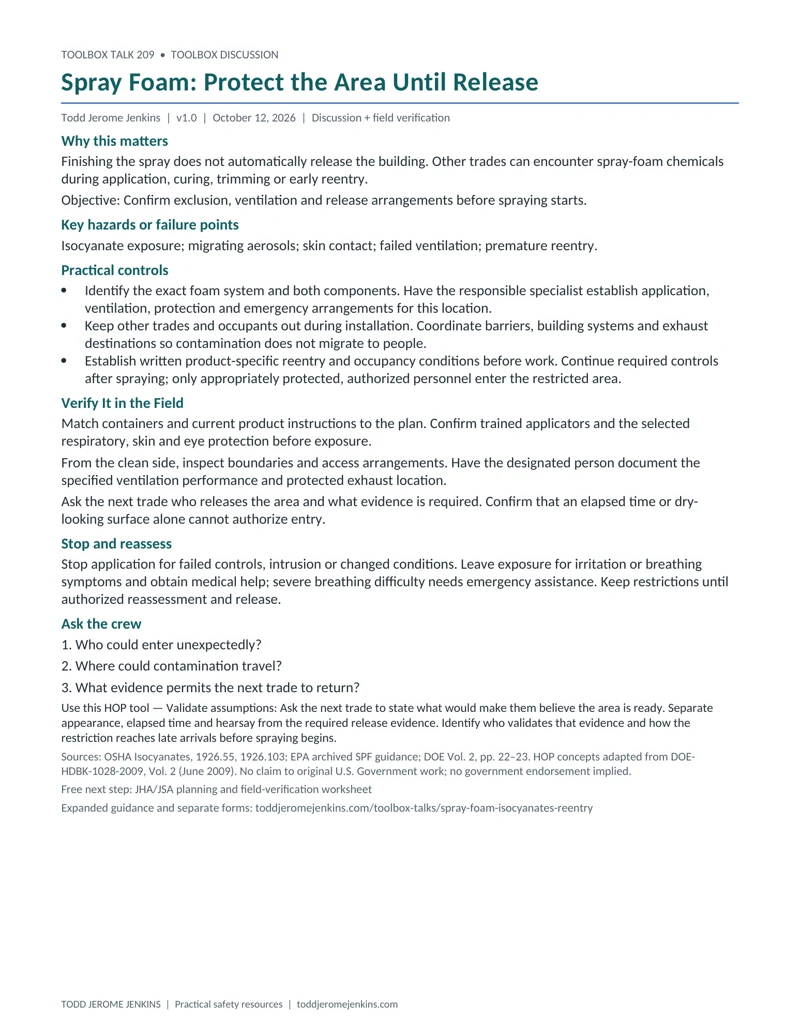
Finishing the spray does not automatically release the building. Other trades can encounter spray-foam chemicals during application, curing, trimming or early reentry.
Learning objective
Confirm exclusion, ventilation and release arrangements before spraying starts.
Key hazards or failure points
Isocyanate exposure; migrating aerosols; skin contact; failed ventilation; premature reentry.
Practical controls
- Identify the exact foam system and both components. Have the responsible specialist establish application, ventilation, protection and emergency arrangements for this location.
- Keep other trades and occupants out during installation. Coordinate barriers, building systems and exhaust destinations so contamination does not migrate to people.
- Establish written product-specific reentry and occupancy conditions before work. Continue required controls after spraying; only appropriately protected, authorized personnel enter the restricted area.
Verify It in the Field
- Match containers and current product instructions to the plan. Confirm trained applicators and the selected respiratory, skin and eye protection before exposure.
- From the clean side, inspect boundaries and access arrangements. Have the designated person document the specified ventilation performance and protected exhaust location.
- Ask the next trade who releases the area and what evidence is required. Confirm that an elapsed time or dry-looking surface alone cannot authorize entry.
Stop and reassess
Stop application for failed controls, intrusion or changed conditions. Leave exposure for irritation or breathing symptoms and obtain medical help; severe breathing difficulty needs emergency assistance. Keep restrictions until authorized reassessment and release.
Crew discussion questions
- Who could enter unexpectedly?
- Where could contamination travel?
- What evidence permits the next trade to return?
For each required control, record its acceptance source and criterion, safe verification method, responsible verifier, actual result and time. Mark VERIFIED, HOLD/NOT VERIFIED, or N/A with a reason. Complete all required inspections; never enter danger or improvise a test to fill out a form.
Use this HOP tool
Validate assumptions
Ask the next trade to state what would make them believe the area is ready. Separate appearance, elapsed time and hearsay from the required release evidence. Identify who validates that evidence and how the restriction reaches late arrivals before spraying begins.
This exercise supports hazard identification or control verification. It does not replace safeguards, required training, specialist decisions or work authorization.
Leader preparation and practical detail
Make release a named responsibility
Illustrative situation: the next trade arrives when spraying ends and assumes the area is ready. The schedule must identify the restricted period, protected-entry rules and person authorized to release the space. Record the required evidence before the work begins so that a delay does not become an improvised reentry decision.
Use product-specific conditions
EPA’s archived spray-foam guidance explains that reentry depends on formulation, curing, ventilation and cleanup. It is historical guidance, not a current product approval or a universal waiting period. Obtain the actual manufacturer’s current instructions and competent technical assessment for the installed system and conditions. This resource deliberately supplies no blanket 24-hour rule or field smell test.
Protect the people outside the spray crew
OSHA identifies occupational asthma, other lung effects and irritation as isocyanate hazards. The plan must include helpers, other trades and occupants as well as applicators. Verify the ventilation arrangement through the specified method and maintain its boundaries after spraying as required. Construction exposure controls and respiratory protection follow 1926.55 and 1926.103; a toolbox briefing does not establish applicator qualification or respirator readiness.
Short supervisor field check
- Exact product system assessed
- Applicator protection confirmed
- Exclusion arrangements working
- Ventilation verified
- Release criteria and owner assigned
Use the separate sheet to document evidence, unresolved restrictions, correction owner, recheck and required release authority. Rebrief affected workers. This record does not replace specialist inspections, permits or engineering determinations.
Attendance and follow-through
Use the separate attendance record for participants, roles, questions, actions and late-arrival rebriefs. Attendance does not prove competence, functioning controls or authorization. Keep completed records private under employer procedures.
Source acknowledgment
HOP concepts are adapted from DOE-HDBK-1028-2009, Human Performance Improvement Handbook, Volume 2 (June 2009). Todd Jerome Jenkins makes no claim to authorship or copyright ownership of original U.S. Government work. The explanations and exercises are original adaptations; no endorsement by DOE or the U.S. Government is implied. Third-party material credited in the handbook retains its separate ownership.
HOP source: Volume 2/VOLUME 2 VALIDATE ASSUMPTIONS.pdf; Printed pp. 22–23. The handbook supplies concepts; task-specific technical references are listed below.
Technical scope and references
Technical sources inspected October 12, 2026; resource edition October 12, 2026. Apply current jurisdictional requirements, the actual task procedure, manufacturer instructions, permits and required competent or qualified decisions. This resource supplies no equipment-specific acceptance criteria.
- OSHA — Isocyanates overview — Current hazard overview; asthma, respiratory and skin effects.
- OSHA 29 CFR 1926.55 — Construction airborne exposure controls; paragraph (b) requires technical approval for each particular use.
- OSHA 29 CFR 1926.103 — Construction respiratory protection requirements are identical to 1910.134; program selection is task-specific.
- EPA archived guidance — SPF vacate and safe reentry — Historical guidance reviewed October 12, 2026; product-specific reentry, ventilation and cleanup, not a universal waiting time.
- EPA archived guidance — SPF ventilation — Historical ventilation principles; current product instructions and task-specific technical assessment govern implementation.
- DOE-HDBK-1028-2009 Volume 2 — Validate assumptions — Printed pp. 22–23; historical HOP concept adapted into an original safe exercise.
Connect this discussion to your JHA/JSA
Use the JHA/JSA planning and field-verification worksheet to connect this discussion to the actual task, controls and responsible people.
Related Todd Jerome Jenkins articles: How to Conduct a Job Safety Analysis and What Is Human and Organizational Performance?.
Related toolbox talks
- Respiratory Hazards: Know What You’re Breathing
- Barricades: What Does This Boundary Keep Out?
- Assumptions: Show What Is Known and What Is Not
Continue the hazard series
Put one verification into practice
Record today’s change and evidence using the free JHA/JSA planning and field-verification worksheet.