Download the free toolbox talk
The one-page talk, editable Word version, and guidance below are open to everyone. No account required.
One-page toolbox talk
Download one-page toolbox talk (PDF, 1 page)Editable one-page toolbox talk (Word)Preview the one-page toolbox talk
Supporting documents
Included with free Safety & Systems membership.
Supervisor field check
A separate check to verify conditions and controls before work. Includes a one-page PDF and editable Word file.
Attendance sheet
A separate sign-in sheet to record the crew discussion. Includes a one-page PDF and editable Word file.
Need the crew records? Join free to use these supporting documents and the Safety & Systems Academy. No payment details. Email updates are optional.
Get supporting documents — free membershipAlready a member? Use the same link to sign in.
Hazard-based toolbox talk 33 of 52, with a practical HOP exercise.
Plan a 5–10 minute toolbox discussion, plus time to verify the actual controls. The one-page toolbox talk and editable Word version are public. Separate supervisor and attendance records are included with free Safety & Systems membership.
Why this matters
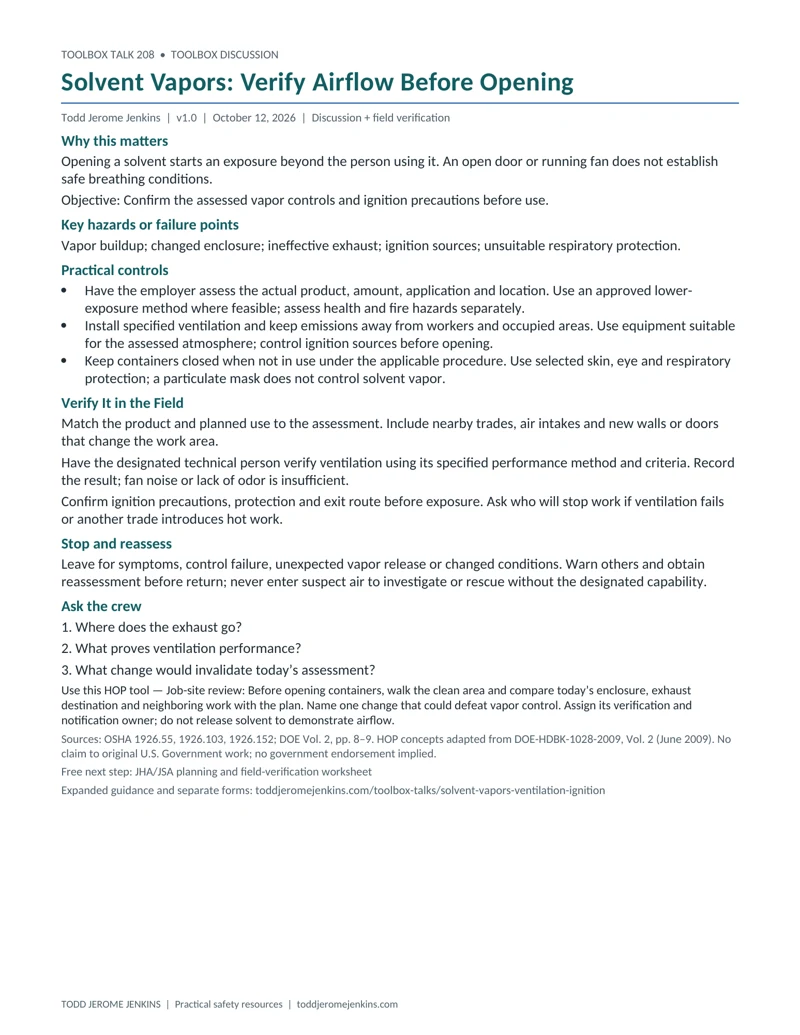
Opening a solvent starts an exposure beyond the person using it. An open door or running fan does not establish safe breathing conditions.
Learning objective
Confirm the assessed vapor controls and ignition precautions before use.
Key hazards or failure points
Vapor buildup; changed enclosure; ineffective exhaust; ignition sources; unsuitable respiratory protection.
Practical controls
- Have the employer assess the actual product, amount, application and location. Use an approved lower-exposure method where feasible; assess health and fire hazards separately.
- Install specified ventilation and keep emissions away from workers and occupied areas. Use equipment suitable for the assessed atmosphere; control ignition sources before opening.
- Keep containers closed when not in use under the applicable procedure. Use selected skin, eye and respiratory protection; a particulate mask does not control solvent vapor.
Verify It in the Field
- Match the product and planned use to the assessment. Include nearby trades, air intakes and new walls or doors that change the work area.
- Have the designated technical person verify ventilation using its specified performance method and criteria. Record the result; fan noise or lack of odor is insufficient.
- Confirm ignition precautions, protection and exit route before exposure. Ask who will stop work if ventilation fails or another trade introduces hot work.
Stop and reassess
Leave for symptoms, control failure, unexpected vapor release or changed conditions. Warn others and obtain reassessment before return; never enter suspect air to investigate or rescue without the designated capability.
Crew discussion questions
- Where does the exhaust go?
- What proves ventilation performance?
- What change would invalidate today’s assessment?
For each required control, record its acceptance source and criterion, safe verification method, responsible verifier, actual result and time. Mark VERIFIED, HOLD/NOT VERIFIED, or N/A with a reason. Complete all required inspections; never enter danger or improvise a test to fill out a form.
Use this HOP tool
Job-site review
Before opening containers, walk the clean area and compare today’s enclosure, exhaust destination and neighboring work with the plan. Name one change that could defeat vapor control. Assign its verification and notification owner; do not release solvent to demonstrate airflow.
This exercise supports hazard identification or control verification. It does not replace safeguards, required training, specialist decisions or work authorization.
Leader preparation and practical detail
The room changes during the job
Illustrative situation: glazing closes an opening that previously supplied replacement air. The old setup no longer demonstrates the assessed conditions. Hold solvent use and have the ventilation arrangement reviewed. Plan these interfaces before the next trade arrives, and identify who owns notification when an opening, fan, duct or occupied area changes.
Health and fire are different questions
A reading used for a flammability decision does not automatically establish acceptable exposure to a specific solvent. The assessment must address the actual substance and the instrument’s capabilities. Construction airborne controls are addressed by 1926.55; flammable-liquid handling has additional requirements under 1926.152. Do not import a storage-room ventilation figure into every solvent task.
Use the actual technical basis
Under 1926.55(b), the equipment and technical measures used for the specified exposure-control purpose require approval for the particular use by a competent industrial hygienist or other technically qualified person. Required respirators remain subject to the respiratory program. This talk selects no cartridge, airflow, exposure limit or monitoring frequency; resolve those details from the task assessment and applicable instructions.
Short supervisor field check
- Task exposure assessment matches
- Ventilation result documented
- Ignition sources controlled
- Required protection confirmed
- Withdrawal plan understood
Use the separate sheet to document evidence, unresolved restrictions, correction owner, recheck and required release authority. Rebrief affected workers. This record does not replace specialist inspections, permits or engineering determinations.
Attendance and follow-through
Use the separate attendance record for participants, roles, questions, actions and late-arrival rebriefs. Attendance does not prove competence, functioning controls or authorization. Keep completed records private under employer procedures.
Source acknowledgment
HOP concepts are adapted from DOE-HDBK-1028-2009, Human Performance Improvement Handbook, Volume 2 (June 2009). Todd Jerome Jenkins makes no claim to authorship or copyright ownership of original U.S. Government work. The explanations and exercises are original adaptations; no endorsement by DOE or the U.S. Government is implied. Third-party material credited in the handbook retains its separate ownership.
HOP source: Volume 2/VOLUME 2 JOB-SITE REVIEW.pdf; Printed pp. 8–9. The handbook supplies concepts; task-specific technical references are listed below.
Technical scope and references
Technical sources inspected October 12, 2026; resource edition October 12, 2026. Apply current jurisdictional requirements, the actual task procedure, manufacturer instructions, permits and required competent or qualified decisions. This resource supplies no equipment-specific acceptance criteria.
- OSHA 29 CFR 1926.55 — Construction airborne exposure controls; paragraph (b) requires technical approval for each particular use.
- OSHA 29 CFR 1926.103 — Construction respiratory protection requirements are identical to 1910.134; program selection is task-specific.
- OSHA 29 CFR 1926.152 — Flammable liquids — Construction storage, transfer and point-of-use requirements; no generic ventilation number adopted.
- OSHA — Solvents overview — Solvent health hazards and links to evaluation and controls.
- DOE-HDBK-1028-2009 Volume 2 — Job-site review — Printed pp. 8–9; historical HOP concept adapted into an original safe exercise.
Connect this discussion to your JHA/JSA
Use the JHA/JSA planning and field-verification worksheet to connect this discussion to the actual task, controls and responsible people.
Related Todd Jerome Jenkins articles: How to Conduct a Job Safety Analysis and What Is Human and Organizational Performance?.
Related toolbox talks
- Respiratory Hazards: Know What You’re Breathing
- Fire Prevention: Separate Fuel from Ignition
- Job-Site Review: Does the Place Match the Plan?
Continue the hazard series
Put one verification into practice
Record today’s change and evidence using the free JHA/JSA planning and field-verification worksheet.