Download the talk and separate crew records
Free to download without an account. Each PDF is one page. Use the Word version to adapt the record to your task and approved procedures.
Supervisor field check
Download supervisor field check (PDF, 1 page)Editable supervisor field check (Word)Preview the one-page crew talk
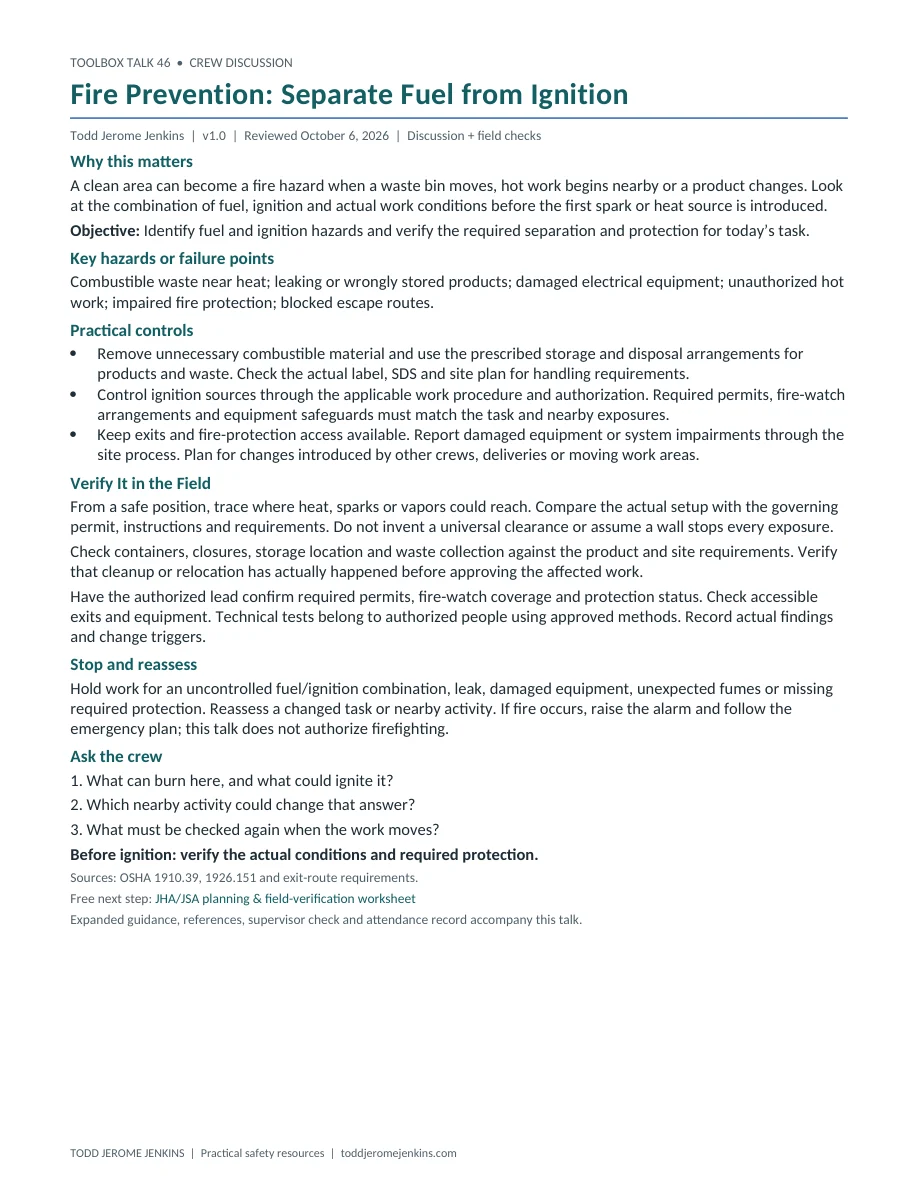
A 5–10 minute crew discussion, plus the time needed for field verification. All six downloads are free without a required signup.
Why this matters
A clean area can become a fire hazard when a waste bin moves, hot work begins nearby or a product changes. Look at the combination of fuel, ignition and actual work conditions before the first spark or heat source is introduced.
Learning objective: Identify fuel and ignition hazards and verify the required separation and protection for today’s task.
Key hazards or failure points
Combustible waste near heat; leaking or wrongly stored products; damaged electrical equipment; unauthorized hot work; impaired fire protection; blocked escape routes.
Practical controls
- Remove unnecessary combustible material and use the prescribed storage and disposal arrangements for products and waste. Check the actual label, SDS and site plan for handling requirements.
- Control ignition sources through the applicable work procedure and authorization. Required permits, fire-watch arrangements and equipment safeguards must match the task and nearby exposures.
- Keep exits and fire-protection access available. Report damaged equipment or system impairments through the site process. Plan for changes introduced by other crews, deliveries or moving work areas.
Verify It in the Field
From a safe position, trace where heat, sparks or vapors could reach. Compare the actual setup with the governing permit, instructions and requirements. Do not invent a universal clearance or assume a wall stops every exposure.
Check containers, closures, storage location and waste collection against the product and site requirements. Verify that cleanup or relocation has actually happened before approving the affected work.
Have the authorized lead confirm required permits, fire-watch coverage and protection status. Check accessible exits and equipment. Technical tests belong to authorized people using approved methods. Record actual findings and change triggers.
Use the separate field check to record the source and criterion, safe method, checker, actual result and time. Mark VERIFIED, HOLD/NOT VERIFIED, or N/A with a reason. Check every required control; the examples below do not clear the whole task.
| Control | Safe verification | Evidence to record |
|---|---|---|
| Fuel control | Inspect actual product/waste storage against the governing source. | Location, criterion and corrected condition. |
| Ignition control | Authorized lead compares work setup with required authorization. | Permit/procedure, protections and actual findings. |
| Exit/protection access | Observe the designated routes and equipment access safely. | Obstructions, correction and recheck result. |
Stop and reassess
Hold work for an uncontrolled fuel/ignition combination, leak, damaged equipment, unexpected fumes or missing required protection. Reassess a changed task or nearby activity. If fire occurs, raise the alarm and follow the emergency plan; this talk does not authorize firefighting.
Crew discussion questions
- What can burn here, and what could ignite it?
- Which nearby activity could change that answer?
- What must be checked again when the work moves?
Before ignition: verify the actual conditions and required protection.
A situation to discuss
Illustrative situation: a combustible-waste bin is moved beside a hot-work area after the briefing. A worker reports the change, and the authorized lead holds the work while the required separation and protection are restored and rechecked.
Leader preparation and practical detail
Plan for the specific fire hazards
Where applicable, a fire-prevention plan addresses major fire hazards, safe handling and storage, ignition control, waste and responsible roles. Construction rules also address fire prevention and storage in their particular contexts. Apply the relevant provisions and task controls rather than treating every product and operation as the same hazard. [1], [2]
Authorization needs field evidence
A permit records an authorization under stated conditions. Compare those conditions with the actual location and nearby work before starting and when conditions change. The duration of a fire watch, storage limits and required distances must come from the applicable requirement or approved procedure. This general talk does not establish those numbers.
Keep the response route usable
Prevention, evacuation and extinguisher response have different purposes. Maintain exits and access to required protection, and use the site’s impairment process when a system is unavailable. If a fire starts, follow the emergency arrangements and your assigned role. Use the separate extinguisher talk for the decision about authorized use; attendance here is not firefighting training. [3]
Short supervisor field check
- Fuel and ignition hazards identified.
- Storage, containers and waste controls verified.
- Required authorization and protection checked.
- Exit and fire-protection access maintained.
- Changes and recheck owner agreed.
Use the separate form to document evidence, restrictions, corrective-action owner, recheck and required restart approval. An unresolved required control means hold the affected work. Missing evidence is not a pass. Complete all task-specific inspections and permits.
Attendance and follow-through
The separate attendance sheet records participants, language support, questions, actions and late-arrival rebriefs. Attendance does not establish competence or prove controls function. Keep completed records private under the employer’s procedures.
Technical scope and references
OSHA 1910.39 applies when another general-industry rule requires a fire-prevention plan; 1926.151 applies to construction. Task-specific hot-work, electrical, chemical and fire-code requirements may also apply. Use the actual governing sources and site program. [1], [2], [3]
References checked October 6, 2026. Apply the jurisdiction, task, employer program and equipment instructions that govern the work. No site-specific manual, permit, engineering determination or product SDS has been approved by this general resource.
- OSHA 29 CFR 1910.39 — Fire prevention plans — General industry. Required when another Part1910 standard requires a fire-prevention plan.
- OSHA 29 CFR 1926.151 — Fire prevention — Construction. Do not collapse context-dependent distances into a single universal crew rule.
- OSHA 29 CFR 1910.37 — Exit route maintenance — General industry. Technical inspection and local building/fire code requirements also need appropriate authority.
Connect this discussion to your JHA/JSA
Use How to Conduct a Job Safety Analysis to connect today’s work steps, hazards and controls. Revisit Pre-Job JHA/JSA: What Changed Today? whenever conditions change.
Related Todd Jerome Jenkins video: What Is a Safety Data Sheet and How Do You Read It?.
Related published crew resources: Electrical & Extension-Cord Checks; Housekeeping Is a Control; Hazard Communication: Labels, SDS & the Task; Emergency Evacuation: Know the Route and Count the Crew; Fire Extinguishers: Know When to Evacuate.
Put one check into practice
Download the free JHA/JSA planning and field-verification worksheet. For today’s task, record an important control, its source and the evidence needed before exposure. Complete the remaining required checks through your task plan.