Download the free crew talk
The one-page talk, editable Word version, and guidance below are open to everyone. No account required.
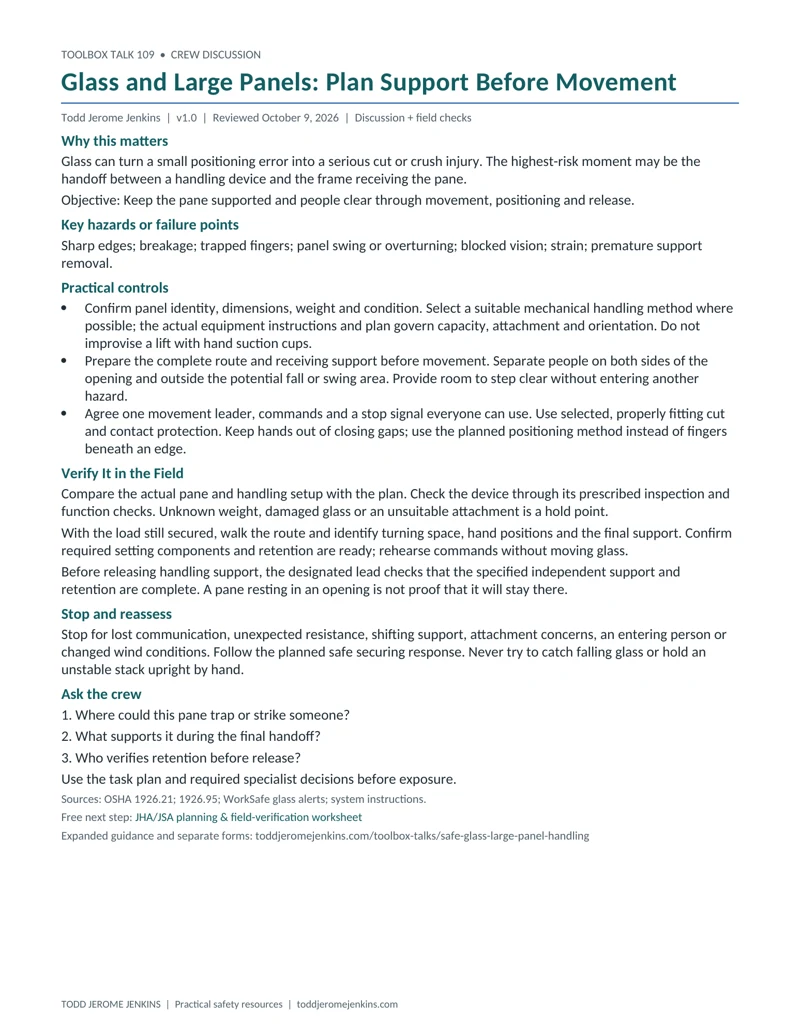
Preview the one-page crew talk
Supporting documents
Included with free Safety & Systems membership.
Supervisor field check
A separate check to verify conditions and controls before work. Includes a one-page PDF and editable Word file.
Attendance sheet
A separate sign-in sheet to record the crew discussion. Includes a one-page PDF and editable Word file.
Need the crew records? Join free to use these supporting documents and the Safety & Systems Academy. No payment details. Email updates are optional.
Get supporting documents — free membershipAlready a member? Use the same link to sign in.
A 5–10 minute crew discussion, plus time to verify the actual controls. The crew talk and Word version are public. Separate supervisor and attendance records are included with free Safety & Systems membership.
Why this matters
Glass can turn a small positioning error into a serious cut or crush injury. The highest-risk moment may be the handoff between a handling device and the frame receiving the pane.
Learning objective
Keep the pane supported and people clear through movement, positioning and release.
Key hazards or failure points
Sharp edges; breakage; trapped fingers; panel swing or overturning; blocked vision; strain; premature support removal.
Practical controls
- Confirm panel identity, dimensions, weight and condition. Select a suitable mechanical handling method where possible; the actual equipment instructions and plan govern capacity, attachment and orientation. Do not improvise a lift with hand suction cups.
- Prepare the complete route and receiving support before movement. Separate people on both sides of the opening and outside the potential fall or swing area. Provide room to step clear without entering another hazard.
- Agree one movement leader, commands and a stop signal everyone can use. Use selected, properly fitting cut and contact protection. Keep hands out of closing gaps; use the planned positioning method instead of fingers beneath an edge.
Verify It in the Field
- Compare the actual pane and handling setup with the plan. Check the device through its prescribed inspection and function checks. Unknown weight, damaged glass or an unsuitable attachment is a hold point.
- With the load still secured, walk the route and identify turning space, hand positions and the final support. Confirm required setting components and retention are ready; rehearse commands without moving glass.
- Before releasing handling support, the designated lead checks that the specified independent support and retention are complete. A pane resting in an opening is not proof that it will stay there.
Stop and reassess
Stop for lost communication, unexpected resistance, shifting support, attachment concerns, an entering person or changed wind conditions. Follow the planned safe securing response. Never try to catch falling glass or hold an unstable stack upright by hand.
Crew discussion questions
- Where could this pane trap or strike someone?
- What supports it during the final handoff?
- Who verifies retention before release?
For each required control, record its acceptance source and criterion, safe verification method, responsible checker, actual result and time. Use VERIFIED, HOLD/NOT VERIFIED, or N/A with a reason. A tick alone is not evidence. Complete all applicable task inspections; do not enter danger or improvise a test to fill out a form.
Leader preparation and practical detail
Use the briefing for the actual movement
This combines safe glass handling, large-panel handling, pinch points and installation line-of-fire into one briefing. The linked storefront JHA is a narrower ground-level example: it excludes large-panel hoisting, curtain walls and elevated glazing. For those tasks, develop the required lift, access, temporary-support and installation plans. This talk does not supply rigging design or lifting authorization.
Show continuous support
Ask the crew to describe what carries and restrains the pane at every transfer. Receiving blocks, retainers and temporary supports must follow the actual glazing system and released installation details. Resolve missing retention, uncertain frame readiness or a forced fit before movement. Support release is a specific check by the designated person, not a gesture inferred from the panel looking seated.
Do not solve instability with another pair of hands
Official Australian regulator alerts describe the danger of inadequately supported glass and hand restraint of unstable stacks. Their prevention guidance informs this talk; it is not represented as US regulation. The manual-handling talk remains the related resource for general route and exertion planning. No universal crew size or safe manual weight applies to every panel.
Keep device and weather limits specific
Use the actual device manual and installation plan for surface compatibility, capacity in the intended orientation, checks and operating limits. The vacuum-lifter resource addresses its separate attachment and monitoring checks. Stop when conditions depart from the approved method; this talk supplies no generic wind speed, vacuum threshold or hand-cup hoisting approval.
Short supervisor field check
- Panel and method confirmed.
- Handling equipment checked.
- Route and both sides separated.
- Commands and positions agreed.
- Independent retention verified.
Confirm the relevant trained/authorized people, unresolved items, interim protection, correction owner and recheck. Record required release authority and rebrief anyone affected. The separate sheet supports these records; it does not replace a specialist inspection, permit or engineering determination.
Attendance and follow-through
Use the separate attendance sheet for participants, roles, discussion concerns, actions and late-arrival rebriefs. Attendance is not proof of competence, functioning controls or authorization to work. Keep completed records private under employer procedures.
Technical scope and references
Reviewed October 9, 2026 for construction crew preparation. Apply the actual task, jurisdiction and relevant standard provisions. Manufacturer sources below are reference examples, not approval of your equipment. No site-specific design, permit, exposure assessment, product SDS or current model manual was supplied; obtain the applicable documents before work. This discussion does not replace required training.
- OSHA 1926.21(b)(2)–(3) — Recognition of unsafe conditions and training for harmful-substance handling.
- OSHA 1926.95(a), (c) — Construction PPE suitability, reliable condition and proper fit; no universal glove specification.
- WorkSafe Queensland — Workers injured by glass sheets — 2018 regulator alert; mechanical handling, planned lifts and support for unbalanced loads. Guidance, not US law.
- NT WorkSafe — Handling and storage of sheet glass — Australian regulator safety alert, updated 2022; restraint before unpacking and avoiding the fall path. Guidance, not US law.
Connect this discussion to your JHA/JSA
Related reference: worked JHA/JSA/AHA example. This ground-level storefront example excludes large-panel hoisting and elevated glazing. Use it for the support and retention handoff only; develop the actual lifting, access and temporary-support analysis separately. Return to What Changed Today? when the plan or conditions change.
Related Todd Jerome Jenkins article: How to Conduct a Job Safety Analysis.
Related crew discussions
Put one check into practice
Use the free JHA/JSA planning and field-verification worksheet to record today’s change, the required protection and the evidence needed before exposure.