Download the talk and separate crew records
Free to download without an account. Each PDF is one page. Use the Word version to adapt the record to your task and approved procedures.
Supervisor field check
Download supervisor field check (PDF, 1 page)Editable supervisor field check (Word)Preview the one-page crew talk
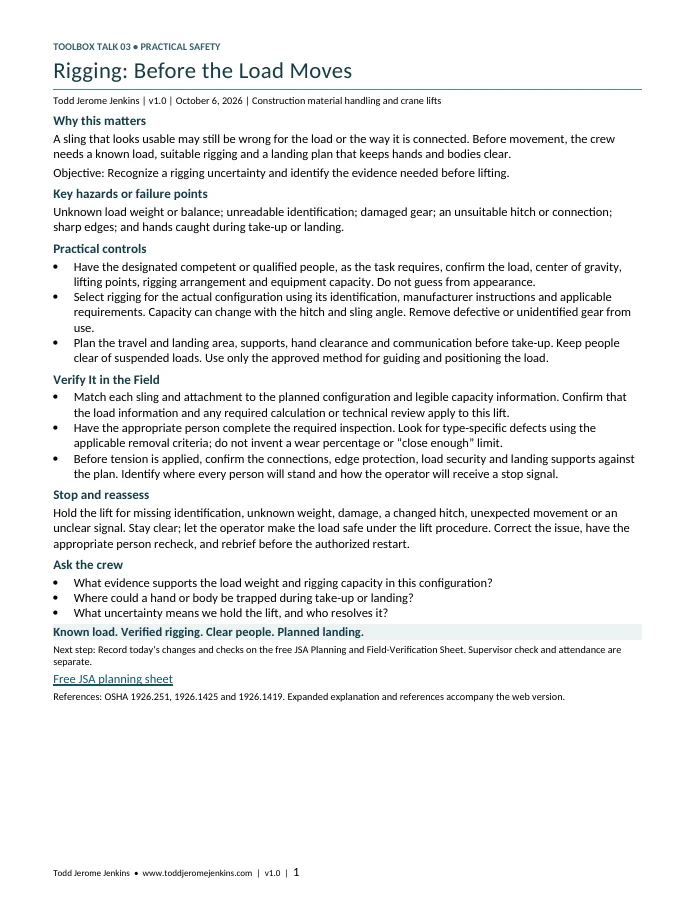
One-page crew talk, with separate supervisor and attendance sheets. Plan a 5–10 minute discussion and allow the time needed for field verification. All downloads are free; no account is required.
Learning objective
Recognize a rigging uncertainty and identify the evidence needed before lifting.
Start with today’s work
Illustrative scenario: A replacement sling arrives with an unreadable tag. Someone recognizes the color and says it is the same capacity as the old one. Keep that sling out of use. Identification, configuration and the applicable capacity information must be established through the required process; color or familiarity is not a capacity determination.
Key hazards or failure points
Unknown load weight or balance; unreadable identification; damaged gear; an unsuitable hitch or connection; sharp edges; and hands caught during take-up or landing.
Practical controls
- Have the designated competent or qualified people, as the task requires, confirm the load, center of gravity, lifting points, rigging arrangement and equipment capacity. Do not guess from appearance.
- Select rigging for the actual configuration using its identification, manufacturer instructions and applicable requirements. Capacity can change with the hitch and sling angle. Remove defective or unidentified gear from use.
- Plan the travel and landing area, supports, hand clearance and communication before take-up. Keep people clear of suspended loads. Use only the approved method for guiding and positioning the load.
Verify It in the Field
- Match each sling and attachment to the planned configuration and legible capacity information. Confirm that the load information and any required calculation or technical review apply to this lift.
- Have the appropriate person complete the required inspection. Look for type-specific defects using the applicable removal criteria; do not invent a wear percentage or “close enough” limit.
- Before tension is applied, confirm the connections, edge protection, load security and landing supports against the plan. Identify where every person will stand and how the operator will receive a stop signal.
For each required control, identify the acceptance source and safe check method, assign a person with the required competence and authority, and record the actual result and time. Use VERIFIED, HOLD/NOT VERIFIED, or N/A with a reason. A checkmark alone does not demonstrate that protection works.
| Control | Safe verification | Criterion, evidence and response |
|---|---|---|
| Capacity and configuration | Compare load information and the planned arrangement with legible sling/attachment identification and applicable capacity data. | 1926.251, manufacturer data and lift plan. Record gear IDs and configuration; unknown capacity means HOLD. |
| Condition | Required inspector checks the actual gear using criteria for that rigging type. | 1926.251 and manufacturer instructions. Record defects and disposition; do not repair or derate gear by guesswork. |
| Landing and release | Review the support arrangement and clear hand positions before movement. | Lift plan and supporting technical requirements. Record the landing location and unresolved issues; hold if the planned release is unsafe. |
These are examples, not a complete task inspection. Check all required controls. Do not enter danger, defeat a safeguard or improvise a test. If the criterion, method or result is uncertain, hold affected work and get the appropriate technical help. No actual equipment model, product SDS or site permit was supplied for these examples; use the documents for your task.
Leader preparation and explanation
Separate condition from suitability
An inspection answers whether gear meets its condition criteria. Selection also asks whether that gear is suitable for this load, hitch, angle, environment and connection. Both checks matter. A good inspection sticker cannot establish that an undersized sling is adequate for a different configuration.
Use the right people and criteria
OSHA 1926.251 contains general and rigging-type-specific requirements. Competent-person inspections and qualified-rigger requirements have distinct scopes; 1926.1425 includes qualified-rigger provisions for the covered fall-zone work. This page does not declare every person who handles rigging qualified. Establish the roles the actual operation requires.
Make the landing part of the plan
Decide how the load will be supported and how rigging will be released without trapping hands or destabilizing the load. Any trial movement or balance check belongs in the approved lift process under the responsible people. This talk is not permission for an improvised test lift or proof load.
Stop and reassess
Hold the lift for missing identification, unknown weight, damage, a changed hitch, unexpected movement or an unclear signal. Stay clear; let the operator make the load safe under the lift procedure. Correct the issue, have the appropriate person recheck, and rebrief before the authorized restart.
When conditions change, return to Pre-Job JHA/JSA: What Changed Today? and revise the affected task plan with the crew.
Three crew discussion questions
- What evidence supports the load weight and rigging capacity in this configuration?
- Where could a hand or body be trapped during take-up or landing?
- What uncertainty means we hold the lift, and who resolves it?
Short supervisor field check
- Load weight, balance, lifting points and configuration have a documented basis.
- Rigging identification and rated capacity match the actual hitch and arrangement.
- Required inspections are complete; defective or unidentified gear is removed.
- Connections, edge protection and landing supports match the reviewed lift plan.
- Roles, safe positions, signals and the response to unexpected movement are understood.
Use the separate supervisor sheet to record the task and change, JHA/JSA revision, acceptance source, safe method, verifier, actual result, unresolved items, corrective action, recheck and required restart authorization. Link specialist inspection records rather than copying private or unnecessary details.
Attendance and follow-through
Use the separate attendance sheet for participant names, roles and acknowledgment, meeting details, concerns, actions and rebriefs. Attendance is not proof of competence, functioning controls or permission to work. Keep completed records under the employer’s privacy and recordkeeping procedures; never post completed sign-in sheets publicly.
Related JHA/JSA resource and existing video
How to Conduct a Job Safety Analysis connects the task steps, hazards and controls. For related background, see What Is the Hierarchy of Controls?.
Related crew discussions
One next step
Use the free JSA Planning and Field-Verification Sheet to record today’s changes and checks with the crew.
Sources and references
Sources reviewed October 6, 2026. Apply each regulation’s industry and activity scope, and current state or local requirements where applicable. Guidance is identified separately. This discussion resource supports preparation; it does not replace task procedures, required training, permits or specialist decisions.
- OSHA 29 CFR 1926.251 — General rigging inspection/identification and type-specific capacity and condition requirements.
- OSHA 29 CFR 1926.1425 — Fall-zone work restrictions and qualified-rigger provisions where applicable.
- OSHA 29 CFR 1926.1419 — Signals and safe stopping after communication is interrupted.