Download the talk and separate crew records
Free to download without an account. Each PDF is one page. Use the Word version to adapt the record to your task and approved procedures.
Supervisor field check
Download supervisor field check (PDF, 1 page)Editable supervisor field check (Word)Preview the one-page crew talk
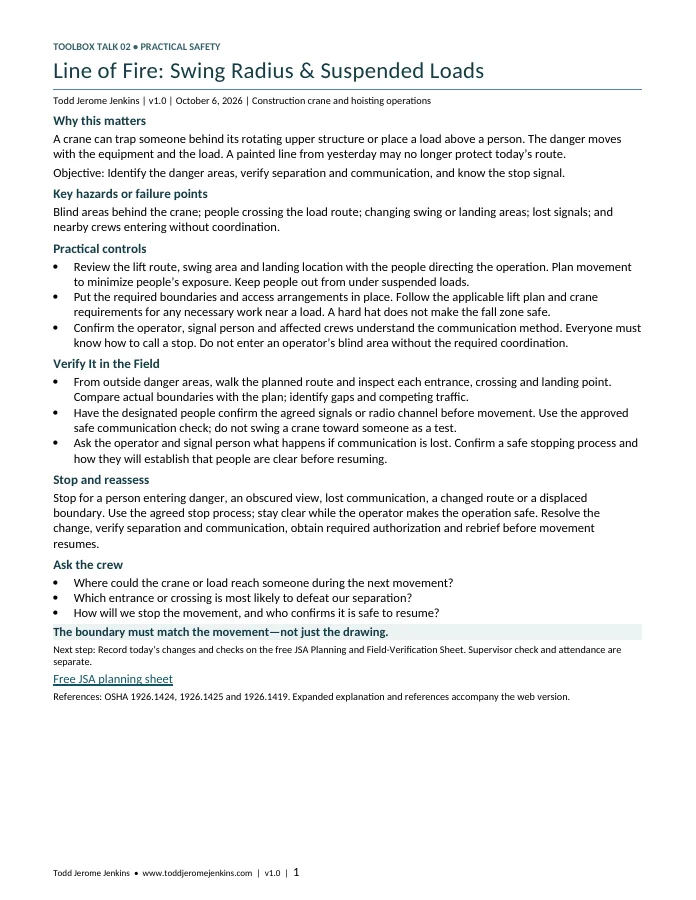
One-page crew talk, with separate supervisor and attendance sheets. Plan a 5–10 minute discussion and allow the time needed for field verification. All downloads are free; no account is required.
Learning objective
Identify the danger areas, verify separation and communication, and know the stop signal.
Start with today’s work
Illustrative scenario: A delivery blocks the planned landing area. The crew suggests landing on the other side of the crane, beside a pedestrian gate. Pause before redirecting the load: the swing boundary, load route, access control and communication may all need revision. The missing landing space is a planning problem to resolve, not a reason to ask pedestrians to be more careful.
Key hazards or failure points
Blind areas behind the crane; people crossing the load route; changing swing or landing areas; lost signals; and nearby crews entering without coordination.
Practical controls
- Review the lift route, swing area and landing location with the people directing the operation. Plan movement to minimize people’s exposure. Keep people out from under suspended loads.
- Put the required boundaries and access arrangements in place. Follow the applicable lift plan and crane requirements for any necessary work near a load. A hard hat does not make the fall zone safe.
- Confirm the operator, signal person and affected crews understand the communication method. Everyone must know how to call a stop. Do not enter an operator’s blind area without the required coordination.
Verify It in the Field
- From outside danger areas, walk the planned route and inspect each entrance, crossing and landing point. Compare actual boundaries with the plan; identify gaps and competing traffic.
- Have the designated people confirm the agreed signals or radio channel before movement. Use the approved safe communication check; do not swing a crane toward someone as a test.
- Ask the operator and signal person what happens if communication is lost. Confirm a safe stopping process and how they will establish that people are clear before resuming.
For each required control, identify the acceptance source and safe check method, assign a person with the required competence and authority, and record the actual result and time. Use VERIFIED, HOLD/NOT VERIFIED, or N/A with a reason. A checkmark alone does not demonstrate that protection works.
| Control | Safe verification | Criterion, evidence and response |
|---|---|---|
| Separation at a gate | Compare the actual gate and crossing with the approved lift/site plan from a safe position; check the specified access arrangement is present. | Lift/site plan; 1926.1424–1425. Record the gate, arrangement, checker and time. Hold movement if the crossing remains uncontrolled. |
| Signals through a blind area | Operator and signal person check the agreed method in the actual location without exposing anyone to movement. | 1926.1419 and the signaling procedure. Record the result; lost or unreliable signals mean a safe stop. |
| Changed landing point | Review the new landing area, supporting arrangements and nearby people before redirecting the load. | Applicable lift plan and technical approval. Record the revised route and approval; do not improvise clearance or capacity. |
These are examples, not a complete task inspection. Check all required controls. Do not enter danger, defeat a safeguard or improvise a test. If the criterion, method or result is uncertain, hold affected work and get the appropriate technical help. No actual equipment model, product SDS or site permit was supplied for these examples; use the documents for your task.
Leader preparation and explanation
Separate two different danger areas
The crane’s rotating upper structure can create a struck-by or crushing hazard even when the hook is empty. A suspended load creates another danger area along its travel and landing path. Identify both in the briefing; a boundary around the crane alone may leave the load route exposed.
Manage necessary access explicitly
OSHA 1926.1425 limits who may be in the fall zone and under what conditions. It does not make every task near a load identical. Use the applicable lift procedure and restrictions for guiding, receiving or connecting a load. This talk does not authorize entry. Coordinate blind-area access under 1926.1424 before rotation.
Check communication without creating exposure
For covered crane operations, 1926.1419 addresses when signals are needed and what happens when they are interrupted. Agree on signals, confirm the means works in the actual conditions, and stop safely if communication fails. A briefing in a quiet trailer does not establish that a radio will be intelligible at the work location.
Stop and reassess
Stop for a person entering danger, an obscured view, lost communication, a changed route or a displaced boundary. Use the agreed stop process; stay clear while the operator makes the operation safe. Resolve the change, verify separation and communication, obtain required authorization and rebrief before movement resumes.
When conditions change, return to Pre-Job JHA/JSA: What Changed Today? and revise the affected task plan with the crew.
Three crew discussion questions
- Where could the crane or load reach someone during the next movement?
- Which entrance or crossing is most likely to defeat our separation?
- How will we stop the movement, and who confirms it is safe to resume?
Short supervisor field check
- Actual swing, load route and landing areas match the current lift plan.
- Entrances, crossings and adjacent work have the specified separation and access control.
- Operator and signal person confirmed the communication method and loss-of-signal response.
- Any necessary fall-zone access meets the applicable plan and regulatory restrictions.
- Crew can identify the stop signal, safe position and restart authority.
Use the separate supervisor sheet to record the task and change, JHA/JSA revision, acceptance source, safe method, verifier, actual result, unresolved items, corrective action, recheck and required restart authorization. Link specialist inspection records rather than copying private or unnecessary details.
Attendance and follow-through
Use the separate attendance sheet for participant names, roles and acknowledgment, meeting details, concerns, actions and rebriefs. Attendance is not proof of competence, functioning controls or permission to work. Keep completed records under the employer’s privacy and recordkeeping procedures; never post completed sign-in sheets publicly.
Related JHA/JSA resource and existing video
How to Conduct a Job Safety Analysis connects the task steps, hazards and controls. For related background, see What Is the Hierarchy of Controls?.
Related crew discussions
One next step
Use the free JSA Planning and Field-Verification Sheet to record today’s changes and checks with the crew.
Sources and references
Sources reviewed October 6, 2026. Apply each regulation’s industry and activity scope, and current state or local requirements where applicable. Guidance is identified separately. This discussion resource supports preparation; it does not replace task procedures, required training, permits or specialist decisions.
- OSHA 29 CFR 1926.1424 — Swing/crush area boundaries, blind-area coordination and overlapping work areas.
- OSHA 29 CFR 1926.1425 — Load routes and restrictions on exposure within the fall zone.
- OSHA 29 CFR 1926.1419 — Signal methods, interruptions and stop signals.