Download the free crew talk
The one-page talk, editable Word version, and guidance below are open to everyone. No account required.
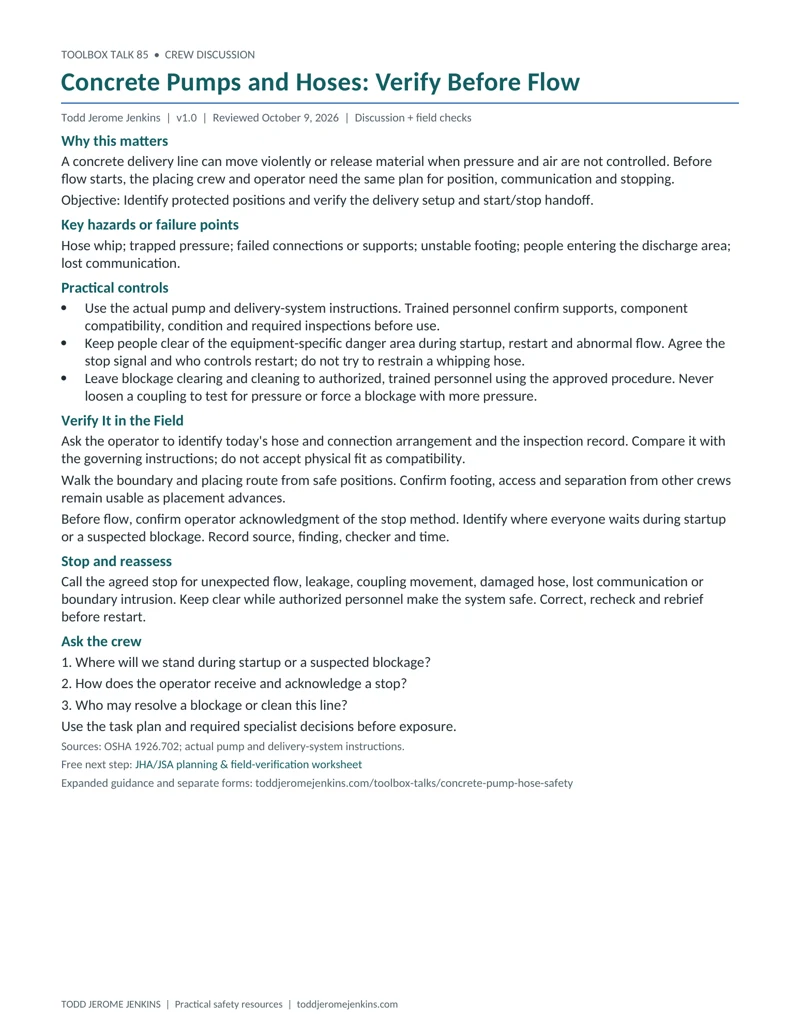
Preview the one-page crew talk
Supporting documents
Included with free Safety & Systems membership.
Supervisor field check
A separate check to verify conditions and controls before work. Includes a one-page PDF and editable Word file.
Attendance sheet
A separate sign-in sheet to record the crew discussion. Includes a one-page PDF and editable Word file.
Need the crew records? Join free to use these supporting documents and the Safety & Systems Academy. No payment details. Email updates are optional.
Get supporting documents — free membershipAlready a member? Use the same link to sign in.
A 5–10 minute crew discussion, plus time to verify the actual controls. The crew talk and Word version are public. Separate supervisor and attendance records are included with free Safety & Systems membership.
Why this matters
A concrete delivery line can move violently or release material when pressure and air are not controlled. Before flow starts, the placing crew and operator need the same plan for position, communication and stopping.
Learning objective
Identify protected positions and verify the delivery setup and start/stop handoff.
Key hazards or failure points
Hose whip; trapped pressure; failed connections or supports; unstable footing; people entering the discharge area; lost communication.
Practical controls
- Use the actual pump and delivery-system instructions. Trained personnel confirm supports, component compatibility, condition and required inspections before use.
- Keep people clear of the equipment-specific danger area during startup, restart and abnormal flow. Agree the stop signal and who controls restart; do not try to restrain a whipping hose.
- Leave blockage clearing and cleaning to authorized, trained personnel using the approved procedure. Never loosen a coupling to test for pressure or force a blockage with more pressure.
Verify It in the Field
- Ask the operator to identify today's hose and connection arrangement and the inspection record. Compare it with the governing instructions; do not accept physical fit as compatibility.
- Walk the boundary and placing route from safe positions. Confirm footing, access and separation from other crews remain usable as placement advances.
- Before flow, confirm operator acknowledgment of the stop method. Identify where everyone waits during startup or a suspected blockage. Record source, finding, checker and time.
Stop and reassess
Call the agreed stop for unexpected flow, leakage, coupling movement, damaged hose, lost communication or boundary intrusion. Keep clear while authorized personnel make the system safe. Correct, recheck and rebrief before restart.
Crew discussion questions
- Where will we stand during startup or a suspected blockage?
- How does the operator receive and acknowledge a stop?
- Who may resolve a blockage or clean this line?
For each required control, record its acceptance source and criterion, safe verification method, responsible checker, actual result and time. Use VERIFIED, HOLD/NOT VERIFIED, or N/A with a reason. A tick alone is not evidence. Complete all applicable task inspections; do not enter danger or improvise a test to fill out a form.
Leader preparation and practical detail
Separate readiness from operation
Illustrative situation: the hose is extended to reach a new bay. The crew pauses while the operator verifies that the changed components, supports and placement route match the approved setup. Yesterday's inspection does not cover an unreviewed configuration.
Use the right provision
OSHA 1926.702(e) addresses discharge-pipe supports and compressed-air hose connectors. Its support requirement is a design duty, not permission to load-test installed piping. Do not describe the compressed-air connector clause as the exact rule for every concrete-delivery coupling. Other pump hazards require the applicable equipment instructions and construction provisions.
A stopped pump can retain energy
Emergency stopping does not prove that pressure or other hazardous energy is controlled. Under 1926.702(j), maintenance or repair with inadvertent-operation hazards requires lockout and tagging of potentially hazardous energy sources. The equipment procedure must establish the safe state before disassembly.
Keep cleaning out of the crew demonstration
The manufacturer reference describes severe ejection and hose-motion hazards during cleaning. This briefing deliberately provides no priming, reversing, compressed-air cleanout or dismantling sequence. Obtain current instructions for the actual equipment and the personnel qualified for that work. No universal pressure, hose length or exclusion distance is supplied.
Short supervisor field check
- Ask the operator to identify today's hose and connection arrangement and the inspection record. Compare it with the governing instructions; do not accept physical fit as compatibility.
- Walk the boundary and placing route from safe positions. Confirm footing, access and separation from other crews remain usable as placement advances.
- Before flow, confirm operator acknowledgment of the stop method. Identify where everyone waits during startup or a suspected blockage. Record source, finding, checker and time.
Confirm the relevant trained/authorized people, unresolved items, interim protection, correction owner and recheck. Record required release authority and rebrief anyone affected. The separate sheet supports these records; it does not replace a specialist inspection, permit or engineering determination.
Attendance and follow-through
Use the separate attendance sheet for participants, roles, discussion concerns, actions and late-arrival rebriefs. Attendance is not proof of competence, functioning controls or authorization to work. Keep completed records private under employer procedures.
Technical scope and references
Reviewed October 9, 2026 for construction crew preparation. Apply the actual task, jurisdiction and relevant standard provisions. Manufacturer sources below are reference examples, not approval of your equipment. No site-specific design, permit, exposure assessment, product SDS or current model manual was supplied; obtain the applicable documents before work. This discussion does not replace required training.
- OSHA 1926.702(e) and (j) — Construction equipment requirements; supports, compressed-air hose joints and maintenance isolation.
- OSHA pump-truck interpretation, May 2, 2013 — Historical interpretation: pump safety extends beyond Subpart Q; not new numerical criteria.
- Putzmeister Safety Manual, September 2020 Rev. 18 — Selected safety sections read as manufacturer reference only; not verified current instructions for your machine.
Connect this discussion to your JHA/JSA
Use the related worked JHA/JSA/AHA example to prepare task steps, hazards and controls. Return to What Changed Today? when the plan or conditions change.
Related Todd Jerome Jenkins article: How to Conduct a Job Safety Analysis.
Related crew discussions
Put one check into practice
Use the free JHA/JSA planning and field-verification worksheet to record today’s change, the required protection and the evidence needed before exposure.