Download the free crew talk
The one-page talk, editable Word version, and guidance below are open to everyone. No account required.
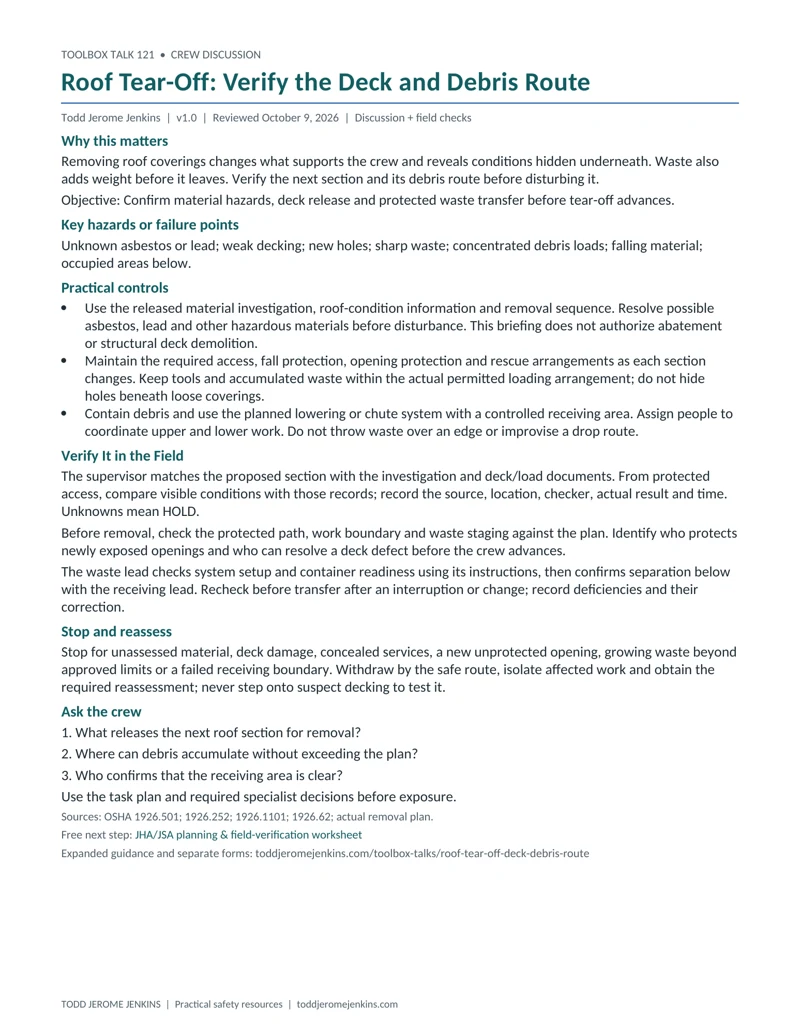
Preview the one-page crew talk
Supporting documents
Included with free Safety & Systems membership.
Supervisor field check
A separate check to verify conditions and controls before work. Includes a one-page PDF and editable Word file.
Attendance sheet
A separate sign-in sheet to record the crew discussion. Includes a one-page PDF and editable Word file.
Need the crew records? Join free to use these supporting documents and the Safety & Systems Academy. No payment details. Email updates are optional.
Get supporting documents — free membershipAlready a member? Use the same link to sign in.
A 5–10 minute crew discussion, plus time to verify the actual controls. The crew talk and Word version are public. Separate supervisor and attendance records are included with free Safety & Systems membership.
Why this matters
Removing roof coverings changes what supports the crew and reveals conditions hidden underneath. Waste also adds weight before it leaves. Verify the next section and its debris route before disturbing it.
Learning objective
Confirm material hazards, deck release and protected waste transfer before tear-off advances.
Key hazards or failure points
Unknown asbestos or lead; weak decking; new holes; sharp waste; concentrated debris loads; falling material; occupied areas below.
Practical controls
- Use the released material investigation, roof-condition information and removal sequence. Resolve possible asbestos, lead and other hazardous materials before disturbance. This briefing does not authorize abatement or structural deck demolition.
- Maintain the required access, fall protection, opening protection and rescue arrangements as each section changes. Keep tools and accumulated waste within the actual permitted loading arrangement; do not hide holes beneath loose coverings.
- Contain debris and use the planned lowering or chute system with a controlled receiving area. Assign people to coordinate upper and lower work. Do not throw waste over an edge or improvise a drop route.
Verify It in the Field
- The supervisor matches the proposed section with the investigation and deck/load documents. From protected access, compare visible conditions with those records; record the source, location, checker, actual result and time. Unknowns mean HOLD.
- Before removal, check the protected path, work boundary and waste staging against the plan. Identify who protects newly exposed openings and who can resolve a deck defect before the crew advances.
- The waste lead checks system setup and container readiness using its instructions, then confirms separation below with the receiving lead. Recheck before transfer after an interruption or change; record deficiencies and their correction.
Stop and reassess
Stop for unassessed material, deck damage, concealed services, a new unprotected opening, growing waste beyond approved limits or a failed receiving boundary. Withdraw by the safe route, isolate affected work and obtain the required reassessment; never step onto suspect decking to test it.
Crew discussion questions
- What releases the next roof section for removal?
- Where can debris accumulate without exceeding the plan?
- Who confirms that the receiving area is clear?
For each required control, record its acceptance source and criterion, safe verification method, responsible checker, actual result and time. Use VERIFIED, HOLD/NOT VERIFIED, or N/A with a reason. A tick alone is not evidence. Complete all applicable task inspections; do not enter danger or improvise a test to fill out a form.
Leader preparation and practical detail
Keep the scope explicit
The linked example covers released membrane and insulation removal from a low-slope roof. It excludes hazardous-material abatement, structural deck demolition and steep-slope shingle removal. Discovery of another material or deteriorated support changes the task. Use the appropriate assessment and authority before proceeding; a previous investigation must be checked against what removal actually reveals.
Separate identification from permission to disturb
The asbestos standard has material- and operation-specific provisions, including roofing conditions and exclusions. The lead standard requires exposure assessment where employees may be exposed. Neither a material’s appearance nor the age of a building is a universal clearance. Record the applicable investigation and employer control decision; this talk supplies no sampling method, exposure limit shortcut or abatement procedure.
Check the full waste route
Section 1926.252(a) requires an enclosed chute when material is dropped more than 20 feet to a point outside the building’s exterior walls. That condition is not permission for an uncontrolled shorter drop. Paragraph (b) separately addresses debris dropped through floor holes without chutes. Have the responsible person select the compliant route, equipment and protected receiving arrangement for the actual job. Keep people out of the transfer exposure and coordinate interruption, container changes and restart.
Verify the changing deck and load
Use the roof-material storage talk for detailed load receipt and location checks. During tear-off, include accumulating debris and the evolving deck condition in the approved loading arrangement. The supervisor records each hold location and maintains its boundary while the responsible technical person resolves it. Record acceptance source, safe check, actual finding, time and restart authority; rebrief the next crew on open sections, defects and temporary protection.
Short supervisor field check
- Material and deck records matched.
- Access and fall/opening protection checked.
- Waste loading controlled.
- Lowering route and receiving area verified.
- Changes and restart release recorded.
Confirm the relevant trained/authorized people, unresolved items, interim protection, correction owner and recheck. Record required release authority and rebrief anyone affected. The separate sheet supports these records; it does not replace a specialist inspection, permit or engineering determination.
Attendance and follow-through
Use the separate attendance sheet for participants, roles, discussion concerns, actions and late-arrival rebriefs. Attendance is not proof of competence, functioning controls or authorization to work. Keep completed records private under employer procedures.
Technical scope and references
Reviewed October 9, 2026 for construction crew preparation. Apply the actual task, jurisdiction and relevant standard provisions. Any manufacturer guidance is reference material, not approval of your equipment or installation. No site-specific design, permit, exposure assessment, product SDS or current model manual was supplied; obtain the applicable documents before work. This discussion does not replace required training.
- OSHA 1926.501(a)(2), (b), (c) — Structural integrity of working surfaces and applicable fall/falling-object protection.
- OSHA 1926.252 — Construction waste routes; exterior drops over 20 feet require enclosed chutes. Other clauses have their own scope.
- OSHA 1926.1101(a), (k)(2)–(4) — Construction asbestos scope and required identification/communication. Roof-product and task provisions have specific conditions and exclusions.
- OSHA 1926.62(d) — Lead exposure assessment provisions when construction work may expose employees to lead.
Connect this discussion to your JHA/JSA
Related reference: worked JHA/JSA/AHA example. This worked example covers released low-slope membrane and insulation removal. It does not cover structural deck demolition, hazardous-material abatement or steep-slope shingle removal; adapt the task plan to the actual roof and scope. Return to What Changed Today? when the plan or conditions change.
Related Todd Jerome Jenkins article: How to Conduct a Job Safety Analysis.
Related crew discussions
- Demolition Prestart Control Verification
- Asbestos Before Disturbing Material
- Roof Material Storage Loading
Put one check into practice
Use the free JHA/JSA planning and field-verification worksheet to record today’s change, the required protection and the evidence needed before exposure.