Download the talk and separate crew records
Free to download without an account. Each PDF is one page. Use the Word version to adapt the record to your task and approved procedures.
Supervisor field check
Download supervisor field check (PDF, 1 page)Editable supervisor field check (Word)Preview the one-page crew talk
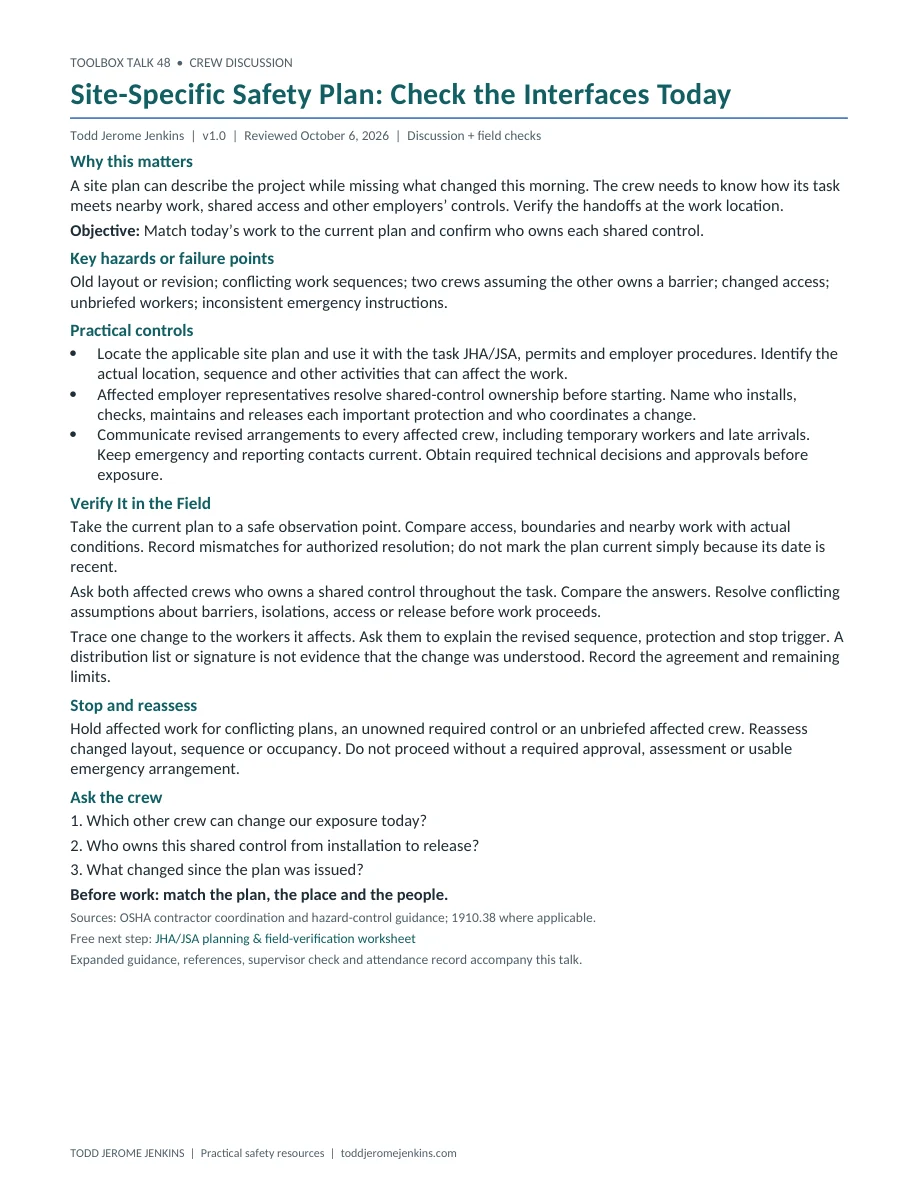
A 5–10 minute crew discussion, plus the time needed for field verification. All six downloads are free without a required signup.
Why this matters
A site plan can describe the project while missing what changed this morning. The crew needs to know how its task meets nearby work, shared access and other employers’ controls. Verify the handoffs at the work location.
Learning objective: Match today’s work to the current plan and confirm who owns each shared control.
Key hazards or failure points
Old layout or revision; conflicting work sequences; two crews assuming the other owns a barrier; changed access; unbriefed workers; inconsistent emergency instructions.
Practical controls
- Locate the applicable site plan and use it with the task JHA/JSA, permits and employer procedures. Identify the actual location, sequence and other activities that can affect the work.
- Affected employer representatives resolve shared-control ownership before starting. Name who installs, checks, maintains and releases each important protection and who coordinates a change.
- Communicate revised arrangements to every affected crew, including temporary workers and late arrivals. Keep emergency and reporting contacts current. Obtain required technical decisions and approvals before exposure.
Verify It in the Field
Take the current plan to a safe observation point. Compare access, boundaries and nearby work with actual conditions. Record mismatches for authorized resolution; do not mark the plan current simply because its date is recent.
Ask both affected crews who owns a shared control throughout the task. Compare the answers. Resolve conflicting assumptions about barriers, isolations, access or release before work proceeds.
Trace one change to the workers it affects. Ask them to explain the revised sequence, protection and stop trigger. A distribution list or signature is not evidence that the change was understood. Record the agreement and remaining limits.
Use the separate field check to record the source and criterion, safe method, checker, actual result and time. Mark VERIFIED, HOLD/NOT VERIFIED, or N/A with a reason. Check every required control; the examples below do not clear the whole task.
| Control | Safe verification | Evidence to record |
|---|---|---|
| Current field arrangement | Compare plan and actual layout from a safe location. | Revision, mismatch and authorized resolution. |
| Shared ownership | Ask affected crews who installs, checks, maintains and releases protection. | Agreed roles and escalation contact. |
| Understood change | Ask affected workers to explain revised sequence and restrictions. | Workers briefed, gaps resolved and time. |
Stop and reassess
Hold affected work for conflicting plans, an unowned required control or an unbriefed affected crew. Reassess changed layout, sequence or occupancy. Do not proceed without a required approval, assessment or usable emergency arrangement.
Crew discussion questions
- Which other crew can change our exposure today?
- Who owns this shared control from installation to release?
- What changed since the plan was issued?
Before work: match the plan, the place and the people.
A situation to discuss
Illustrative situation: a temporary access route crosses another crew’s lifting area. Both crews initially believe the other will keep pedestrians out. Their representatives resolve the route, sequence and barrier ownership, then verify the arrangement before either activity begins.
Leader preparation and practical detail
Use the plan at the right level
A site plan organizes project-wide arrangements; the task JHA/JSA identifies the steps, exposures and controls for the specific job. Compare them when work changes. A site plan is not an automatic approval for every task, and a task briefing cannot silently override site-wide protection. [1], [2]
Name the whole control handoff
For a shared control, installation is only the first responsibility. Someone must maintain it, recognize changes, arrange correction and authorize release under the applicable system. Ask each affected employer to confirm the arrangement. OSHA’s recommended practices emphasize communication and coordination across host employers, contractors and staffing arrangements. [1]
Verify communication after a revision
Confirm that the people doing the work received the change and can explain what it means at their location. Include emergency instructions when access or response routes change. Keep the revision traceable, and resolve a field mismatch through the responsible plan owner rather than allowing an informal workaround to become the new plan. [1], [3]
Short supervisor field check
- Correct plan, JHA/JSA and permit versions available.
- Field layout matches or changes resolved.
- Shared-control responsibilities agreed.
- Emergency and reporting contacts current.
- Affected workers understand changes and limits.
Use the separate form to document evidence, restrictions, corrective-action owner, recheck and required restart approval. An unresolved required control means hold the affected work. Missing evidence is not a pass. Complete all task-specific inspections and permits.
Attendance and follow-through
The separate attendance sheet records participants, language support, questions, actions and late-arrival rebriefs. Attendance does not establish competence or prove controls function. Keep completed records private under the employer’s procedures.
Technical scope and references
This is a practical plan-application resource. It does not claim OSHA universally requires a document titled SSSP. Contract, employer and hazard-specific requirements determine required contents and approvals. OSHA coordination guidance is a recommended practice; 1910.38 has its own applicability. [1], [2], [3]
References checked October 6, 2026. Apply the jurisdiction, task, employer program and equipment instructions that govern the work. No site-specific manual, permit, engineering determination or product SDS has been approved by this general resource.
- OSHA Recommended Practices — Communication and Coordination — Recommended practices for multiemployer/staffing arrangements, not a claim every job requires a document titled SSSP.
- OSHA Recommended Practices — Hazard Prevention and Control — Recommended practices, not a standalone technical acceptance standard. Site-specific criteria must come from applicable authoritative sources.
- OSHA 29 CFR 1910.38 — Emergency action plans — General industry; not a universal claim that this section independently requires a written plan in every workplace.
Connect this discussion to your JHA/JSA
Use How to Conduct a Job Safety Analysis to connect today’s work steps, hazards and controls. Revisit Pre-Job JHA/JSA: What Changed Today? whenever conditions change.
Related Todd Jerome Jenkins video: Is a Job Safety Analysis Required by OSHA? | JSA Explained.
Related published crew resources: Emergency Evacuation: Know the Route and Count the Crew; New to the Job: Show the Work Before You Start; Competent Person: Know Who Can Correct the Hazard; Barricades: What Does This Boundary Keep Out?.
Put one check into practice
Download the free JHA/JSA planning and field-verification worksheet. For today’s task, record an important control, its source and the evidence needed before exposure. Complete the remaining required checks through your task plan.