Download the talk and separate crew records
Free to download without an account. Each PDF is one page. Use the Word version to adapt the record to your task and approved procedures.
Supervisor field check
Download supervisor field check (PDF, 1 page)Editable supervisor field check (Word)Preview the one-page crew talk
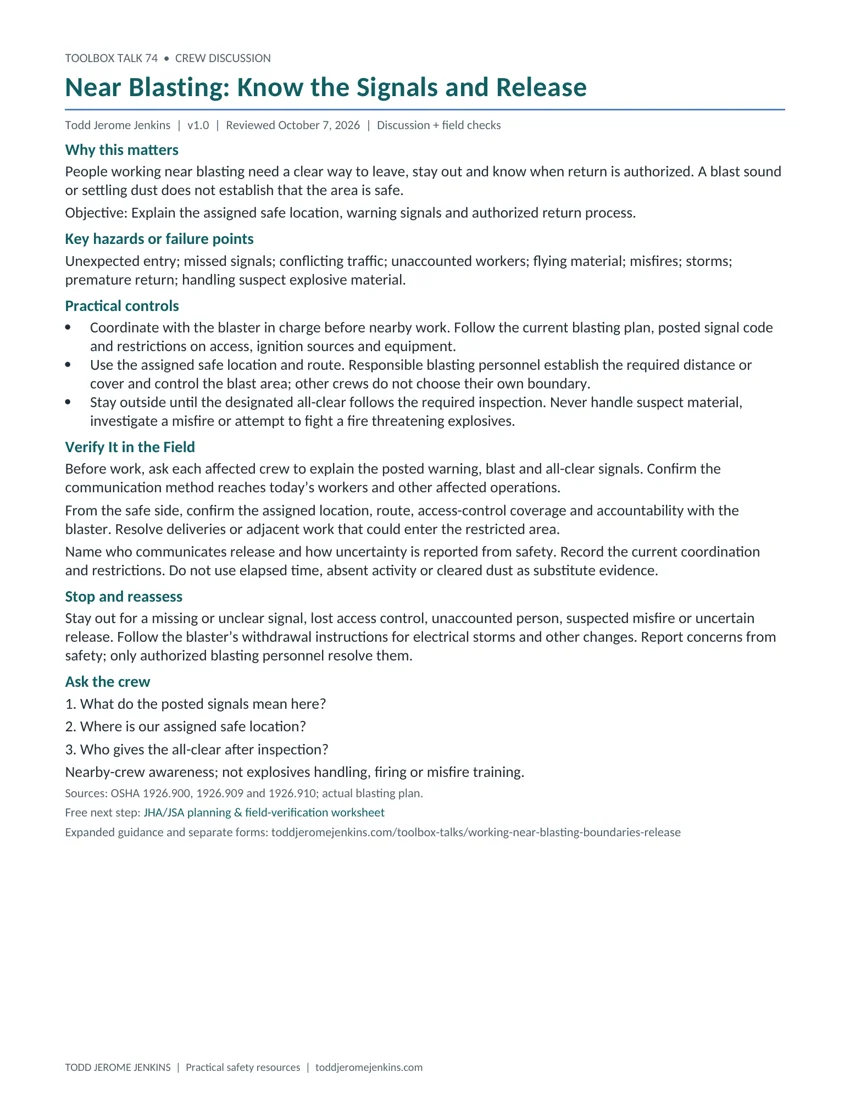
A 5–10 minute crew discussion, plus the time needed for field verification. All six downloads are free without a required signup.
Why this matters
People working near blasting need a clear way to leave, stay out and know when return is authorized. A blast sound or settling dust does not establish that the area is safe.
Learning objective: Explain the assigned safe location, warning signals and authorized return process.
Key hazards or failure points
Unexpected entry; missed signals; conflicting traffic; unaccounted workers; flying material; misfires; storms; premature return; handling suspect explosive material.
Practical controls
- Coordinate with the blaster in charge before nearby work. Follow the current blasting plan, posted signal code and restrictions on access, ignition sources and equipment.
- Use the assigned safe location and route. Responsible blasting personnel establish the required distance or cover and control the blast area; other crews do not choose their own boundary.
- Stay outside until the designated all-clear follows the required inspection. Never handle suspect material, investigate a misfire or attempt to fight a fire threatening explosives.
Verify It in the Field
Before work, ask each affected crew to explain the posted warning, blast and all-clear signals. Confirm the communication method reaches today’s workers and other affected operations.
From the safe side, confirm the assigned location, route, access-control coverage and accountability with the blaster. Resolve deliveries or adjacent work that could enter the restricted area.
Name who communicates release and how uncertainty is reported from safety. Record the current coordination and restrictions. Do not use elapsed time, absent activity or cleared dust as substitute evidence.
Use the separate field check to record the acceptance source and criterion, safe method, checker, actual result and time. Mark VERIFIED, HOLD/NOT VERIFIED, or N/A with a reason. A checkmark alone is not evidence that protection works. Complete all required task checks; do not enter danger or improvise a test.
| Control | Safe verification | Evidence |
|---|---|---|
| Understood signals | Ask affected workers to explain posted code and assigned actions. | Code/location, communication coverage and resolved gaps. |
| Controlled access | Confirm routes and coverage from outside the blast area. | Assigned safe location, access controllers and accountability. |
| Authorized return | Receive designated all-clear after required inspection. | Release source, time and continuing restrictions. |
Stop and reassess
Stay out for a missing or unclear signal, lost access control, unaccounted person, suspected misfire or uncertain release. Follow the blaster’s withdrawal instructions for electrical storms and other changes. Report concerns from safety; only authorized blasting personnel resolve them.
Crew discussion questions
- What do the posted signals mean here?
- Where is our assigned safe location?
- Who gives the all-clear after inspection?
A situation to discuss
Illustrative situation: a delivery arrives after the nearby crew has withdrawn. The driver cannot identify the posted signals or permitted route. Access remains held while the blaster’s coordination process resolves the delivery; the driver does not follow another vehicle into the area.
Leader preparation and practical detail
Keep the briefing within the crew’s role
Construction blasting provisions restrict explosives work to appropriately qualified and authorized people. This resource addresses communication and separation for nearby crews. It deliberately provides no charge design, loading, firing, transport, storage or misfire procedure. The blaster controls the technical operation and required protective arrangement. [1]
Confirm the actual signal code
Under 1926.909, the signal code must be posted and employees must understand it. The crew should explain the site’s current signals and assigned actions before nearby work begins. If ordinary noise, location or a communication failure prevents reliable understanding, resolve the arrangement with the blaster before relying on it. Do not invent an alternative signal pattern. [2]
Return follows inspection
The all-clear follows required post-blast inspection under 1926.909 and 1926.910. Dust settling, hearing the blast or waiting a familiar interval is insufficient. If a worker finds suspect material after release, keep clear and notify the blaster rather than pick it up, move it or resume the affected task. [2, 3]
Short supervisor field check
- Blaster and communication method identified.
- Affected crews understand the posted signals.
- Safe locations, routes and accountability confirmed.
- Road, pedestrian and adjacent-work access coordinated.
- Inspection-based release and uncertainty response understood.
Record unresolved items, restrictions, correction owner, recheck result and required restart authorization. Reference permits and specialist inspections rather than treating this form as a replacement. Rebrief workers affected by a change.
Attendance and follow-through
Use the separate attendance sheet for participants, discussion concerns, actions and late-arrival rebriefs. Attendance does not establish competence, verify controls or authorize work. Keep completed records private under the employer’s recordkeeping procedures.
Technical scope and references
Construction crews working near authorized blasting under Subpart U. This talk does not qualify a blaster or establish distances, cover design, radio restrictions or a misfire response method. Use the applicable blasting plan, rules and responsible blasting personnel. [1–3]
References reviewed October 7, 2026. Apply the industry, activity and jurisdiction that govern the work. No actual site permit, equipment manual, exposure assessment or engineering determination was supplied for this general discussion.
- OSHA 1926.900 — General blasting provisions — Authorized roles, access restrictions and storm/fire precautions.
- OSHA 1926.909 — Firing the blast — Posted signals, protected locations and inspection-based all-clear.
- OSHA 1926.910 — Inspection after blasting — Required blaster inspection before people return.
Connect this discussion to your JHA/JSA
Use How to Conduct a Job Safety Analysis to connect task steps, hazards and controls. Revisit Pre-Job JHA/JSA: What Changed Today? when conditions change.
Related crew discussions
- Line of Fire: Swing Radius & Suspended Loads
- Work Zones: Verify the Traffic Setup
- Severe Weather: Know When and Where to Shelter
- Barricades: What Does This Boundary Keep Out?
- Site-Specific Safety Plan: Check the Interfaces Today
Put one check into practice
Use the free JHA/JSA planning and field-verification worksheet to record today’s changes, important controls and the evidence needed before exposure.