Download the talk and separate crew records
Free to download without an account. Each PDF is one page. Use the Word version to adapt the record to your task and approved procedures.
Supervisor field check
Download supervisor field check (PDF, 1 page)Editable supervisor field check (Word)Preview the one-page crew talk
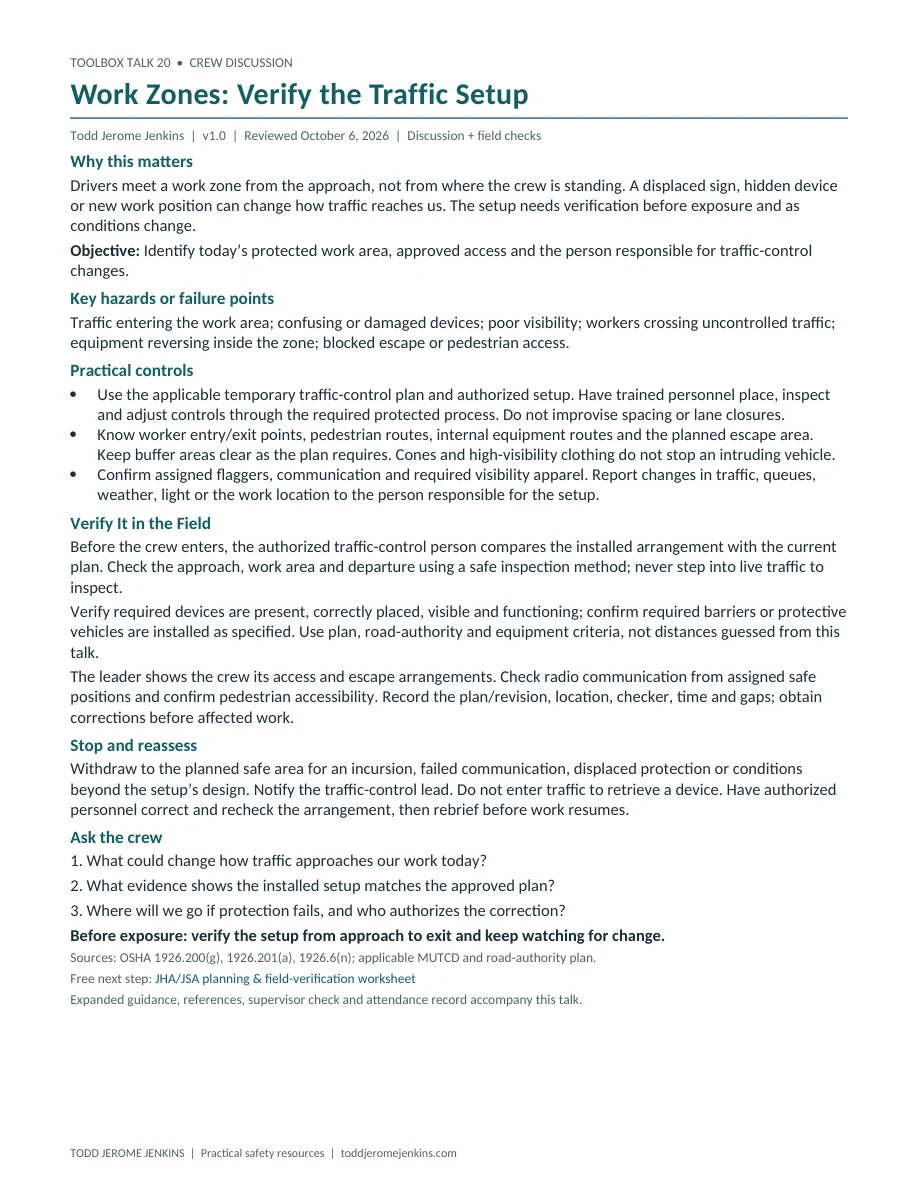
A 5–10 minute crew discussion, plus the time needed for field verification. All six downloads are free without a required signup.
Why this matters
Drivers meet a work zone from the approach, not from where the crew is standing. A displaced sign, hidden device or new work position can change how traffic reaches us. The setup needs verification before exposure and as conditions change.
Learning objective: Identify today’s protected work area, approved access and the person responsible for traffic-control changes.
Key hazards or failure points
Traffic entering the work area; confusing or damaged devices; poor visibility; workers crossing uncontrolled traffic; equipment reversing inside the zone; blocked escape or pedestrian access.
Practical controls
- Use the applicable temporary traffic-control plan and authorized setup. Have trained personnel place, inspect and adjust controls through the required protected process. Do not improvise spacing or lane closures.
- Know worker entry/exit points, pedestrian routes, internal equipment routes and the planned escape area. Keep buffer areas clear as the plan requires. Cones and high-visibility clothing do not stop an intruding vehicle.
- Confirm assigned flaggers, communication and required visibility apparel. Report changes in traffic, queues, weather, light or the work location to the person responsible for the setup.
Verify It in the Field
Before the crew enters, the authorized traffic-control person compares the installed arrangement with the current plan. Check the approach, work area and departure using a safe inspection method; never step into live traffic to inspect.
Verify required devices are present, correctly placed, visible and functioning; confirm required barriers or protective vehicles are installed as specified. Use plan, road-authority and equipment criteria, not distances guessed from this talk.
The leader shows the crew its access and escape arrangements. Check radio communication from assigned safe positions and confirm pedestrian accessibility. Record the plan/revision, location, checker, time and gaps; obtain corrections before affected work.
Use the separate field check to record the source and criterion, safe method, checker, actual result and time. Mark VERIFIED, HOLD/NOT VERIFIED, or N/A with a reason. Check every required control; the examples below do not clear the whole task.
| Control | Safe verification | Evidence to record |
|---|---|---|
| Installed arrangement | Authorized person compares devices and protection with the applicable plan using a safe inspection method. | Plan/revision, location, condition and placement results recorded. |
| Crew access | Leader checks assigned entries, crossings, escape area and internal equipment routes. | Workers can show routes without entering uncontrolled traffic. |
| Communication | Check from assigned protected positions before operations. | Flagger/leader communication and failure response confirmed; gaps corrected. |
Stop and reassess
Withdraw to the planned safe area for an incursion, failed communication, displaced protection or conditions beyond the setup’s design. Notify the traffic-control lead. Do not enter traffic to retrieve a device. Have authorized personnel correct and recheck the arrangement, then rebrief before work resumes.
Crew discussion questions
- What could change how traffic approaches our work today?
- What evidence shows the installed setup matches the approved plan?
- Where will we go if protection fails, and who authorizes the correction?
Before exposure: verify the setup from approach to exit and keep watching for change.
A situation to discuss
Illustrative situation: the crew advances its work while the original signs remain in place. The installed arrangement may no longer match the work location. The traffic-control lead evaluates and adjusts the plan through the authorized process before workers occupy the new position.
Leader preparation and practical detail
Inspect the whole traffic arrangement
The crew’s immediate area is only part of the system. The responsible person needs to consider the approach, transitions, activity area and departure, along with affected pedestrians and access points. Check under the lighting and traffic conditions actually encountered, using a protected inspection method. [5], [6]
Assign design and change decisions
Workers should report a confusing approach or failed device promptly. Trained and authorized personnel make the necessary traffic-control changes; a worker should not move a cone into live traffic to solve the problem informally. Record which plan and revision the checker used and what changed after the inspection.
Separate public traffic from internal movements
Even a correctly installed road closure can leave workers exposed to construction equipment inside the zone. Discuss deliveries, backing, crossings and pedestrian access as a second part of the task plan. Refer to the mobile-equipment talk for those controls. Clothing improves visibility; it does not replace physical protection specified by the plan.
Short supervisor field check
- Applicable road-authority requirements and current task plan/revision identified.
- Authorized traffic-control person verified installation and required protection.
- Crew access, escape, pedestrian accessibility and internal routes checked.
- Flagger assignments, communication and visibility apparel confirmed.
- Changing-condition checks, incursion response and restart authority agreed.
Use the separate form to document evidence, restrictions, corrective-action owner, recheck and required restart approval. An unresolved required control means hold the affected work. Missing evidence is not a pass. Complete all task-specific inspections and permits.
Attendance and follow-through
The separate attendance sheet records participants, language support, questions, actions and late-arrival rebriefs. Attendance does not establish competence or prove controls function. Keep completed records private under the employer’s procedures.
Technical scope and references
OSHA 1926.200(g) and 1926.201(a) reference MUTCD Part 6. OSHA 1926.6(n) identifies the 2009 edition with 2012 Revisions 1 and 2. FHWA identifies its current publication as the 11th Edition with Revision 1, December 2025. These are different references. The road authority must establish the applicable adopted edition, supplements and project requirements. This resource gives no taper, buffer, barrier-deflection or sign-spacing dimensions. [1], [2], [3], [4], [5], [6]
References checked October 6, 2026. Apply the jurisdiction, task, employer program and equipment instructions that govern the work. No site-specific manual, permit, engineering determination or product SDS has been approved by this general resource.
- OSHA 29 CFR 1926.200 — Accident prevention signs and tags — Construction traffic-control signs/devices.
- OSHA 29 CFR 1926.201 — Signaling — Construction flagging; incorporated Part 6.
- OSHA 29 CFR 1926.6 — Incorporation by reference — Identifies the edition incorporated into federal OSHA traffic provisions.
- FHWA — MUTCD Current Edition: 11th Edition with Revision 1 — Current FHWA publication identified as December 2025; adoption and project requirements must be checked.
- FHWA — 2009 MUTCD, Chapter 6B: Fundamental Principles — Historical edition relevant to OSHA incorporation; apply applicable adopted requirements.
- FHWA — 2009 MUTCD, Chapter 6D: Pedestrian and Worker Safety — Historical edition relevant to OSHA incorporation; no dimensions copied.
Connect this discussion to your JHA/JSA
Use How to Conduct a Job Safety Analysis to connect today’s work steps, hazards and controls. Revisit Pre-Job JHA/JSA: What Changed Today? whenever conditions change.
Related Todd Jerome Jenkins video: What Is the Hierarchy of Controls?.
Put one check into practice
Download the free JHA/JSA planning and field-verification worksheet. For today’s task, record an important control, its source and the evidence needed before exposure. Complete the remaining required checks through your task plan.