Download the talk and separate crew records
Free to download without an account. Each PDF is one page. Use the Word version to adapt the record to your task and approved procedures.
Supervisor field check
Download supervisor field check (PDF, 1 page)Editable supervisor field check (Word)Preview the one-page crew talk
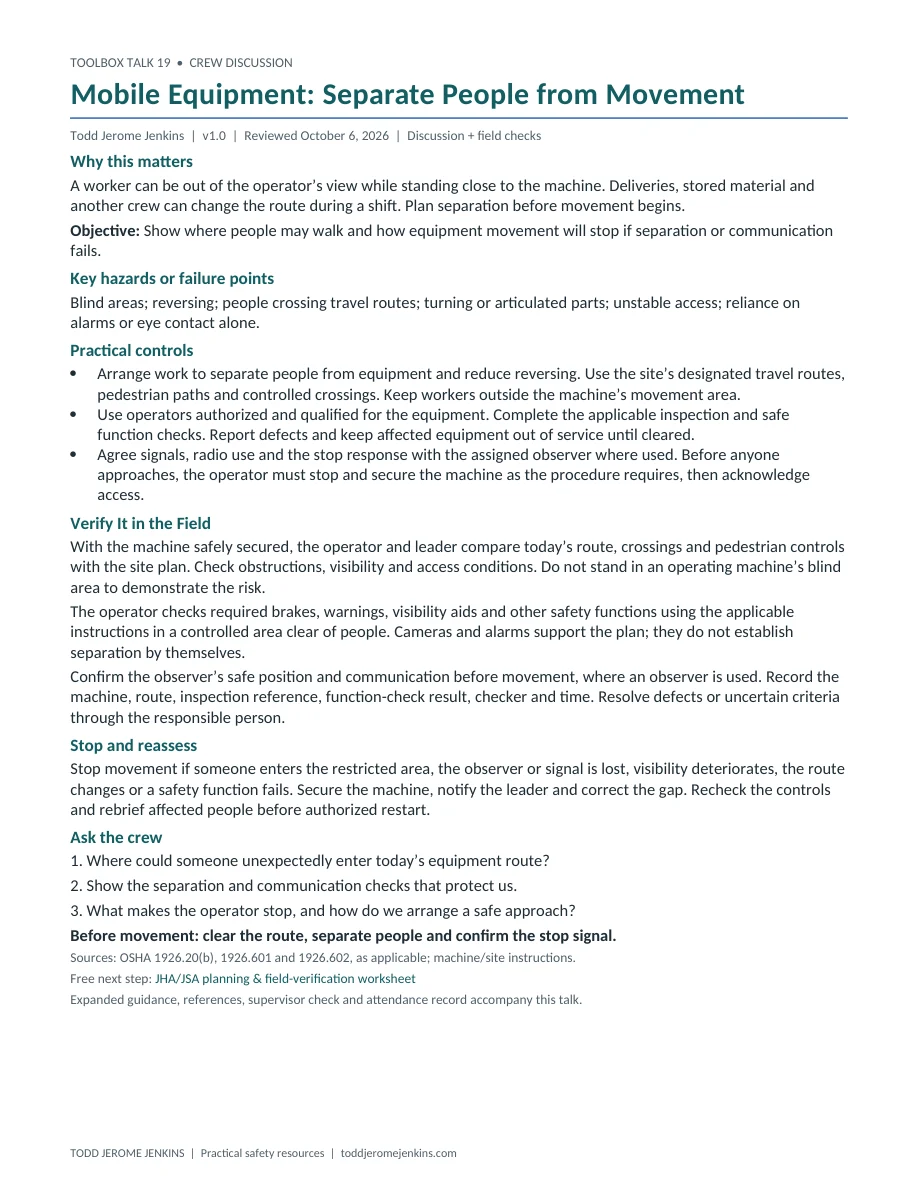
A 5–10 minute crew discussion, plus the time needed for field verification. All six downloads are free without a required signup.
Why this matters
A worker can be out of the operator’s view while standing close to the machine. Deliveries, stored material and another crew can change the route during a shift. Plan separation before movement begins.
Learning objective: Show where people may walk and how equipment movement will stop if separation or communication fails.
Key hazards or failure points
Blind areas; reversing; people crossing travel routes; turning or articulated parts; unstable access; reliance on alarms or eye contact alone.
Practical controls
- Arrange work to separate people from equipment and reduce reversing. Use the site’s designated travel routes, pedestrian paths and controlled crossings. Keep workers outside the machine’s movement area.
- Use operators authorized and qualified for the equipment. Complete the applicable inspection and safe function checks. Report defects and keep affected equipment out of service until cleared.
- Agree signals, radio use and the stop response with the assigned observer where used. Before anyone approaches, the operator must stop and secure the machine as the procedure requires, then acknowledge access.
Verify It in the Field
With the machine safely secured, the operator and leader compare today’s route, crossings and pedestrian controls with the site plan. Check obstructions, visibility and access conditions. Do not stand in an operating machine’s blind area to demonstrate the risk.
The operator checks required brakes, warnings, visibility aids and other safety functions using the applicable instructions in a controlled area clear of people. Cameras and alarms support the plan; they do not establish separation by themselves.
Confirm the observer’s safe position and communication before movement, where an observer is used. Record the machine, route, inspection reference, function-check result, checker and time. Resolve defects or uncertain criteria through the responsible person.
Use the separate field check to record the source and criterion, safe method, checker, actual result and time. Mark VERIFIED, HOLD/NOT VERIFIED, or N/A with a reason. Check every required control; the examples below do not clear the whole task.
| Control | Safe verification | Evidence to record |
|---|---|---|
| Separation | Compare pedestrian routes and controlled crossings with today’s layout. | Routes usable; conflicts resolved before equipment movement. |
| Machine readiness | Authorized operator follows the applicable inspection and function-check instructions. | Machine ID, source and actual results documented; defects withheld from service. |
| Communication | Confirm assigned observer position and signals with equipment secured. | Operator and observer agree to stop on lost communication; approach method understood. |
Stop and reassess
Stop movement if someone enters the restricted area, the observer or signal is lost, visibility deteriorates, the route changes or a safety function fails. Secure the machine, notify the leader and correct the gap. Recheck the controls and rebrief affected people before authorized restart.
Crew discussion questions
- Where could someone unexpectedly enter today’s equipment route?
- Show the separation and communication checks that protect us.
- What makes the operator stop, and how do we arrange a safe approach?
Before movement: clear the route, separate people and confirm the stop signal.
A situation to discuss
Illustrative situation: a delivery blocks the established walkway. Workers begin looking for another way around the load, near a loader route. The leader holds movement and restores or formally revises the pedestrian arrangement before the route is used again.
Leader preparation and practical detail
Check how people actually reach the job
Start at the access point, break area and material pickup locations. A barrier can be present but ineffective if it forces people into a shortcut. Ask the crew which crossing is difficult to use. Resolve the route with the responsible site person instead of relying on everyone noticing a moving machine.
Match requirements to the equipment
OSHA 1926.601 covers specified off-highway jobsite vehicles and excludes equipment covered by 1926.602. Both contain relevant backing provisions, but their scope and other requirements differ. Construction operators must be qualified by training or experience under 1926.20(b)(4); some equipment has additional operator requirements. Do not treat this talk as an operator qualification. [1], [2], [3]
Verify warnings without putting a person at risk
Agree how the prescribed check will be carried out and keep people clear of movement. A functioning camera is evidence about the camera, not proof that the entire area is clear. Never use a coworker as a test obstacle. Defects go through the site’s isolation and repair process; this talk does not instruct workers to repair hydraulic or electrical systems.
Short supervisor field check
- Equipment and pedestrian routes match today’s plan and conditions.
- Crossings, separation and access arrangements work in the field.
- Authorized/qualified operator and required inspection confirmed.
- Safety functions checked by the prescribed safe method; defects resolved.
- Observer arrangements, stop signals and approach/restart rules understood.
Use the separate form to document evidence, restrictions, corrective-action owner, recheck and required restart approval. An unresolved required control means hold the affected work. Missing evidence is not a pass. Complete all task-specific inspections and permits.
Attendance and follow-through
The separate attendance sheet records participants, language support, questions, actions and late-arrival rebriefs. Attendance does not establish competence or prove controls function. Keep completed records private under the employer’s procedures.
Technical scope and references
Focus: construction equipment movement and workers on foot. This does not supply universal exclusion distances, brake-test limits or reversing rules for every machine. Use the applicable regulation, manufacturer instructions and site plan. Crane lifting and fall-zone access have distinct requirements; use the separate line-of-fire and rigging resources for those tasks. [1], [2], [3]
References checked October 6, 2026. Apply the jurisdiction, task, employer program and equipment instructions that govern the work. No site-specific manual, permit, engineering determination or product SDS has been approved by this general resource.
- OSHA 29 CFR 1926.20 — General safety and health provisions — Construction; inspections, unsafe equipment and operator capability.
- OSHA 29 CFR 1926.601 — Motor vehicles — Specified vehicles at off-highway jobsites; excludes 1926.602 equipment.
- OSHA 29 CFR 1926.602 — Material handling equipment — Construction equipment types have different provisions.
Connect this discussion to your JHA/JSA
Use How to Conduct a Job Safety Analysis to connect today’s work steps, hazards and controls. Revisit Pre-Job JHA/JSA: What Changed Today? whenever conditions change.
Related Todd Jerome Jenkins video: What Is the Hierarchy of Controls?.
Related published crew resources: Line of Fire: Swing Radius & Suspended Loads; Housekeeping Is a Control.
Put one check into practice
Download the free JHA/JSA planning and field-verification worksheet. For today’s task, record an important control, its source and the evidence needed before exposure. Complete the remaining required checks through your task plan.