Download the free toolbox talk
The one-page talk, editable Word version, and guidance below are open to everyone. No account required.
One-page toolbox talk
Download one-page toolbox talk (PDF, 1 page)Editable one-page toolbox talk (Word)Preview the one-page toolbox talk
Supporting documents
Included with free Safety & Systems membership.
Supervisor field check
A separate check to verify conditions and controls before work. Includes a one-page PDF and editable Word file.
Attendance sheet
A separate sign-in sheet to record the crew discussion. Includes a one-page PDF and editable Word file.
Need the crew records? Join free to use these supporting documents and the Safety & Systems Academy. No payment details. Email updates are optional.
Get supporting documents — free membershipAlready a member? Use the same link to sign in.
Hazard-based toolbox talk 41 of 52, with a practical HOP exercise.
Plan a 5–10 minute toolbox discussion, plus time to verify the actual controls. The one-page toolbox talk and editable Word version are public. Separate supervisor and attendance records are included with free Safety & Systems membership.
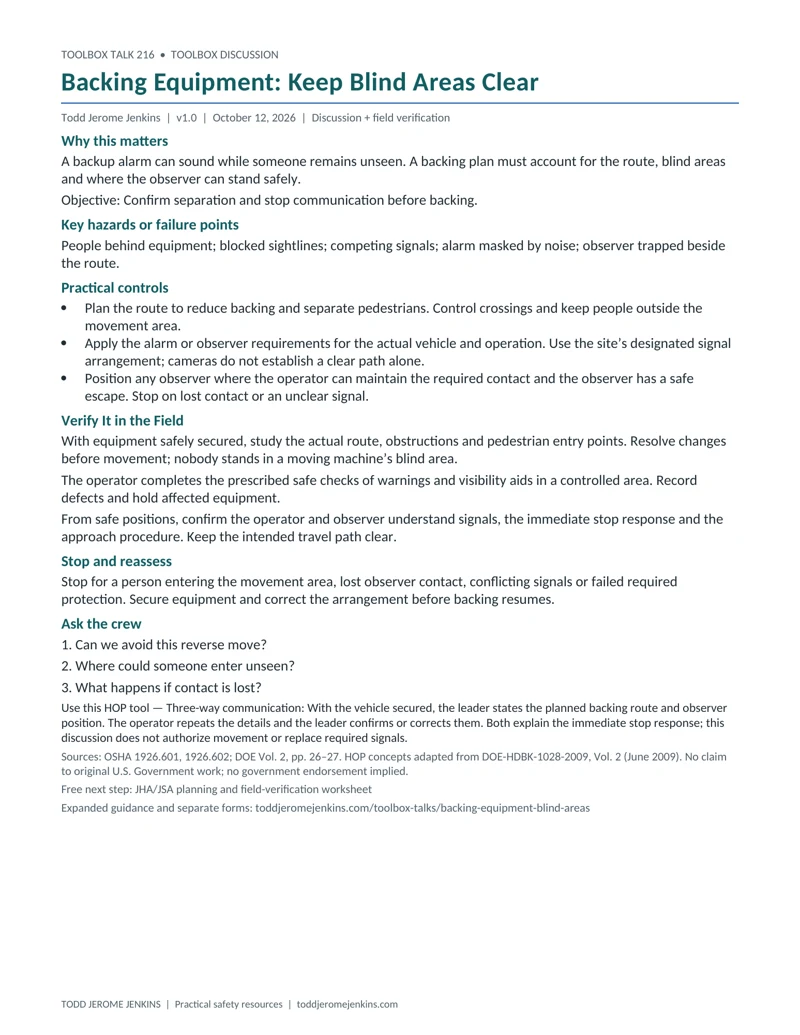
Why this matters
A backup alarm can sound while someone remains unseen. A backing plan must account for the route, blind areas and where the observer can stand safely.
Learning objective
Confirm separation and stop communication before backing.
Key hazards or failure points
People behind equipment; blocked sightlines; competing signals; alarm masked by noise; observer trapped beside the route.
Practical controls
- Plan the route to reduce backing and separate pedestrians. Control crossings and keep people outside the movement area.
- Apply the alarm or observer requirements for the actual vehicle and operation. Use the site’s designated signal arrangement; cameras do not establish a clear path alone.
- Position any observer where the operator can maintain the required contact and the observer has a safe escape. Stop on lost contact or an unclear signal.
Verify It in the Field
- With equipment safely secured, study the actual route, obstructions and pedestrian entry points. Resolve changes before movement; nobody stands in a moving machine’s blind area.
- The operator completes the prescribed safe checks of warnings and visibility aids in a controlled area. Record defects and hold affected equipment.
- From safe positions, confirm the operator and observer understand signals, the immediate stop response and the approach procedure. Keep the intended travel path clear.
Stop and reassess
Stop for a person entering the movement area, lost observer contact, conflicting signals or failed required protection. Secure equipment and correct the arrangement before backing resumes.
Crew discussion questions
- Can we avoid this reverse move?
- Where could someone enter unseen?
- What happens if contact is lost?
For each required control, record its acceptance source and criterion, safe verification method, responsible verifier, actual result and time. Mark VERIFIED, HOLD/NOT VERIFIED, or N/A with a reason. Complete all required inspections; never enter danger or improvise a test to fill out a form.
Use this HOP tool
Three-way communication
With the vehicle secured, the leader states the planned backing route and observer position. The operator repeats the details and the leader confirms or corrects them. Both explain the immediate stop response; this discussion does not authorize movement or replace required signals.
This exercise supports hazard identification or control verification. It does not replace safeguards, required training, specialist decisions or work authorization.
Leader preparation and practical detail
Make the route visible before movement
Illustrative situation: a delivery changes the normal pedestrian route so workers now cross behind a truck. A working alarm does not resolve the new interface. Hold backing while the responsible leader changes the routing or controls the crossing. Study the plan with the equipment secured; do not use a worker standing behind moving equipment as a visibility demonstration.
Apply the right backing rule
Construction 1926.601(b)(4) covers its defined off-highway motor vehicles with obstructed rear views; 1926.602(a)(9)(ii) addresses covered earthmoving or compacting equipment. Their alarm-or-signaler provisions are not a universal requirement to have both on every machine. Follow any additional applicable site or state requirement. OSHA’s backing-solutions page offers supplementary planning and technology guidance, not a substitute for the rule.
Keep the observer out of the hazard
The observer needs a planned position, escape route and reliable contact, not merely a high-visibility vest. Assign the signaling arrangement and stop when it breaks down. Three-way communication can clarify the planned route before movement; it must never delay an urgent stop or replace required movement signals. Verify camera and alarm functions under actual instructions, while recognizing that either can leave hazards unresolved.
Short supervisor field check
- Backing reduced where practicable
- Pedestrian separation established
- Required warning arrangement ready
- Observer position safe
- Stop response understood
Use the separate sheet to document evidence, unresolved restrictions, correction owner, recheck and required release authority. Rebrief affected workers. This record does not replace specialist inspections, permits or engineering determinations.
Attendance and follow-through
Use the separate attendance record for participants, roles, questions, actions and late-arrival rebriefs. Attendance does not prove competence, functioning controls or authorization. Keep completed records private under employer procedures.
Source acknowledgment
HOP concepts are adapted from DOE-HDBK-1028-2009, Human Performance Improvement Handbook, Volume 2 (June 2009). Todd Jerome Jenkins makes no claim to authorship or copyright ownership of original U.S. Government work. The explanations and exercises are original adaptations; no endorsement by DOE or the U.S. Government is implied. Third-party material credited in the handbook retains its separate ownership.
HOP source: Volume 2/VOLUME 2 EFFECTIVE COMMUNICATION Three-Way Communication.pdf; Printed pp. 26–27. The handbook supplies concepts; task-specific technical references are listed below.
Technical scope and references
Technical sources inspected October 12, 2026; resource edition October 12, 2026. Apply current jurisdictional requirements, the actual task procedure, manufacturer instructions, permits and required competent or qualified decisions. This resource supplies no equipment-specific acceptance criteria.
- OSHA 29 CFR 1926.601 — Off-highway construction motor vehicles: obstructed rear view and inspection provisions.
- OSHA 29 CFR 1926.602 — Covered earthmoving/compacting equipment: reverse warning or signaling provisions.
- OSHA — Backing Safety Solutions — Supplementary guidance on spotters, visibility aids and internal traffic plans.
- DOE-HDBK-1028-2009 Volume 2 — Three-way communication — Printed pp. 26–27; historical HOP guidance adapted into an original exercise.
Connect this discussion to your JHA/JSA
Use the JHA/JSA planning and field-verification worksheet to connect this discussion to the actual task, controls and responsible people.
Related Todd Jerome Jenkins articles: How to Conduct a Job Safety Analysis and What Is Human and Organizational Performance?.
Related toolbox talks
- Mobile Equipment: Separate People from Movement
- Three-Way Communication: Close the Loop Before Acting
- Work Zones: Verify the Traffic Setup
Continue the hazard series
- Multiple-Trade Noise: Coordinate Before the Tools Start
- Telehandler Attachments: Match the Load Chart
Put one verification into practice
Record today’s change and evidence using the free JHA/JSA planning and field-verification worksheet.