Download the talk and separate crew records
Free to download without an account. Each PDF is one page. Use the Word version to adapt the record to your task and approved procedures.
Supervisor field check
Download supervisor field check (PDF, 1 page)Editable supervisor field check (Word)Preview the one-page crew talk
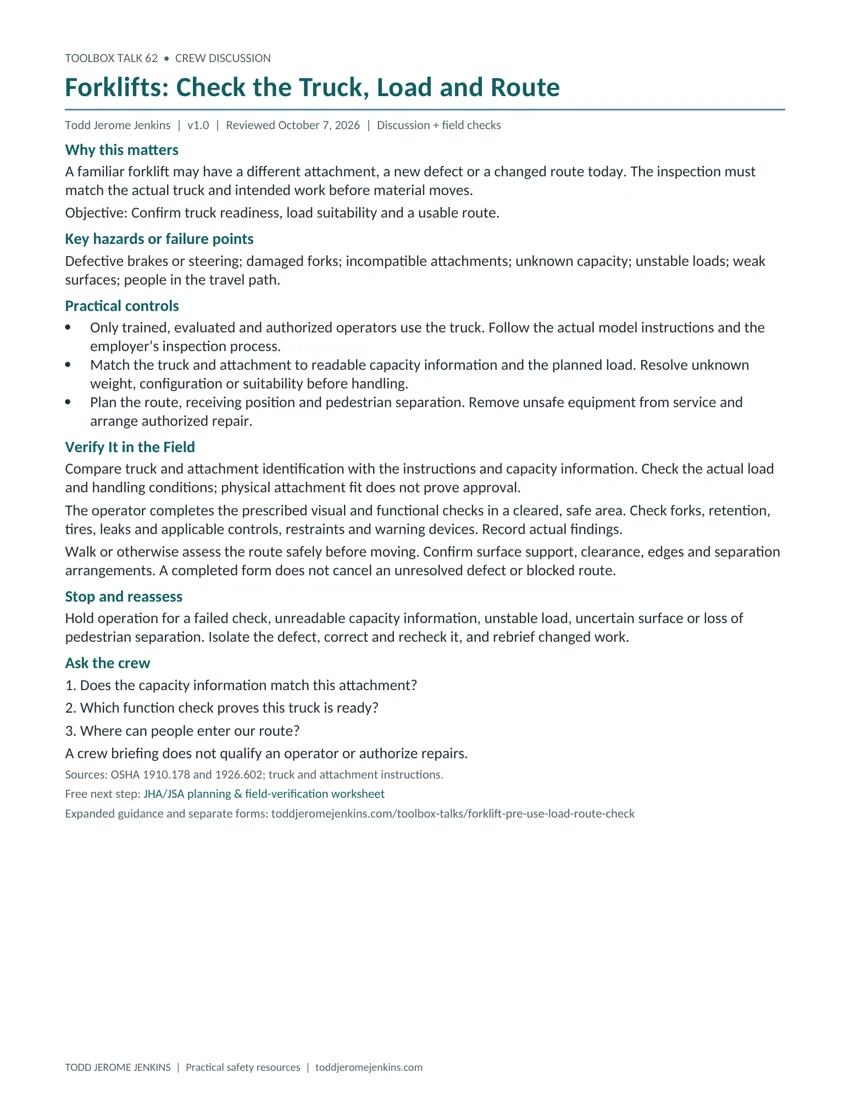
A 5–10 minute crew discussion, plus the time needed for field verification. All six downloads are free without a required signup.
Why this matters
A familiar forklift may have a different attachment, a new defect or a changed route today. The inspection must match the actual truck and intended work before material moves.
Learning objective: Confirm truck readiness, load suitability and a usable route.
Key hazards or failure points
Defective brakes or steering; damaged forks; incompatible attachments; unknown capacity; unstable loads; weak surfaces; people in the travel path.
Practical controls
- Only trained, evaluated and authorized operators use the truck. Follow the actual model instructions and the employer’s inspection process.
- Match the truck and attachment to readable capacity information and the planned load. Resolve unknown weight, configuration or suitability before handling.
- Plan the route, receiving position and pedestrian separation. Remove unsafe equipment from service and arrange authorized repair.
Verify It in the Field
Compare truck and attachment identification with the instructions and capacity information. Check the actual load and handling conditions; physical attachment fit does not prove approval.
The operator completes the prescribed visual and functional checks in a cleared, safe area. Check forks, retention, tires, leaks and applicable controls, restraints and warning devices. Record actual findings.
Walk or otherwise assess the route safely before moving. Confirm surface support, clearance, edges and separation arrangements. A completed form does not cancel an unresolved defect or blocked route.
Use the separate field check to record the acceptance source and criterion, safe method, checker, actual result and time. Mark VERIFIED, HOLD/NOT VERIFIED, or N/A with a reason. A checkmark alone is not evidence that protection works. Complete all required task checks; do not enter danger or improvise a test.
| Control | Safe verification | Evidence |
|---|---|---|
| Truck configuration | Compare identifiers and capacity information. | Truck, attachment, load basis and permitted setup. |
| Operating functions | Authorized operator performs specified checks safely. | Function, criterion, actual result and defects. |
| Travel interface | Assess the actual route and separation arrangement. | Route restrictions, corrections and responsible person. |
Stop and reassess
Hold operation for a failed check, unreadable capacity information, unstable load, uncertain surface or loss of pedestrian separation. Isolate the defect, correct and recheck it, and rebrief changed work.
Crew discussion questions
- Does the capacity information match this attachment?
- Which function check proves this truck is ready?
- Where can people enter our route?
A situation to discuss
Illustrative situation: an attachment has been changed since the last shift. The operator finds that the available capacity information describes the former setup. Handling is held until the correct information and permitted configuration are established.
Leader preparation and practical detail
Keep inspection model specific
A checklist must reflect the truck. Different designs have different tires, power sources, controls and protective equipment. Do not use a generic tick list to invent required attachments or acceptance tolerances. The actual manual and applicable requirements govern the safe function check. [1, 2]
Check the load and the route together
Readable capacity information is essential, but the load’s position, stability and attachment configuration also matter. Assess the actual surface, clearance, grade and receiving arrangement before handling. The related JHA works through those task interfaces; this talk focuses on readiness before the first move. [1, 2]
Apply the correct inspection rule
For general industry, 1910.178(q)(7) requires examination before service, at least daily, and after each shift for round-the-clock use. Construction requirements include 1926.602(c); its training provision at (d) is identical to 1910.178(l). That training cross-reference does not import every general-industry provision. Follow any stricter applicable employer inspection schedule. [1, 2]
Short supervisor field check
- Operator training, evaluation and authorization confirmed.
- Truck, attachment and capacity information match.
- Prescribed checks completed with acceptable results.
- Load, route and receiving position assessed.
- Pedestrian separation and defect hold process ready.
Record unresolved items, restrictions, correction owner, recheck result and required restart authorization. Reference permits and specialist inspections rather than treating this form as a replacement. Rebrief workers affected by a change.
Attendance and follow-through
Use the separate attendance sheet for participants, discussion concerns, actions and late-arrival rebriefs. Attendance does not establish competence, verify controls or authorize work. Keep completed records private under the employer’s recordkeeping procedures.
Technical scope and references
Forklift readiness discussion. General-industry and construction provisions differ. Use the applicable requirements, manufacturer instructions and employer program; this is not operator training, a complete inspection or a load-capacity calculation. [1, 2]
References reviewed October 7, 2026. Apply the industry, activity and jurisdiction that govern the work. No actual site permit, equipment manual, exposure assessment or engineering determination was supplied for this general discussion.
- OSHA 1910.178 — Powered industrial trucks — General-industry operation, loading, defects and examination requirements.
- OSHA 1926.602 — Material handling equipment — Construction industrial trucks and operator-training provisions.
Connect this discussion to your JHA/JSA
Use How to Conduct a Job Safety Analysis to connect task steps, hazards and controls. Revisit Pre-Job JHA/JSA: What Changed Today? when conditions change.
Work through the related Forklift Operation JHA, then adapt its assumptions to the actual work.
Related crew discussions
- Mobile Equipment: Separate People from Movement
- Manual Handling: Change the Lift Before You Lift
- Safety Checklists: Show the Evidence Before the Tick
- Pre-Job JHA/JSA: What Changed Today?
Put one check into practice
Use the free JHA/JSA planning and field-verification worksheet to record today’s changes, important controls and the evidence needed before exposure.