Download the talk and separate crew records
Free to download without an account. Each PDF is one page. Use the Word version to adapt the record to your task and approved procedures.
Supervisor field check
Download supervisor field check (PDF, 1 page)Editable supervisor field check (Word)Preview the one-page crew talk
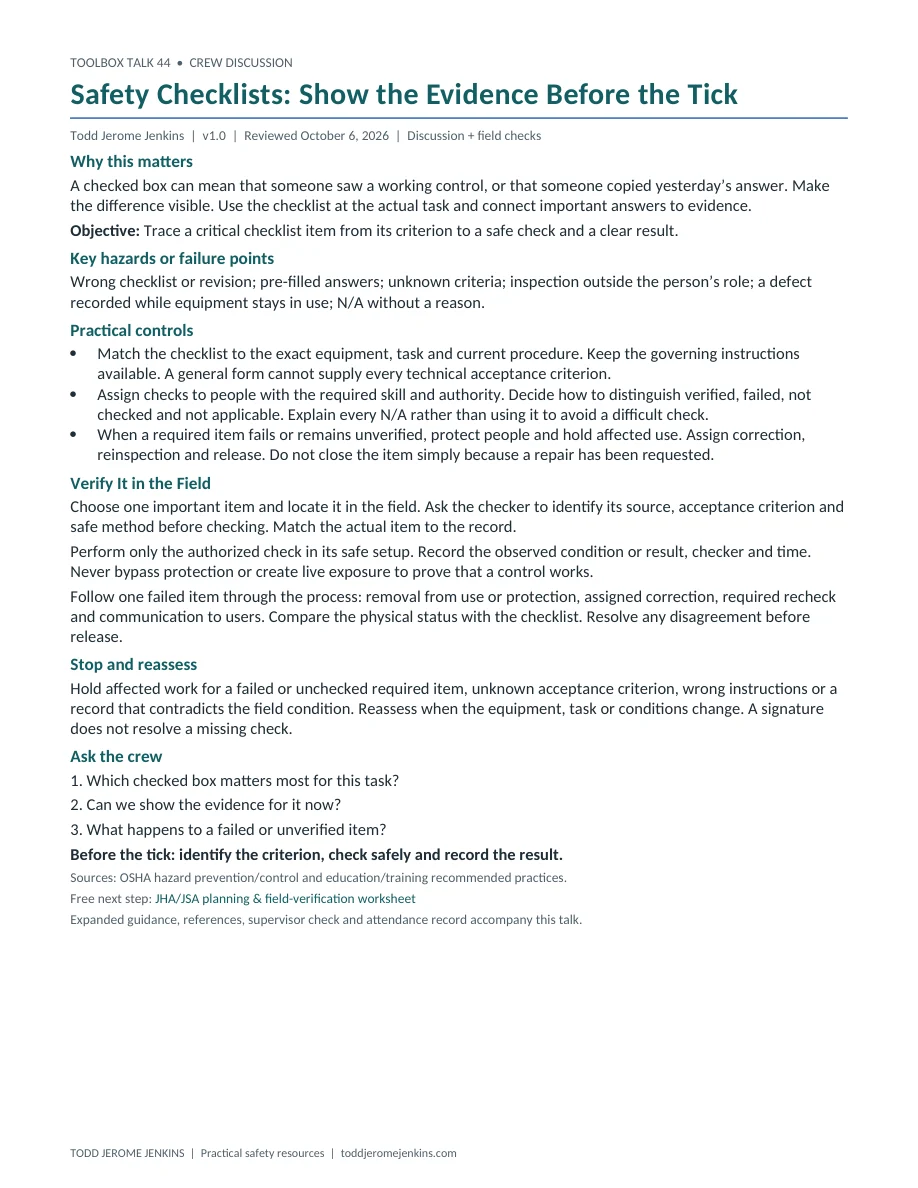
A 5–10 minute crew discussion, plus the time needed for field verification. All six downloads are free without a required signup.
Why this matters
A checked box can mean that someone saw a working control, or that someone copied yesterday’s answer. Make the difference visible. Use the checklist at the actual task and connect important answers to evidence.
Learning objective: Trace a critical checklist item from its criterion to a safe check and a clear result.
Key hazards or failure points
Wrong checklist or revision; pre-filled answers; unknown criteria; inspection outside the person’s role; a defect recorded while equipment stays in use; N/A without a reason.
Practical controls
- Match the checklist to the exact equipment, task and current procedure. Keep the governing instructions available. A general form cannot supply every technical acceptance criterion.
- Assign checks to people with the required skill and authority. Decide how to distinguish verified, failed, not checked and not applicable. Explain every N/A rather than using it to avoid a difficult check.
- When a required item fails or remains unverified, protect people and hold affected use. Assign correction, reinspection and release. Do not close the item simply because a repair has been requested.
Verify It in the Field
Choose one important item and locate it in the field. Ask the checker to identify its source, acceptance criterion and safe method before checking. Match the actual item to the record.
Perform only the authorized check in its safe setup. Record the observed condition or result, checker and time. Never bypass protection or create live exposure to prove that a control works.
Follow one failed item through the process: removal from use or protection, assigned correction, required recheck and communication to users. Compare the physical status with the checklist. Resolve any disagreement before release.
Use the separate field check to record the source and criterion, safe method, checker, actual result and time. Mark VERIFIED, HOLD/NOT VERIFIED, or N/A with a reason. Check every required control; the examples below do not clear the whole task.
| Control | Safe verification | Evidence to record |
|---|---|---|
| Correct checklist | Compare task/equipment and procedure revision with the form. | Item identification and current source. |
| Evidence for a pass | Observe the authorized safe check and actual result. | Criterion, method, result, checker and time. |
| Defect closure | Trace restriction through correction and reinspection. | Owner, release evidence and user notification. |
Stop and reassess
Hold affected work for a failed or unchecked required item, unknown acceptance criterion, wrong instructions or a record that contradicts the field condition. Reassess when the equipment, task or conditions change. A signature does not resolve a missing check.
Crew discussion questions
- Which checked box matters most for this task?
- Can we show the evidence for it now?
- What happens to a failed or unverified item?
Before the tick: identify the criterion, check safely and record the result.
A situation to discuss
Illustrative situation: a daily form says the access route is clear, but a new delivery blocks it. The crew updates the status, corrects the obstruction and rechecks the route. Yesterday’s completed form is not used to approve today’s access.
Leader preparation and practical detail
Use forms to support decisions
A checklist helps organize work, but its wording needs to match the operation. Add the actual item identification and source when a generic line such as “guard checked” is too vague. The useful question is what was checked and whether the required condition was met. OSHA recommends verifying control effectiveness; the form itself is not a technical standard. [1]
Make an unresolved result visible
Separate “not checked” from “passed.” Explain a legitimate N/A and retain its basis. When the check needs a specialist or a safe shutdown, schedule that work and keep the exposure held. A person who lacks the required capability should report the gap rather than create a reassuring answer. Training and assigned roles need to match the work. [2]
Verify release as well as inspection
Defect management has several stages: identify the problem, restrict use, correct it, recheck against the source and communicate release. A purchase order proves only that something was ordered. Follow the item until the protection is actually usable and any required approval has been obtained. [1]
Short supervisor field check
- Checklist matches task/equipment/revision.
- Critical criteria and inspector roles identified.
- Actual safe check observed and recorded.
- Failed or unchecked items protected and assigned.
- Release evidence and user communication complete.
Use the separate form to document evidence, restrictions, corrective-action owner, recheck and required restart approval. An unresolved required control means hold the affected work. Missing evidence is not a pass. Complete all task-specific inspections and permits.
Attendance and follow-through
The separate attendance sheet records participants, language support, questions, actions and late-arrival rebriefs. Attendance does not establish competence or prove controls function. Keep completed records private under the employer’s procedures.
Technical scope and references
This resource teaches evidence-based checklist use. It is not a universal equipment inspection or a substitute for required permits, specialist inspections or manufacturer instructions. OSHA’s cited pages are recommended management practices. [1], [2]
References checked October 6, 2026. Apply the jurisdiction, task, employer program and equipment instructions that govern the work. No site-specific manual, permit, engineering determination or product SDS has been approved by this general resource.
- OSHA Recommended Practices — Hazard Prevention and Control — Recommended practices, not a standalone technical acceptance standard. Site-specific criteria must come from applicable authoritative sources.
- OSHA Recommended Practices — Education and Training — Recommended practices. Topic-specific mandatory training still applies.
Connect this discussion to your JHA/JSA
Use How to Conduct a Job Safety Analysis to connect today’s work steps, hazards and controls. Revisit Pre-Job JHA/JSA: What Changed Today? whenever conditions change.
Related Todd Jerome Jenkins video: Is a Job Safety Analysis Required by OSHA? | JSA Explained.
Related published crew resources: Hierarchy of Controls: Verify the Protection; Learning from Incidents: Verify the Fix.
Put one check into practice
Download the free JHA/JSA planning and field-verification worksheet. For today’s task, record an important control, its source and the evidence needed before exposure. Complete the remaining required checks through your task plan.