Download the free crew talk
The one-page talk, editable Word version, and guidance below are open to everyone. No account required.
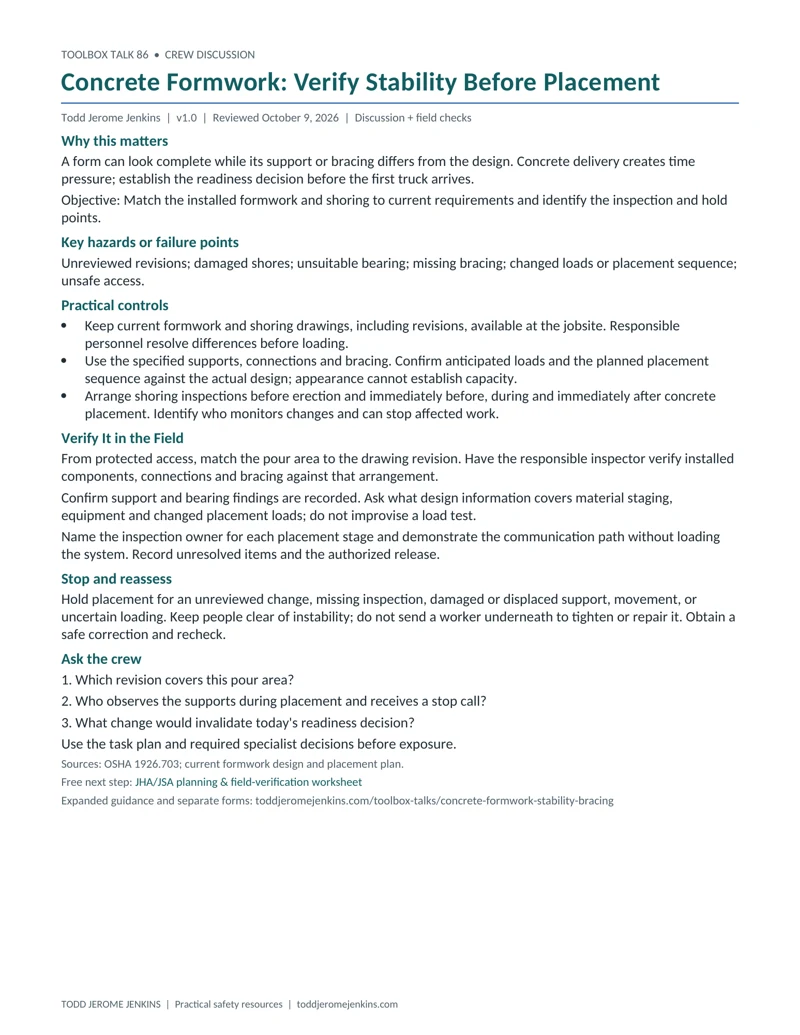
Preview the one-page crew talk
Supporting documents
Included with free Safety & Systems membership.
Supervisor field check
A separate check to verify conditions and controls before work. Includes a one-page PDF and editable Word file.
Attendance sheet
A separate sign-in sheet to record the crew discussion. Includes a one-page PDF and editable Word file.
Need the crew records? Join free to use these supporting documents and the Safety & Systems Academy. No payment details. Email updates are optional.
Get supporting documents — free membershipAlready a member? Use the same link to sign in.
A 5–10 minute crew discussion, plus time to verify the actual controls. The crew talk and Word version are public. Separate supervisor and attendance records are included with free Safety & Systems membership.
Why this matters
A form can look complete while its support or bracing differs from the design. Concrete delivery creates time pressure; establish the readiness decision before the first truck arrives.
Learning objective
Match the installed formwork and shoring to current requirements and identify the inspection and hold points.
Key hazards or failure points
Unreviewed revisions; damaged shores; unsuitable bearing; missing bracing; changed loads or placement sequence; unsafe access.
Practical controls
- Keep current formwork and shoring drawings, including revisions, available at the jobsite. Responsible personnel resolve differences before loading.
- Use the specified supports, connections and bracing. Confirm anticipated loads and the planned placement sequence against the actual design; appearance cannot establish capacity.
- Arrange shoring inspections before erection and immediately before, during and immediately after concrete placement. Identify who monitors changes and can stop affected work.
Verify It in the Field
- From protected access, match the pour area to the drawing revision. Have the responsible inspector verify installed components, connections and bracing against that arrangement.
- Confirm support and bearing findings are recorded. Ask what design information covers material staging, equipment and changed placement loads; do not improvise a load test.
- Name the inspection owner for each placement stage and demonstrate the communication path without loading the system. Record unresolved items and the authorized release.
Stop and reassess
Hold placement for an unreviewed change, missing inspection, damaged or displaced support, movement, or uncertain loading. Keep people clear of instability; do not send a worker underneath to tighten or repair it. Obtain a safe correction and recheck.
Crew discussion questions
- Which revision covers this pour area?
- Who observes the supports during placement and receives a stop call?
- What change would invalidate today's readiness decision?
For each required control, record its acceptance source and criterion, safe verification method, responsible checker, actual result and time. Use VERIFIED, HOLD/NOT VERIFIED, or N/A with a reason. A tick alone is not evidence. Complete all applicable task inspections; do not enter danger or improvise a test to fill out a form.
Leader preparation and practical detail
Make the comparison specific
Illustrative situation: a delivery is staged on a supported deck because the ground route is crowded. Before accepting it, the employer establishes that the actual load and location are covered by the structural information. A cleared access route is not evidence of load capacity.
Separate the design and field roles
The field discussion asks whether the designed arrangement is present and its required inspections are complete. It does not certify structural adequacy. OSHA 1926.703 requires formwork capable of resisting anticipated loads, onsite plans, suitable shoring and defined inspection timing. The responsible technical personnel resolve departures.
Recognize special shoring requirements
For tiered single-post shoring, 1926.703(b)(8) includes qualified design and inspection of erected shoring by an engineer qualified in structural design. Do not generalize that exact role requirement to every formwork system. Obtain the roles and criteria applicable to the actual system.
Keep the release tied to conditions
Record the drawing, location, inspected condition, checker, time and any restriction. Review changes in support, placement, access or loads before continuing. This resource supplies no brace spacing, bearing capacity, placement rate or stripping strength.
Short supervisor field check
- From protected access, match the pour area to the drawing revision. Have the responsible inspector verify installed components, connections and bracing against that arrangement.
- Confirm support and bearing findings are recorded. Ask what design information covers material staging, equipment and changed placement loads; do not improvise a load test.
- Name the inspection owner for each placement stage and demonstrate the communication path without loading the system. Record unresolved items and the authorized release.
Confirm the relevant trained/authorized people, unresolved items, interim protection, correction owner and recheck. Record required release authority and rebrief anyone affected. The separate sheet supports these records; it does not replace a specialist inspection, permit or engineering determination.
Attendance and follow-through
Use the separate attendance sheet for participants, roles, discussion concerns, actions and late-arrival rebriefs. Attendance is not proof of competence, functioning controls or authorization to work. Keep completed records private under employer procedures.
Technical scope and references
Reviewed October 9, 2026 for construction crew preparation. Apply the actual task, jurisdiction and relevant standard provisions. Manufacturer sources below are reference examples, not approval of your equipment. No site-specific design, permit, exposure assessment, product SDS or current model manual was supplied; obtain the applicable documents before work. This discussion does not replace required training.
- OSHA 1926.703(a) and (b) — Cast-in-place formwork and shoring requirements.
- OSHA 1926.701(a) — Employer determination for construction loads using structural-design information.
- OSHA tiered single-post shoring interpretation — Scope-specific explanation of design and engineering inspection roles.
Connect this discussion to your JHA/JSA
Use the related worked JHA/JSA/AHA example to prepare task steps, hazards and controls. Return to What Changed Today? when the plan or conditions change.
Related Todd Jerome Jenkins article: How to Conduct a Job Safety Analysis.
Related crew discussions
Put one check into practice
Use the free JHA/JSA planning and field-verification worksheet to record today’s change, the required protection and the evidence needed before exposure.