Download the talk and separate crew records
Free to download without an account. Each PDF is one page. Use the Word version to adapt the record to your task and approved procedures.
Supervisor field check
Download supervisor field check (PDF, 1 page)Editable supervisor field check (Word)Preview the one-page crew talk
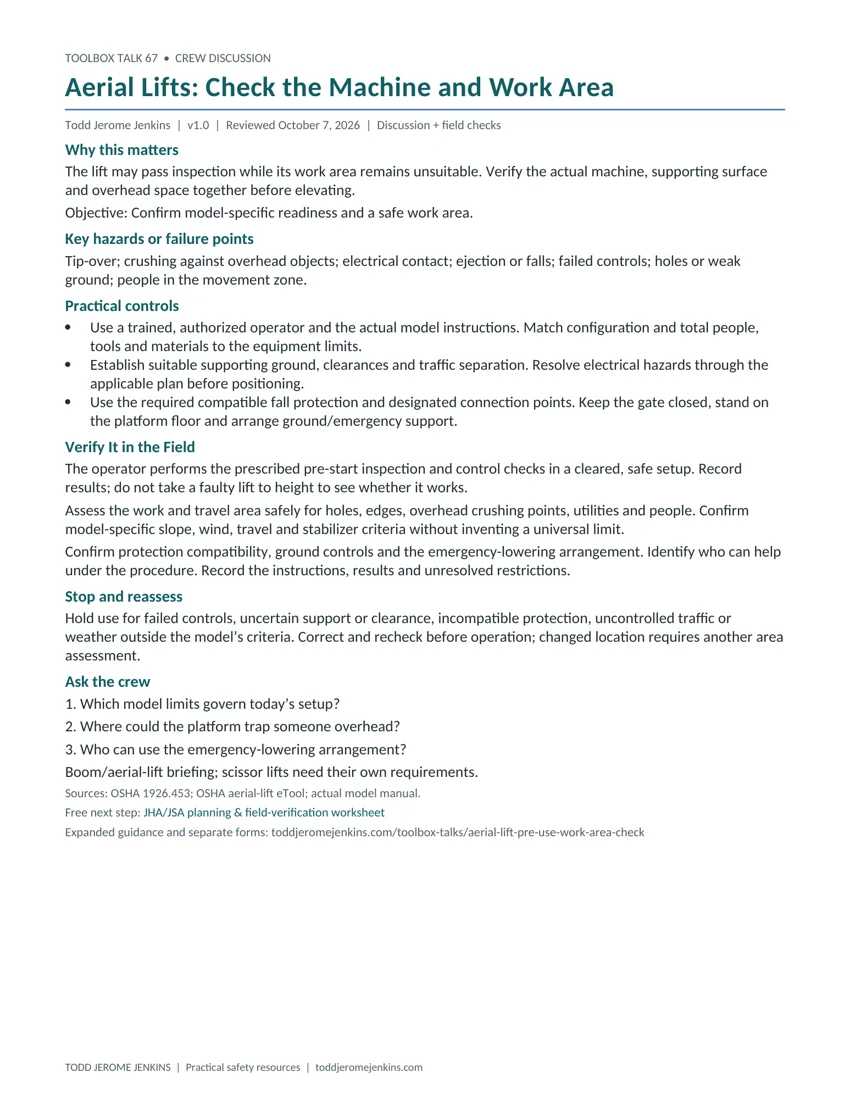
A 5–10 minute crew discussion, plus the time needed for field verification. All six downloads are free without a required signup.
Why this matters
The lift may pass inspection while its work area remains unsuitable. Verify the actual machine, supporting surface and overhead space together before elevating.
Learning objective: Confirm model-specific readiness and a safe work area.
Key hazards or failure points
Tip-over; crushing against overhead objects; electrical contact; ejection or falls; failed controls; holes or weak ground; people in the movement zone.
Practical controls
- Use a trained, authorized operator and the actual model instructions. Match configuration and total people, tools and materials to the equipment limits.
- Establish suitable supporting ground, clearances and traffic separation. Resolve electrical hazards through the applicable plan before positioning.
- Use the required compatible fall protection and designated connection points. Keep the gate closed, stand on the platform floor and arrange ground/emergency support.
Verify It in the Field
The operator performs the prescribed pre-start inspection and control checks in a cleared, safe setup. Record results; do not take a faulty lift to height to see whether it works.
Assess the work and travel area safely for holes, edges, overhead crushing points, utilities and people. Confirm model-specific slope, wind, travel and stabilizer criteria without inventing a universal limit.
Confirm protection compatibility, ground controls and the emergency-lowering arrangement. Identify who can help under the procedure. Record the instructions, results and unresolved restrictions.
Use the separate field check to record the acceptance source and criterion, safe method, checker, actual result and time. Mark VERIFIED, HOLD/NOT VERIFIED, or N/A with a reason. A checkmark alone is not evidence that protection works. Complete all required task checks; do not enter danger or improvise a test.
| Control | Safe verification | Evidence |
|---|---|---|
| Machine readiness | Operator completes the model’s safe checks. | Model, method, actual result and defects. |
| Work-area suitability | Assess support and movement/overhead paths before operation. | Limits, hazards, restrictions and corrections. |
| Emergency arrangement | Confirm ground access, designated help and procedure. | People, communication and unresolved readiness gaps. |
Stop and reassess
Hold use for failed controls, uncertain support or clearance, incompatible protection, uncontrolled traffic or weather outside the model’s criteria. Correct and recheck before operation; changed location requires another area assessment.
Crew discussion questions
- Which model limits govern today’s setup?
- Where could the platform trap someone overhead?
- Who can use the emergency-lowering arrangement?
A situation to discuss
Illustrative situation: the lift passes its machine check, but a new overhead pipe crosses the planned platform path. The operator holds elevation and revises positioning and access before the task proceeds.
Leader preparation and practical detail
Use the correct equipment category
Boom-type aerial lifts and scissor lifts must not be treated as interchangeable. This resource addresses boom/aerial-lift preparation. The actual equipment category, instructions and applicable standard determine protection and operating requirements. [1, 2]
A function check needs a safe setup
The operator follows the model procedure for controls and safety devices, with the area clear and the machine in the specified condition. Daily control testing applies to extensible and articulating boom platforms under 1926.453. A defect requires correction, not an improvised bypass or trial at height. [1]
Plan assistance before elevation
Identify the ground controls and people authorized to use them under the equipment procedure. An emergency plan must work at the location, with access and communication available. This talk supplies no universal lowering sequence, anchorage capacity or electrical approach distance. Use the actual instructions and applicable technical determination. [2]
Short supervisor field check
- Operator and model-specific instructions confirmed.
- Inspection and control checks acceptable.
- Ground, utilities and clearances assessed.
- Capacity and compatible fall protection verified.
- Ground support and emergency lowering ready.
Record unresolved items, restrictions, correction owner, recheck result and required restart authorization. Reference permits and specialist inspections rather than treating this form as a replacement. Rebrief workers affected by a change.
Attendance and follow-through
Use the separate attendance sheet for participants, discussion concerns, actions and late-arrival rebriefs. Attendance does not establish competence, verify controls or authorize work. Keep completed records private under the employer’s recordkeeping procedures.
Technical scope and references
Construction boom/aerial-lift preparation. Scissor lifts require a separate applicability review. No equipment model was supplied; all model-specific criteria and emergency operations must come from the actual instructions and required trained personnel. [1, 2]
References reviewed October 7, 2026. Apply the industry, activity and jurisdiction that govern the work. No actual site permit, equipment manual, exposure assessment or engineering determination was supplied for this general discussion.
- OSHA 1926.453 — Aerial lifts — Construction aerial-lift requirements, controls and operation.
- OSHA eTool — Aerial lifts — Guidance on training, inspection, work areas and operating hazards.
Connect this discussion to your JHA/JSA
Use How to Conduct a Job Safety Analysis to connect task steps, hazards and controls. Revisit Pre-Job JHA/JSA: What Changed Today? when conditions change.
Work through the related Aerial Lift JHA, then adapt its assumptions to the actual work.
Related crew discussions
- Fall Prevention: Verify the Controls
- Mobile Equipment: Separate People from Movement
- Competent Person: Know Who Can Correct the Hazard
- Electrical & Extension-Cord Checks
Put one check into practice
Use the free JHA/JSA planning and field-verification worksheet to record today’s changes, important controls and the evidence needed before exposure.