Download the free toolbox talk
The one-page talk, editable Word version, and guidance below are open to everyone. No account required.
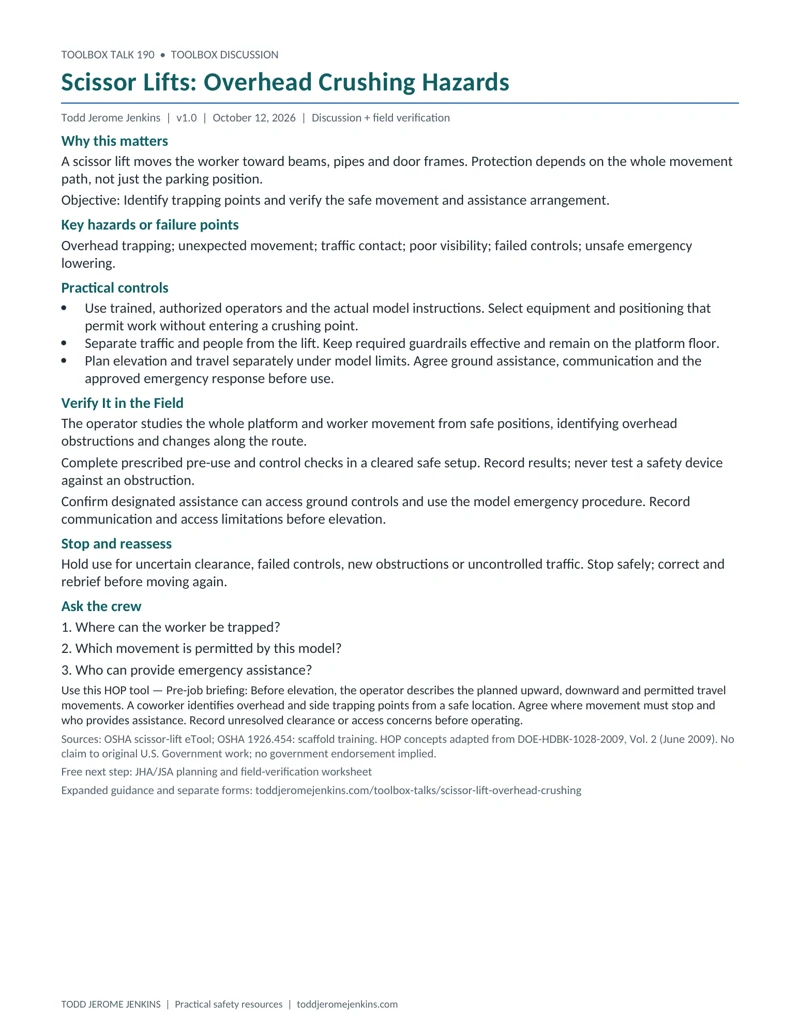
One-page toolbox talk
Download one-page toolbox talk (PDF, 1 page)Editable one-page toolbox talk (Word)Preview the one-page toolbox talk
Supporting documents
Included with free Safety & Systems membership.
Supervisor field check
A separate check to verify conditions and controls before work. Includes a one-page PDF and editable Word file.
Attendance sheet
A separate sign-in sheet to record the crew discussion. Includes a one-page PDF and editable Word file.
Need the crew records? Join free to use these supporting documents and the Safety & Systems Academy. No payment details. Email updates are optional.
Get supporting documents — free membershipAlready a member? Use the same link to sign in.
Hazard-based toolbox talk 15 of 52, with a practical HOP exercise.
Plan a 5–10 minute toolbox discussion, plus time to verify the actual controls. The one-page toolbox talk and editable Word version are public. Separate supervisor and attendance records are included with free Safety & Systems membership.
Why this matters
A scissor lift moves the worker toward beams, pipes and door frames. Protection depends on the whole movement path, not just the parking position.
Learning objective
Identify trapping points and verify the safe movement and assistance arrangement.
Key hazards or failure points
Overhead trapping; unexpected movement; traffic contact; poor visibility; failed controls; unsafe emergency lowering.
Practical controls
- Use trained, authorized operators and the actual model instructions. Select equipment and positioning that permit work without entering a crushing point.
- Separate traffic and people from the lift. Keep required guardrails effective and remain on the platform floor.
- Plan elevation and travel separately under model limits. Agree ground assistance, communication and the approved emergency response before use.
Verify It in the Field
- The operator studies the whole platform and worker movement from safe positions, identifying overhead obstructions and changes along the route.
- Complete prescribed pre-use and control checks in a cleared safe setup. Record results; never test a safety device against an obstruction.
- Confirm designated assistance can access ground controls and use the model emergency procedure. Record communication and access limitations before elevation.
Stop and reassess
Hold use for uncertain clearance, failed controls, new obstructions or uncontrolled traffic. Stop safely; correct and rebrief before moving again.
Crew discussion questions
- Where can the worker be trapped?
- Which movement is permitted by this model?
- Who can provide emergency assistance?
For each required control, record its acceptance source and criterion, safe verification method, responsible verifier, actual result and time. Mark VERIFIED, HOLD/NOT VERIFIED, or N/A with a reason. Complete all required inspections; never enter danger or improvise a test to fill out a form.
Use this HOP tool
Pre-job briefing
Before elevation, the operator describes the planned upward, downward and permitted travel movements. A coworker identifies overhead and side trapping points from a safe location. Agree where movement must stop and who provides assistance. Record unresolved clearance or access concerns before operating.
This exercise supports hazard identification or control verification. It does not replace safeguards, required training, specialist decisions or work authorization.
Leader preparation and practical detail
Use the correct equipment category
OSHA identifies scissor lifts as mobile supported scaffold platforms; they are different from boom-type aerial lifts. Apply the construction scaffold requirements and actual equipment instructions. Do not import a boom-lift rule or a generic wind or travel limit into this task. Required training includes the relevant equipment and worksite hazards.
Study worker clearance as well as platform clearance
A platform can fit under an obstruction while an occupant cannot. Study beams, pipes, doors and adjacent moving equipment across elevation, lowering and any permitted travel. Arrange positioning and separation before movement. Ground guides must remain out of crushing zones and communicate under the planned method; they are not a substitute for suitable clearance.
An emergency plan must fit the model
Before use, confirm who can provide assistance, how they communicate and how the actual model’s ground or emergency controls work. Do not improvise a rescue or test by approaching an overhead object. A defective control or missing access arrangement requires correction. This focused talk complements, rather than replaces, the complete model inspection and employer training.
Short supervisor field check
- Model and operator confirmed
- Overhead route studied
- Controls checked safely
- Traffic separated
- Assistance arrangement ready
Use the separate sheet to document evidence, unresolved restrictions, correction owner, recheck and required release authority. Rebrief affected workers. This record does not replace specialist inspections, permits or engineering determinations.
Attendance and follow-through
Use the separate attendance record for participants, roles, questions, actions and late-arrival rebriefs. Attendance does not prove competence, functioning controls or authorization. Keep completed records private under employer procedures.
Source acknowledgment
HOP concepts are adapted from DOE-HDBK-1028-2009, Human Performance Improvement Handbook, Volume 2 (June 2009). Todd Jerome Jenkins makes no claim to authorship or copyright ownership of original U.S. Government work. The explanations and exercises are original adaptations; no endorsement by DOE or the U.S. Government is implied. Third-party material credited in the handbook retains its separate ownership.
HOP source: Volume 2/VOLUME 2 PRE-JOB BRIEFING.pdf; PDF1–4; printed34–37. The handbook supplies concepts; task-specific technical references are listed below.
Technical scope and references
Technical sources inspected October 9, 2026; resource edition October 12, 2026. Apply current jurisdictional requirements, the actual task procedure, manufacturer instructions, permits and required competent or qualified decisions. This resource supplies no equipment-specific acceptance criteria.
- OSHA scissor-lift eTool — Construction scaffold classification, positioning and safe use.
- OSHA 1926.454: scaffold training — Applicable construction training and retraining.
- DOE-HDBK-1028-2009 Volume 2 (June 2009) — PDF1–4; printed34–37; HOP concept basis, original exercise.
Connect this discussion to your JHA/JSA
Related worked JHA/JSA/AHA example. The example uses an indoor electric scissor lift on a verified slab with lowered travel. Adapt only through the actual model instructions, worksite assessment and applicable requirements.
Related Todd Jerome Jenkins articles: How to Conduct a Job Safety Analysis and What Is Human and Organizational Performance?.
Related toolbox talks
- Aerial Lifts: Check the Machine and Work Area
- Scaffolds: Verify Readiness Before Access
- Mobile Equipment: Separate People from Movement
Continue the hazard series
Put one verification into practice
Record today’s change and evidence using the free JHA/JSA planning and field-verification worksheet.