Download the free toolbox talk
The one-page talk, editable Word version, and guidance below are open to everyone. No account required.
One-page toolbox talk
Download one-page toolbox talk (PDF, 1 page)Editable one-page toolbox talk (Word)Preview the one-page toolbox talk
Supporting documents
Included with free Safety & Systems membership.
Supervisor field check
A separate check to verify conditions and controls before work. Includes a one-page PDF and editable Word file.
Attendance sheet
A separate sign-in sheet to record the crew discussion. Includes a one-page PDF and editable Word file.
Need the crew records? Join free to use these supporting documents and the Safety & Systems Academy. No payment details. Email updates are optional.
Get supporting documents — free membershipAlready a member? Use the same link to sign in.
Hazard-based toolbox talk 14 of 52, with a practical HOP exercise.
Plan a 5–10 minute toolbox discussion, plus time to verify the actual controls. The one-page toolbox talk and editable Word version are public. Separate supervisor and attendance records are included with free Safety & Systems membership.
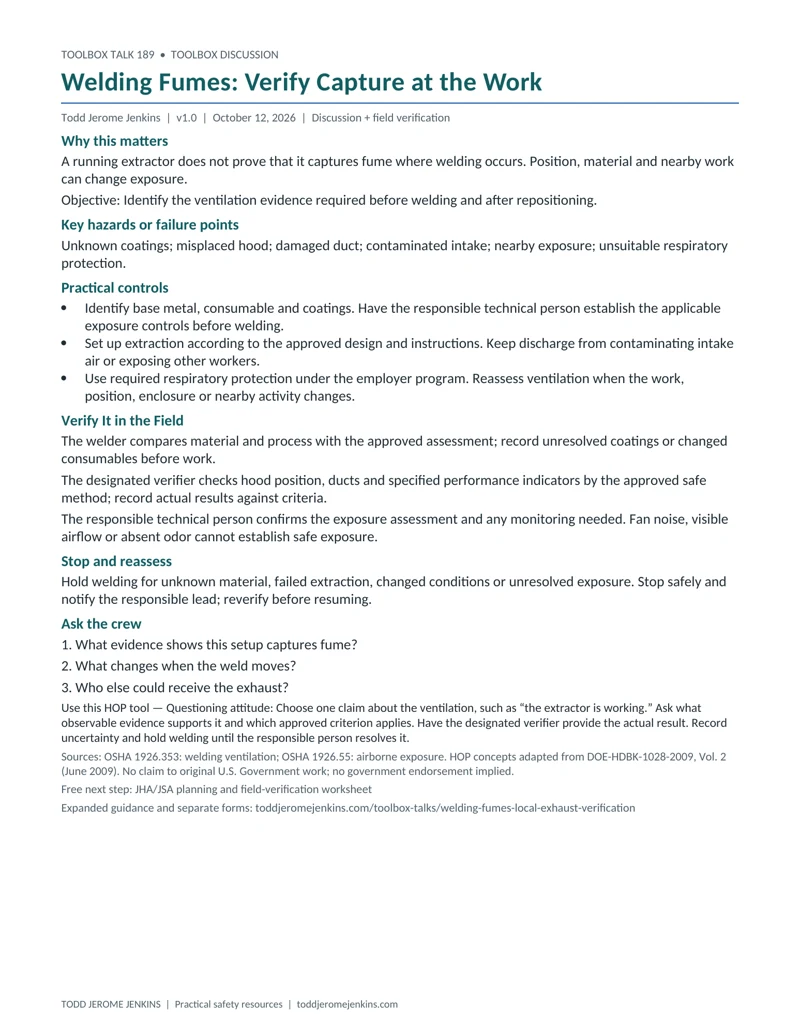
Why this matters
A running extractor does not prove that it captures fume where welding occurs. Position, material and nearby work can change exposure.
Learning objective
Identify the ventilation evidence required before welding and after repositioning.
Key hazards or failure points
Unknown coatings; misplaced hood; damaged duct; contaminated intake; nearby exposure; unsuitable respiratory protection.
Practical controls
- Identify base metal, consumable and coatings. Have the responsible technical person establish the applicable exposure controls before welding.
- Set up extraction according to the approved design and instructions. Keep discharge from contaminating intake air or exposing other workers.
- Use required respiratory protection under the employer program. Reassess ventilation when the work, position, enclosure or nearby activity changes.
Verify It in the Field
- The welder compares material and process with the approved assessment; record unresolved coatings or changed consumables before work.
- The designated verifier checks hood position, ducts and specified performance indicators by the approved safe method; record actual results against criteria.
- The responsible technical person confirms the exposure assessment and any monitoring needed. Fan noise, visible airflow or absent odor cannot establish safe exposure.
Stop and reassess
Hold welding for unknown material, failed extraction, changed conditions or unresolved exposure. Stop safely and notify the responsible lead; reverify before resuming.
Crew discussion questions
- What evidence shows this setup captures fume?
- What changes when the weld moves?
- Who else could receive the exhaust?
For each required control, record its acceptance source and criterion, safe verification method, responsible verifier, actual result and time. Mark VERIFIED, HOLD/NOT VERIFIED, or N/A with a reason. Complete all required inspections; never enter danger or improvise a test to fill out a form.
Use this HOP tool
Questioning attitude
Choose one claim about the ventilation, such as “the extractor is working.” Ask what observable evidence supports it and which approved criterion applies. Have the designated verifier provide the actual result. Record uncertainty and hold welding until the responsible person resolves it.
This exercise supports hazard identification or control verification. It does not replace safeguards, required training, specialist decisions or work authorization.
Leader preparation and practical detail
Match ventilation to the actual process
Construction 1926.353 distinguishes general ventilation, local exhaust and specified material or enclosure situations. Local exhaust must capture near the source and keep breathing-zone concentrations within the applicable limits. No single hood distance or airflow value is supplied here: obtain the approved arrangement for this work and extraction equipment.
Performance evidence belongs to the technical basis
Under 1926.55(b), control equipment and technical measures require approval for the particular use by a competent industrial hygienist or other technically qualified person. The crew can record the prescribed indicator or test result, but cannot replace an exposure determination with eyesight. Substance-specific requirements may also apply.
Make the question actionable
Ask what evidence supports the present hood position, not merely whether ventilation is running. Record the approved criterion and who resolves a mismatch. Repositioning must preserve effective capture and avoid pulling contaminants through another worker’s breathing area. This briefing complements the hot-work fire-control briefing; it does not grant confined-space entry or replace respiratory-program requirements.
Short supervisor field check
- Material and process confirmed
- Control basis available
- Extraction result recorded
- Nearby workers protected
- Changes require reassessment
Use the separate sheet to document evidence, unresolved restrictions, correction owner, recheck and required release authority. Rebrief affected workers. This record does not replace specialist inspections, permits or engineering determinations.
Attendance and follow-through
Use the separate attendance record for participants, roles, questions, actions and late-arrival rebriefs. Attendance does not prove competence, functioning controls or authorization. Keep completed records private under employer procedures.
Source acknowledgment
HOP concepts are adapted from DOE-HDBK-1028-2009, Human Performance Improvement Handbook, Volume 2 (June 2009). Todd Jerome Jenkins makes no claim to authorship or copyright ownership of original U.S. Government work. The explanations and exercises are original adaptations; no endorsement by DOE or the U.S. Government is implied. Third-party material credited in the handbook retains its separate ownership.
HOP source: Volume 2/VOLUME 2 QUESTIONING ATTITUDE — AT THE ACTIVITY LEVEL.pdf; PDF1–3; printed10–12. The handbook supplies concepts; task-specific technical references are listed below.
Technical scope and references
Technical sources inspected October 9, 2026; resource edition October 12, 2026. Apply current jurisdictional requirements, the actual task procedure, manufacturer instructions, permits and required competent or qualified decisions. This resource supplies no equipment-specific acceptance criteria.
- OSHA 1926.353: welding ventilation — Construction process, material and enclosure provisions.
- OSHA 1926.55: airborne exposure — Exposure limits and technically approved controls.
- DOE-HDBK-1028-2009 Volume 2 (June 2009) — PDF1–3; printed10–12; HOP concept basis, original exercise.
Connect this discussion to your JHA/JSA
Related worked JHA/JSA/AHA example. The example uses identified, uncoated mild steel at an outdoor station. It illustrates assessment and ventilation verification; it does not clear other materials, enclosures or actual exposures.
Related Todd Jerome Jenkins articles: How to Conduct a Job Safety Analysis and What Is Human and Organizational Performance?.
Related toolbox talks
- Hot Work: Verify the Area and Fire Watch
- Respiratory Hazards: Know What You’re Breathing
- Hazard Communication: Labels, SDS & the Task
Continue the hazard series
Put one verification into practice
Record today’s change and evidence using the free JHA/JSA planning and field-verification worksheet.