Download the talk and separate crew records
Free to download without an account. Each PDF is one page. Use the Word version to adapt the record to your task and approved procedures.
Supervisor field check
Download supervisor field check (PDF, 1 page)Editable supervisor field check (Word)Preview the one-page crew talk
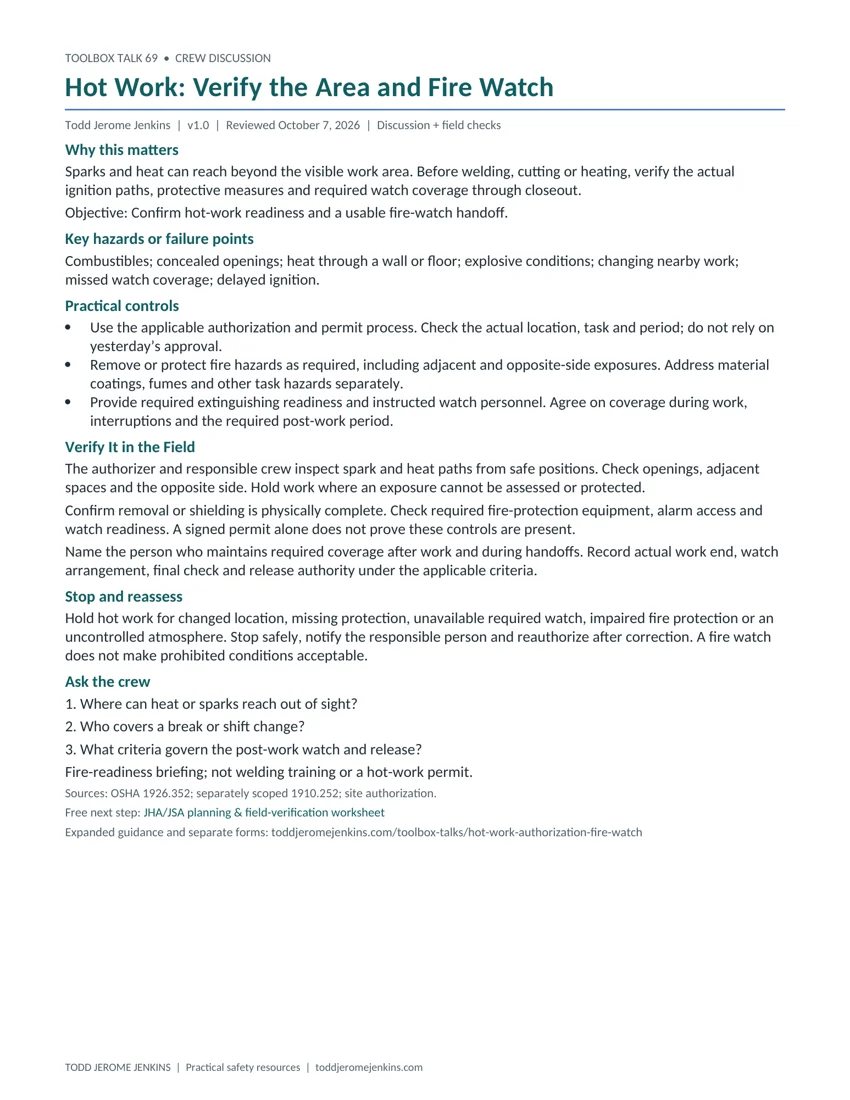
A 5–10 minute crew discussion, plus the time needed for field verification. All six downloads are free without a required signup.
Why this matters
Sparks and heat can reach beyond the visible work area. Before welding, cutting or heating, verify the actual ignition paths, protective measures and required watch coverage through closeout.
Learning objective: Confirm hot-work readiness and a usable fire-watch handoff.
Key hazards or failure points
Combustibles; concealed openings; heat through a wall or floor; explosive conditions; changing nearby work; missed watch coverage; delayed ignition.
Practical controls
- Use the applicable authorization and permit process. Check the actual location, task and period; do not rely on yesterday’s approval.
- Remove or protect fire hazards as required, including adjacent and opposite-side exposures. Address material coatings, fumes and other task hazards separately.
- Provide required extinguishing readiness and instructed watch personnel. Agree on coverage during work, interruptions and the required post-work period.
Verify It in the Field
The authorizer and responsible crew inspect spark and heat paths from safe positions. Check openings, adjacent spaces and the opposite side. Hold work where an exposure cannot be assessed or protected.
Confirm removal or shielding is physically complete. Check required fire-protection equipment, alarm access and watch readiness. A signed permit alone does not prove these controls are present.
Name the person who maintains required coverage after work and during handoffs. Record actual work end, watch arrangement, final check and release authority under the applicable criteria.
Use the separate field check to record the acceptance source and criterion, safe method, checker, actual result and time. Mark VERIFIED, HOLD/NOT VERIFIED, or N/A with a reason. A checkmark alone is not evidence that protection works. Complete all required task checks; do not enter danger or improvise a test.
| Control | Safe verification | Evidence |
|---|---|---|
| Protected ignition paths | Inspect actual adjacent and opposite-side exposures safely. | Location, identified paths and completed protection. |
| Available watch | Confirm instructed personnel, coverage and alarm access. | Names/roles, communication and handoff arrangement. |
| Controlled closeout | Use applicable post-work criteria and authorized release. | Actual end time, continued coverage and final finding. |
Stop and reassess
Hold hot work for changed location, missing protection, unavailable required watch, impaired fire protection or an uncontrolled atmosphere. Stop safely, notify the responsible person and reauthorize after correction. A fire watch does not make prohibited conditions acceptable.
Crew discussion questions
- Where can heat or sparks reach out of sight?
- Who covers a break or shift change?
- What criteria govern the post-work watch and release?
A situation to discuss
Illustrative situation: work on one side of a wall is authorized, but storage has been moved against the opposite side. The crew holds the task, reassesses heat transfer and protects the affected area before renewed authorization.
Leader preparation and practical detail
Inspect the area beyond the task
Construction 1926.352 addresses fire hazards, sparks and heat, including opposite-side protection. The useful briefing question is not just whether a blanket is present: it is whether all relevant ignition paths have been assessed and the required protection is complete. Inaccessible or unresolved exposures need escalation before work. [1]
Use the applicable watch criteria
Construction 1926.352(e) requires a sufficient post-work period where its fire-watch provision applies. General-industry 1910.252 contains its own conditions and at-least-half-hour watch requirement. Do not apply a universal 30-minute or 35-foot rule to every task. The applicable rule, required permit and site criteria govern coverage and closeout. [1, 2]
Coordinate the handoff
Record when ignition-producing work actually ends, who retains watch responsibilities and how concerns are escalated. A worker leaving the area does not end a required watch. Other task controls—such as exposure assessment, ventilation, eye protection and cylinder handling—remain necessary; this fire-focused discussion does not approve the entire job. [1, 2]
Short supervisor field check
- Task, location, period and approval match.
- Adjacent and concealed ignition paths assessed.
- Required removal/shielding and fire protection ready.
- Watch personnel, alarms and handoffs confirmed.
- Post-work coverage and release criteria established.
Record unresolved items, restrictions, correction owner, recheck result and required restart authorization. Reference permits and specialist inspections rather than treating this form as a replacement. Rebrief workers affected by a change.
Attendance and follow-through
Use the separate attendance sheet for participants, discussion concerns, actions and late-arrival rebriefs. Attendance does not establish competence, verify controls or authorize work. Keep completed records private under the employer’s recordkeeping procedures.
Technical scope and references
Fire-prevention readiness for welding, cutting and heating. Construction and general-industry provisions differ. This is not a welding qualification, confined-space permit or container-cleaning procedure. Apply the actual authorization and specialist task requirements. [1, 2]
References reviewed October 7, 2026. Apply the industry, activity and jurisdiction that govern the work. No actual site permit, equipment manual, exposure assessment or engineering determination was supplied for this general discussion.
- OSHA 1926.352 — Fire prevention — Construction welding, cutting and heating fire precautions.
- OSHA 1910.252 — General welding requirements — Separately scoped general-industry fire prevention and watch provisions.
Connect this discussion to your JHA/JSA
Use How to Conduct a Job Safety Analysis to connect task steps, hazards and controls. Revisit Pre-Job JHA/JSA: What Changed Today? when conditions change.
Work through the related Welding and Cutting JSA, then adapt its assumptions to the actual work.
Related crew discussions
- Fire Prevention: Separate Fuel from Ignition
- Fire Extinguishers: Know When to Evacuate
- Respiratory Hazards: Know What You’re Breathing
- Eye & Face Protection
- Emergency Readiness: Can We Reach Supplies and Call for Help?
Put one check into practice
Use the free JHA/JSA planning and field-verification worksheet to record today’s changes, important controls and the evidence needed before exposure.