Download the free crew talk
The one-page talk, editable Word version, and guidance below are open to everyone. No account required.
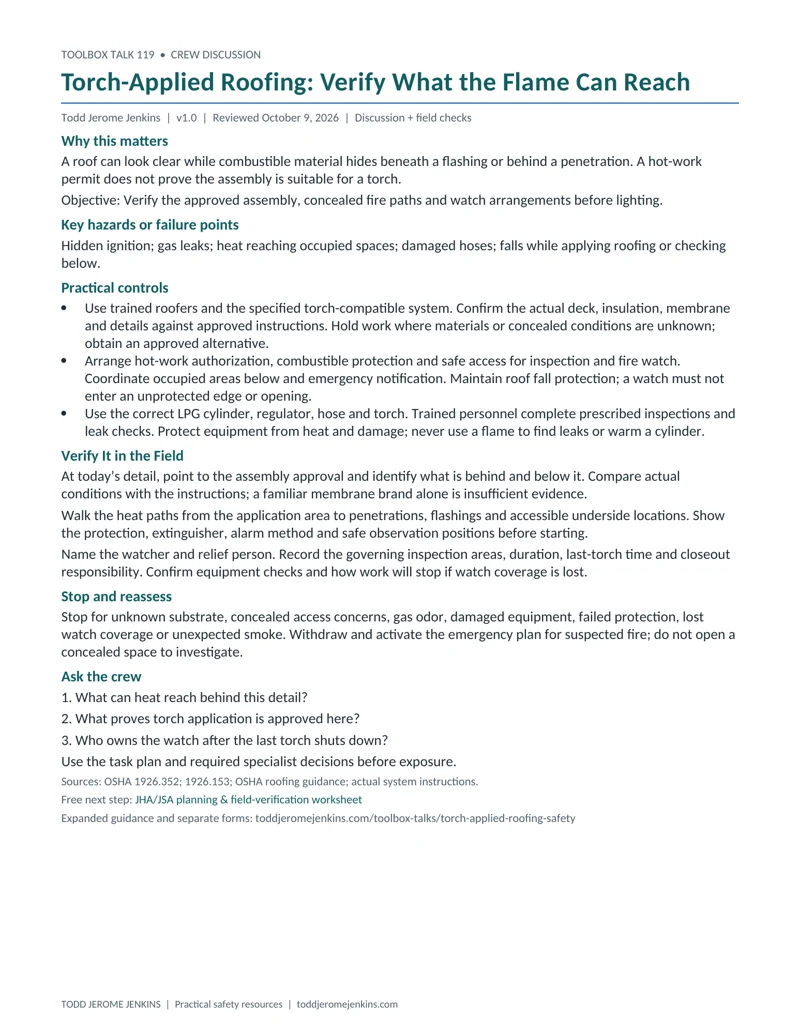
Preview the one-page crew talk
Supporting documents
Included with free Safety & Systems membership.
Supervisor field check
A separate check to verify conditions and controls before work. Includes a one-page PDF and editable Word file.
Attendance sheet
A separate sign-in sheet to record the crew discussion. Includes a one-page PDF and editable Word file.
Need the crew records? Join free to use these supporting documents and the Safety & Systems Academy. No payment details. Email updates are optional.
Get supporting documents — free membershipAlready a member? Use the same link to sign in.
A 5–10 minute crew discussion, plus time to verify the actual controls. The crew talk and Word version are public. Separate supervisor and attendance records are included with free Safety & Systems membership.
Why this matters
A roof can look clear while combustible material hides beneath a flashing or behind a penetration. A hot-work permit does not prove the assembly is suitable for a torch.
Learning objective
Verify the approved assembly, concealed fire paths and watch arrangements before lighting.
Key hazards or failure points
Hidden ignition; gas leaks; heat reaching occupied spaces; damaged hoses; falls while applying roofing or checking below.
Practical controls
- Use trained roofers and the specified torch-compatible system. Confirm the actual deck, insulation, membrane and details against approved instructions. Hold work where materials or concealed conditions are unknown; obtain an approved alternative.
- Arrange hot-work authorization, combustible protection and safe access for inspection and fire watch. Coordinate occupied areas below and emergency notification. Maintain roof fall protection; a watch must not enter an unprotected edge or opening.
- Use the correct LPG cylinder, regulator, hose and torch. Trained personnel complete prescribed inspections and leak checks. Protect equipment from heat and damage; never use a flame to find leaks or warm a cylinder.
Verify It in the Field
- At today’s detail, point to the assembly approval and identify what is behind and below it. Compare actual conditions with the instructions; a familiar membrane brand alone is insufficient evidence.
- Walk the heat paths from the application area to penetrations, flashings and accessible underside locations. Show the protection, extinguisher, alarm method and safe observation positions before starting.
- Name the watcher and relief person. Record the governing inspection areas, duration, last-torch time and closeout responsibility. Confirm equipment checks and how work will stop if watch coverage is lost.
Stop and reassess
Stop for unknown substrate, concealed access concerns, gas odor, damaged equipment, failed protection, lost watch coverage or unexpected smoke. Withdraw and activate the emergency plan for suspected fire; do not open a concealed space to investigate.
Crew discussion questions
- What can heat reach behind this detail?
- What proves torch application is approved here?
- Who owns the watch after the last torch shuts down?
For each required control, record its acceptance source and criterion, safe verification method, responsible checker, actual result and time. Use VERIFIED, HOLD/NOT VERIFIED, or N/A with a reason. A tick alone is not evidence. Complete all applicable task inspections; do not enter danger or improvise a test to fill out a form.
Leader preparation and practical detail
Release the assembly, not just the permit
The linked JHA covers trained application of a specified torch-compatible system in a released low-slope area. It excludes unapproved assemblies, unseen application areas and torching onto combustible decks. Identify insulation, old repairs, penetrations and adjacent cavities. If the design or concealed condition cannot be established, hold torch work and have the responsible roofing/design authority select an approved method. A permit cannot resolve an unsuitable assembly.
Plan a roofing-specific fire watch
OSHA 1926.352 addresses construction welding, cutting and heating; its additional-watch provision uses a sufficient period, not a universal minute count. OSHA’s 2015 roofing booklet separately recommends inspection through the day and a minimum two hours after the last torch, including roof field, flashings and underside. This is advisory roofing guidance, not a universal statutory timer. Establish the actual permit, manufacturer, fire-code and site requirements before work, including any longer monitoring and documented handoff. Do not shorten a roof-specific requirement by borrowing a generic welding interval.
Use LPG rules for the LPG system
Section 1926.153 governs LPG equipment and distinguishes use from storage. The oxygen/fuel-cylinder storage rule discussed in the general cylinder talk is not a universal torch-roofing layout. No particular torch manual or assembly specification was supplied; this talk gives no pressure, flame setting or cylinder-spacing recipe. Keep trained equipment checks and shutdown actions tied to the actual system.
Record evidence before exposure
The field checker should record the assembly document and revision, detail location, inspection findings, responsible reviewer, equipment-check result and watch assignment. An infrared scan, if part of the approved procedure, does not independently prove every concealed combustible is safe. Unavailable safe access is a planning problem to resolve before lighting. Link the existing hot-work talk for general watch responsibilities and the cylinder talk for identity and handling awareness.
Short supervisor field check
- Assembly and details approved.
- Concealed heat paths addressed.
- LPG equipment checks complete.
- Watch and emergency access ready.
- Post-work coverage and handoff assigned.
Confirm the relevant trained/authorized people, unresolved items, interim protection, correction owner and recheck. Record required release authority and rebrief anyone affected. The separate sheet supports these records; it does not replace a specialist inspection, permit or engineering determination.
Attendance and follow-through
Use the separate attendance sheet for participants, roles, discussion concerns, actions and late-arrival rebriefs. Attendance is not proof of competence, functioning controls or authorization to work. Keep completed records private under employer procedures.
Technical scope and references
Reviewed October 9, 2026 for construction crew preparation. Apply the actual task, jurisdiction and relevant standard provisions. Manufacturer sources below are reference examples, not approval of your equipment. No site-specific design, permit, exposure assessment, product SDS or current model manual was supplied; obtain the applicable documents before work. This discussion does not replace required training.
- OSHA 1926.352 — Fire prevention — Construction welding, cutting and heating: combustible control, extinguishing equipment and fire-watch provisions.
- OSHA 1926.153 — LP-Gas — Approved LPG equipment, container positioning and activity-specific use and storage requirements.
- OSHA — Protecting Roofing Workers (2015) — Advisory roofing guidance, printed pages 25–27: hot asphalt, concealed torch-fire hazards and roof-specific watch recommendations; not a new regulation.
Connect this discussion to your JHA/JSA
Use the related worked JHA/JSA/AHA example to prepare task steps, hazards and controls. Return to What Changed Today? when the plan or conditions change.
Related Todd Jerome Jenkins article: How to Conduct a Job Safety Analysis.
Related crew discussions
- Hot Work Authorization Fire Watch
- Compressed Gas Cylinder Handling Storage
- Fire Prevention Before Work
Put one check into practice
Use the free JHA/JSA planning and field-verification worksheet to record today’s change, the required protection and the evidence needed before exposure.