Download the talk and separate crew records
Free to download without an account. Each PDF is one page. Use the Word version to adapt the record to your task and approved procedures.
Supervisor field check
Download supervisor field check (PDF, 1 page)Editable supervisor field check (Word)Preview the one-page crew talk
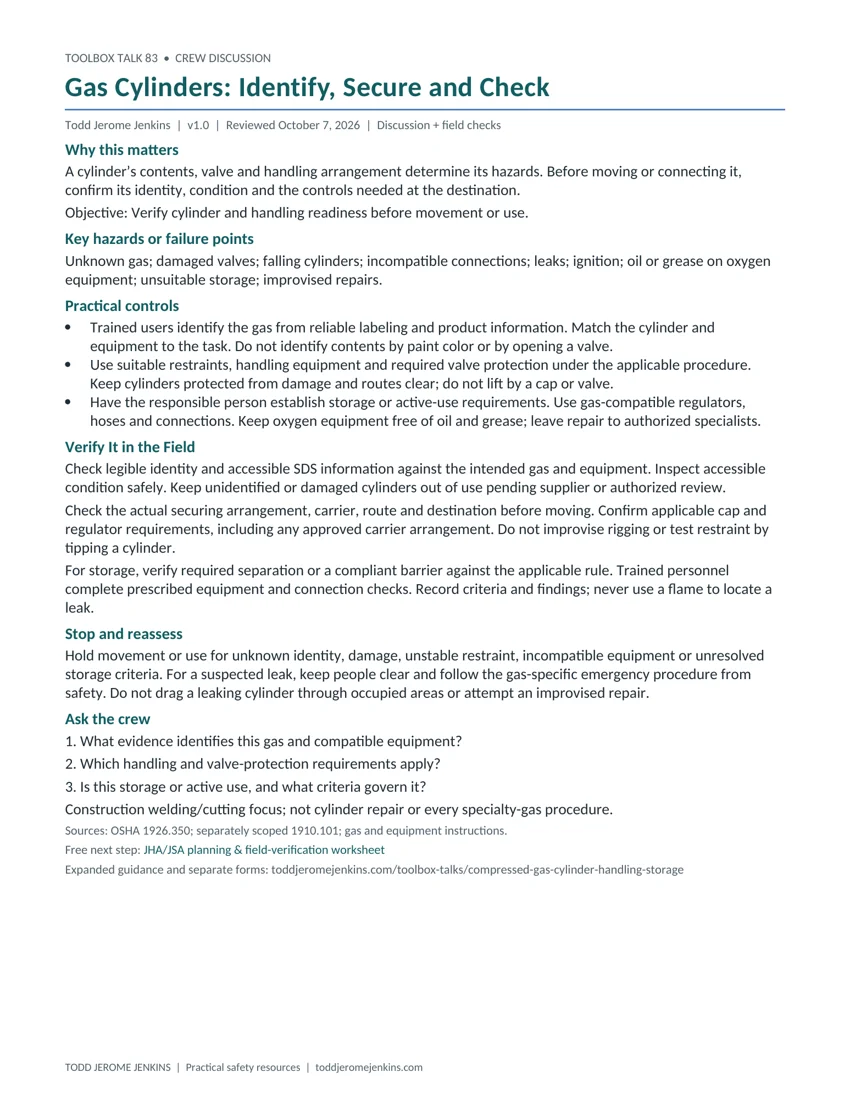
A 5–10 minute crew discussion, plus the time needed for field verification. All six downloads are free without a required signup.
Why this matters
A cylinder’s contents, valve and handling arrangement determine its hazards. Before moving or connecting it, confirm its identity, condition and the controls needed at the destination.
Learning objective: Verify cylinder and handling readiness before movement or use.
Key hazards or failure points
Unknown gas; damaged valves; falling cylinders; incompatible connections; leaks; ignition; oil or grease on oxygen equipment; unsuitable storage; improvised repairs.
Practical controls
- Trained users identify the gas from reliable labeling and product information. Match the cylinder and equipment to the task. Do not identify contents by paint color or by opening a valve.
- Use suitable restraints, handling equipment and required valve protection under the applicable procedure. Keep cylinders protected from damage and routes clear; do not lift by a cap or valve.
- Have the responsible person establish storage or active-use requirements. Use gas-compatible regulators, hoses and connections. Keep oxygen equipment free of oil and grease; leave repair to authorized specialists.
Verify It in the Field
Check legible identity and accessible SDS information against the intended gas and equipment. Inspect accessible condition safely. Keep unidentified or damaged cylinders out of use pending supplier or authorized review.
Check the actual securing arrangement, carrier, route and destination before moving. Confirm applicable cap and regulator requirements, including any approved carrier arrangement. Do not improvise rigging or test restraint by tipping a cylinder.
For storage, verify required separation or a compliant barrier against the applicable rule. Trained personnel complete prescribed equipment and connection checks. Record criteria and findings; never use a flame to locate a leak.
Use the separate field check to record the acceptance source and criterion, safe method, checker, actual result and time. Mark VERIFIED, HOLD/NOT VERIFIED, or N/A with a reason. A checkmark alone is not evidence that protection works. Complete all required task checks; do not enter danger or improvise a test.
| Control | Safe verification | Evidence |
|---|---|---|
| Correct gas and equipment | Compare readable cylinder identity with product and equipment information. | Gas, cylinder identification and compatibility source. |
| Protected movement | Check carrier, restraint, route and applicable valve protection. | Procedure, actual arrangement and unresolved defect. |
| Compliant storage | Verify applicable measured separation or specified barrier evidence. | Storage classification, criterion, measurement or barrier documentation. |
Stop and reassess
Hold movement or use for unknown identity, damage, unstable restraint, incompatible equipment or unresolved storage criteria. For a suspected leak, keep people clear and follow the gas-specific emergency procedure from safety. Do not drag a leaking cylinder through occupied areas or attempt an improvised repair.
Crew discussion questions
- What evidence identifies this gas and compatible equipment?
- Which handling and valve-protection requirements apply?
- Is this storage or active use, and what criteria govern it?
A situation to discuss
Illustrative situation: cylinders are moved from an active welding setup into overnight storage. The crew holds placement until the responsible person confirms the storage arrangement, required separation and protection. The earlier work-area setup is not assumed to satisfy the storage rules.
Leader preparation and practical detail
Keep the regulatory scope clear
Construction 1926.350 addresses gas welding and cutting, including cylinder handling, storage and equipment. General-industry compressed-gas requirements in 1910.101 have a separate scope and incorporate additional referenced requirements. This page does not reproduce those incorporated publications or supply a procedure for every specialty gas, bulk tank or transport operation. [1, 2]
Apply storage separation accurately
For covered oxygen cylinders in storage, 1926.350(a)(10) requires separation from fuel-gas cylinders or combustible materials by at least 20 feet, or a noncombustible barrier at least 5 feet high with at least a half-hour fire-resistance rating. Record which arrangement applies and verify its actual condition. Do not apply the storage rule as a blanket prescription for every connected active-use set, or credit an unrated board as the required barrier. [1]
Use the correct movement and connection procedure
Section 1926.350 includes specific movement provisions and a special-carrier exception relevant to regulator removal and valve protection. Use the actual applicable arrangement rather than an oversimplified rule. Connections, prescribed leak checks and valve operations require trained personnel and gas/equipment-specific instructions. This briefing provides no generic valve-cracking, adapter, pressure or tightening recipe. [1]
Short supervisor field check
- Gas identity, SDS and intended equipment match.
- Cylinder and valve condition acceptable.
- Restraints, carrier, route and valve protection verified.
- Storage or active-use criteria correctly applied.
- Prescribed checks and gas-specific emergency route confirmed.
Record unresolved items, restrictions, correction owner, recheck result and required restart authorization. Reference permits and specialist inspections rather than treating this form as a replacement. Rebrief workers affected by a change.
Attendance and follow-through
Use the separate attendance sheet for participants, discussion concerns, actions and late-arrival rebriefs. Attendance does not establish competence, verify controls or authorize work. Keep completed records private under the employer’s recordkeeping procedures.
Technical scope and references
Primarily construction gas-welding/cutting cylinder readiness under 1926.350; general-industry 1910.101 is separately identified. Supplier instructions, the actual gas, equipment and applicable rules govern. No specific cylinder system, regulator manual or supplier emergency procedure was supplied. [1, 2]
References reviewed October 7, 2026. Apply the industry, activity and jurisdiction that govern the work. No actual site permit, equipment manual, exposure assessment or engineering determination was supplied for this general discussion.
- OSHA 1926.350 — Gas welding and cutting — Construction cylinder handling, storage separation and gas-welding equipment requirements.
- OSHA 1910.101 — Compressed gases — Separately scoped general-industry cylinder condition and incorporated handling requirements.
Connect this discussion to your JHA/JSA
Use How to Conduct a Job Safety Analysis to connect task steps, hazards and controls. Revisit Pre-Job JHA/JSA: What Changed Today? when conditions change.
Work through the related Welding and Cutting JSA, then adapt its assumptions to the actual work.
Related Todd Jerome Jenkins video: What Is a Safety Data Sheet and How Do You Read It?.
Related crew discussions
- Hazard Communication: Labels, SDS & the Task
- Hand Protection: Match the Glove to the Task
- Barricades: What Does This Boundary Keep Out?
- Fire Prevention: Separate Fuel from Ignition
- Hot Work: Verify the Area and Fire Watch
- Temporary Heaters: Check the Setup Before Use
Put one check into practice
Use the free JHA/JSA planning and field-verification worksheet to record today’s changes, important controls and the evidence needed before exposure.