Download the talk and separate crew records
Free to download without an account. Each PDF is one page. Use the Word version to adapt the record to your task and approved procedures.
Supervisor field check
Download supervisor field check (PDF, 1 page)Editable supervisor field check (Word)Preview the one-page crew talk
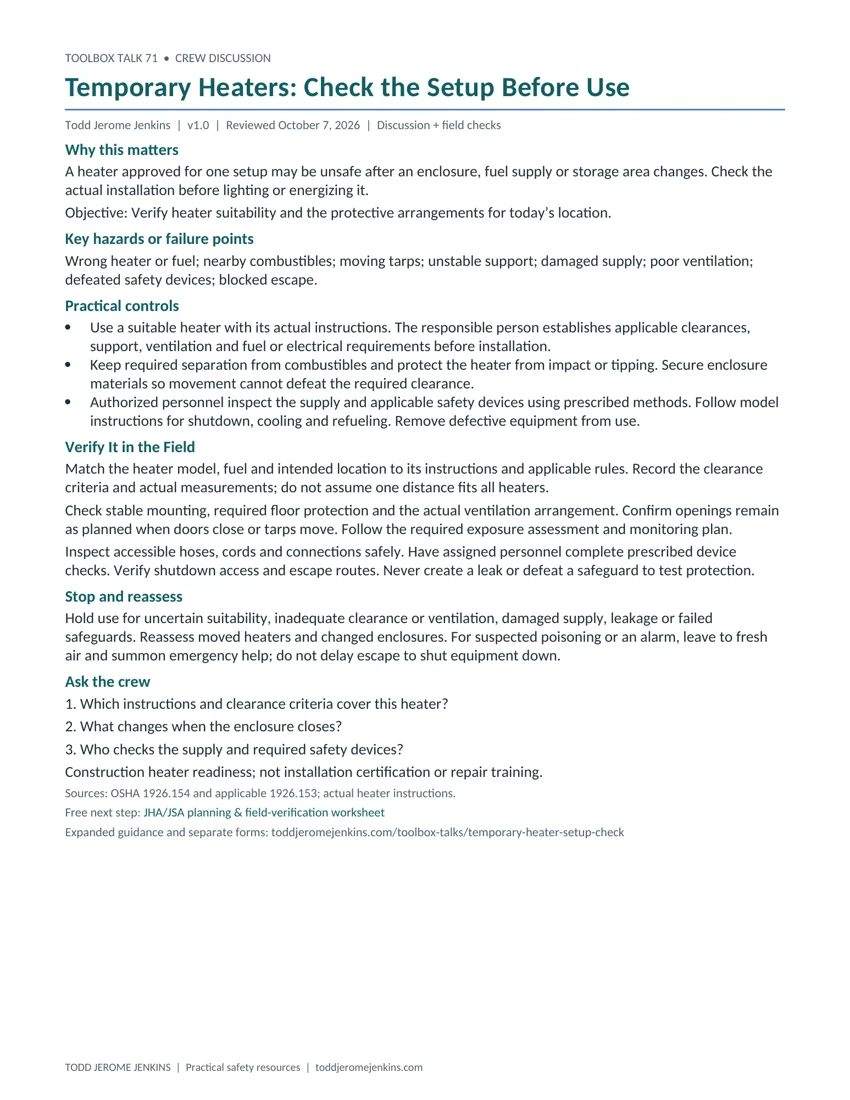
A 5–10 minute crew discussion, plus the time needed for field verification. All six downloads are free without a required signup.
Why this matters
A heater approved for one setup may be unsafe after an enclosure, fuel supply or storage area changes. Check the actual installation before lighting or energizing it.
Learning objective: Verify heater suitability and the protective arrangements for today’s location.
Key hazards or failure points
Wrong heater or fuel; nearby combustibles; moving tarps; unstable support; damaged supply; poor ventilation; defeated safety devices; blocked escape.
Practical controls
- Use a suitable heater with its actual instructions. The responsible person establishes applicable clearances, support, ventilation and fuel or electrical requirements before installation.
- Keep required separation from combustibles and protect the heater from impact or tipping. Secure enclosure materials so movement cannot defeat the required clearance.
- Authorized personnel inspect the supply and applicable safety devices using prescribed methods. Follow model instructions for shutdown, cooling and refueling. Remove defective equipment from use.
Verify It in the Field
Match the heater model, fuel and intended location to its instructions and applicable rules. Record the clearance criteria and actual measurements; do not assume one distance fits all heaters.
Check stable mounting, required floor protection and the actual ventilation arrangement. Confirm openings remain as planned when doors close or tarps move. Follow the required exposure assessment and monitoring plan.
Inspect accessible hoses, cords and connections safely. Have assigned personnel complete prescribed device checks. Verify shutdown access and escape routes. Never create a leak or defeat a safeguard to test protection.
Use the separate field check to record the acceptance source and criterion, safe method, checker, actual result and time. Mark VERIFIED, HOLD/NOT VERIFIED, or N/A with a reason. A checkmark alone is not evidence that protection works. Complete all required task checks; do not enter danger or improvise a test.
| Control | Safe verification | Evidence |
|---|---|---|
| Required separation | Compare measured installation clearances with actual applicable sources. | Model, source, distances and corrected interference. |
| Ventilation arrangement | Responsible person assesses current enclosure and prescribed checks. | Door/tarp condition, assessment and required monitoring results. |
| Safe supply | Authorized person performs prescribed inspection and device checks. | Component identity, findings, correction and release. |
Stop and reassess
Hold use for uncertain suitability, inadequate clearance or ventilation, damaged supply, leakage or failed safeguards. Reassess moved heaters and changed enclosures. For suspected poisoning or an alarm, leave to fresh air and summon emergency help; do not delay escape to shut equipment down.
Crew discussion questions
- Which instructions and clearance criteria cover this heater?
- What changes when the enclosure closes?
- Who checks the supply and required safety devices?
A situation to discuss
Illustrative situation: temporary sheeting is added after a heater was installed. The crew holds heater use while the responsible person reassesses moving fabric, ventilation and the actual clearances. Yesterday’s inspection does not approve the new enclosure.
Leader preparation and practical detail
Use the correct clearance source
Construction 1926.154 has different clearance provisions, including its table, listed-equipment conditions and separate requirements for combustible tarpaulins or similar coverings. A generic three-foot rule cannot cover every setup. Record which provision and equipment instruction apply, then check the installed arrangement from a safe position. [1]
Treat fuel systems as part of the installation
LP-Gas installations have additional requirements under 1926.153. Cylinder storage and cylinders connected for permitted use are different situations; do not assume one instruction covers both. The appropriate installer must resolve approved components, connections, applicable safety devices and supply protection. Workers should report defects rather than improvise repairs. [2]
Recheck enclosure changes
Ventilation must suit the temporary heating arrangement. Electric and fuel-fired heaters introduce different hazards; a suitable electric alternative still requires a sound electrical supply and fire precautions. Combustion exposure cannot be judged by smell or the presence of a fan. Link the carbon-monoxide briefing to the site’s assessed controls and response plan. [1]
Short supervisor field check
- Model, fuel and location suitability confirmed.
- Clearance source and actual measurements recorded.
- Support, floor protection and ventilation verified.
- Supply and applicable safety-device checks acceptable.
- Shutdown access, escape and change triggers clear.
Record unresolved items, restrictions, correction owner, recheck result and required restart authorization. Reference permits and specialist inspections rather than treating this form as a replacement. Rebrief workers affected by a change.
Attendance and follow-through
Use the separate attendance sheet for participants, discussion concerns, actions and late-arrival rebriefs. Attendance does not establish competence, verify controls or authorize work. Keep completed records private under the employer’s recordkeeping procedures.
Technical scope and references
Construction temporary heating under 1926.154, with 1926.153 where LP-Gas applies. No model-specific manual was supplied, and this talk does not establish airflow, alarm settings, electrical capacity or a universal clearance. Use the governing requirements and actual instructions. [1, 2]
References reviewed October 7, 2026. Apply the industry, activity and jurisdiction that govern the work. No actual site permit, equipment manual, exposure assessment or engineering determination was supplied for this general discussion.
- OSHA 1926.154 — Temporary heating devices — Ventilation, clearance, support and fuel-specific safeguards.
- OSHA 1926.153 — Liquefied petroleum gas — Additional construction LP-Gas system, use and storage requirements.
Connect this discussion to your JHA/JSA
Use How to Conduct a Job Safety Analysis to connect task steps, hazards and controls. Revisit Pre-Job JHA/JSA: What Changed Today? when conditions change.
Related crew discussions
- Electrical & Extension-Cord Checks
- Cold Weather: Check Warmth, Traction and Recovery
- Fire Prevention: Separate Fuel from Ignition
- Carbon Monoxide: Keep Exhaust Out of the Work
Put one check into practice
Use the free JHA/JSA planning and field-verification worksheet to record today’s changes, important controls and the evidence needed before exposure.