Download the free crew talk
The one-page talk, editable Word version, and guidance below are open to everyone. No account required.
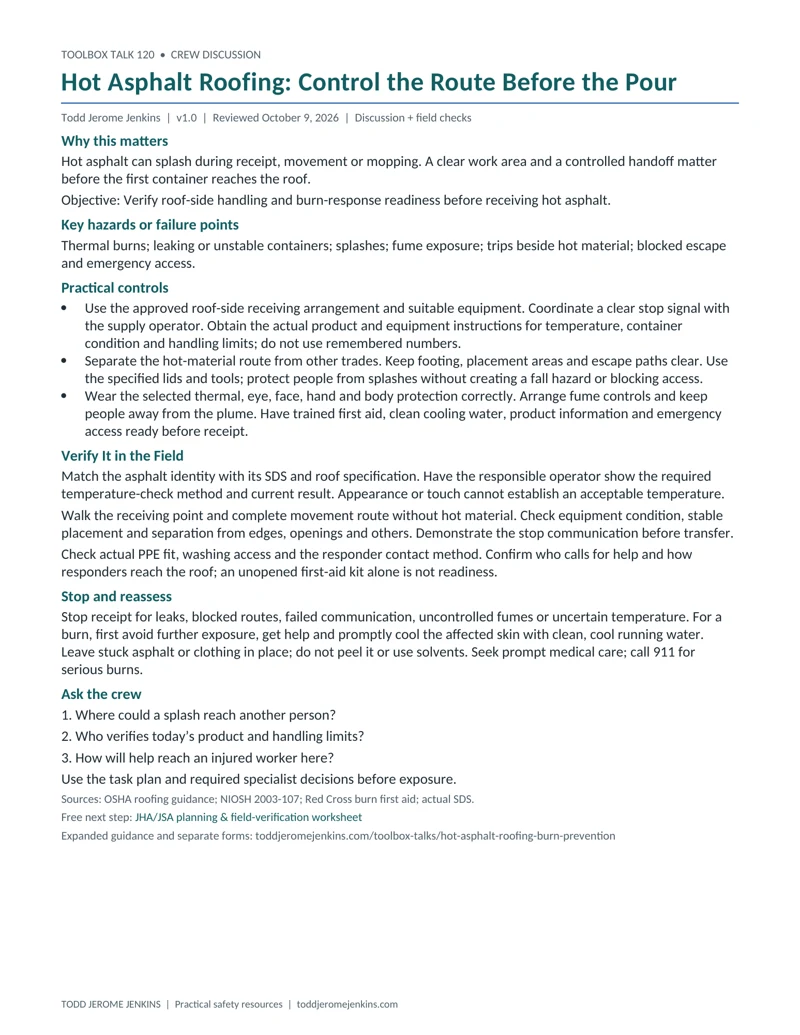
Preview the one-page crew talk
Supporting documents
Included with free Safety & Systems membership.
Supervisor field check
A separate check to verify conditions and controls before work. Includes a one-page PDF and editable Word file.
Attendance sheet
A separate sign-in sheet to record the crew discussion. Includes a one-page PDF and editable Word file.
Need the crew records? Join free to use these supporting documents and the Safety & Systems Academy. No payment details. Email updates are optional.
Get supporting documents — free membershipAlready a member? Use the same link to sign in.
A 5–10 minute crew discussion, plus time to verify the actual controls. The crew talk and Word version are public. Separate supervisor and attendance records are included with free Safety & Systems membership.
Why this matters
Hot asphalt can splash during receipt, movement or mopping. A clear work area and a controlled handoff matter before the first container reaches the roof.
Learning objective
Verify roof-side handling and burn-response readiness before receiving hot asphalt.
Key hazards or failure points
Thermal burns; leaking or unstable containers; splashes; fume exposure; trips beside hot material; blocked escape and emergency access.
Practical controls
- Use the approved roof-side receiving arrangement and suitable equipment. Coordinate a clear stop signal with the supply operator. Obtain the actual product and equipment instructions for temperature, container condition and handling limits; do not use remembered numbers.
- Separate the hot-material route from other trades. Keep footing, placement areas and escape paths clear. Use the specified lids and tools; protect people from splashes without creating a fall hazard or blocking access.
- Wear the selected thermal, eye, face, hand and body protection correctly. Arrange fume controls and keep people away from the plume. Have trained first aid, clean cooling water, product information and emergency access ready before receipt.
Verify It in the Field
- Match the asphalt identity with its SDS and roof specification. Have the responsible operator show the required temperature-check method and current result. Appearance or touch cannot establish an acceptable temperature.
- Walk the receiving point and complete movement route without hot material. Check equipment condition, stable placement and separation from edges, openings and others. Demonstrate the stop communication before transfer.
- Check actual PPE fit, washing access and the responder contact method. Confirm who calls for help and how responders reach the roof; an unopened first-aid kit alone is not readiness.
Stop and reassess
Stop receipt for leaks, blocked routes, failed communication, uncontrolled fumes or uncertain temperature. For a burn, first avoid further exposure, get help and promptly cool the affected skin with clean, cool running water. Leave stuck asphalt or clothing in place; do not peel it or use solvents. Seek prompt medical care; call 911 for serious burns.
Crew discussion questions
- Where could a splash reach another person?
- Who verifies today’s product and handling limits?
- How will help reach an injured worker here?
For each required control, record its acceptance source and criterion, safe verification method, responsible checker, actual result and time. Use VERIFIED, HOLD/NOT VERIFIED, or N/A with a reason. A tick alone is not evidence. Complete all applicable task inspections; do not enter danger or improvise a test to fill out a form.
Leader preparation and practical detail
Keep the scope at the roof-side handoff
The linked JHA covers a released low-slope roof, receipt from a separately planned supply system, controlled movement and application. It excludes kettle operation, fuel transfer, delivery-system maintenance, coal tar and torch application. Those need their own procedures and qualified personnel. Do not turn this crew discussion into kettle-lighting, hose-clearing or pressure-release instructions.
Verify actual limits and a usable route
Obtain the specified asphalt, roof-system requirements and equipment instructions before supply starts. Record who checks the required temperature and what evidence permits receipt. Do not publish a universal kettle setting, flash-point margin, container fill percentage or carrying distance. Resolve damaged containers, unstable placement and crossing trades before loading. Reassess whenever the route or supply arrangement changes.
Control fumes without losing other protections
NIOSH’s 2003 guidance remains useful for planning equipment, keeping appropriate lids closed, positioning work to reduce exposure and coordinating nearby occupants and air intakes. It is dated guidance, not an updated product manual. Do not repeat its numerical application recipes as universal limits. The employer must establish exposure controls; lack of odor is not clearance. Any respiratory protection requires the applicable employer program.
Prepare for thermal burns before work
Use the actual product SDS and trained first-aid arrangements. For a thermal splash, prioritize scene safety, prompt cooling with clean cool running water and medical help. Do not remove adhered asphalt or stuck clothing, apply solvents, or use ice or greasy remedies. Red Cross guidance calls for immediate emergency treatment for serious burns, including deep burns and burns involving critical locations such as the face or hands. Do not delay urgent care while searching for paperwork; send product details with responders. Cooling injured skin is not an instruction to add water to hot bulk asphalt. The chemical-exposure talk supports readiness but does not replace this thermal-burn response.
Short supervisor field check
- Product and handling criteria matched.
- Receiving signal and equipment checked.
- Route and hot-material boundary clear.
- Protection and fume controls verified.
- Burn response and roof access ready.
Confirm the relevant trained/authorized people, unresolved items, interim protection, correction owner and recheck. Record required release authority and rebrief anyone affected. The separate sheet supports these records; it does not replace a specialist inspection, permit or engineering determination.
Attendance and follow-through
Use the separate attendance sheet for participants, roles, discussion concerns, actions and late-arrival rebriefs. Attendance is not proof of competence, functioning controls or authorization to work. Keep completed records private under employer procedures.
Technical scope and references
Reviewed October 9, 2026 for construction crew preparation. Apply the actual task, jurisdiction and relevant standard provisions. Manufacturer sources below are reference examples, not approval of your equipment. No site-specific design, permit, exposure assessment, product SDS or current model manual was supplied; obtain the applicable documents before work. This discussion does not replace required training.
- OSHA — Protecting Roofing Workers (2015) — Advisory roofing guidance, printed pages 25–27: hot asphalt, concealed torch-fire hazards and roof-specific watch recommendations; not a new regulation.
- NIOSH 2003-107 — Reducing Roofers’ Exposure to Asphalt Fumes — Historical guidance still hosted by CDC: pre-job planning, roof application, fume reduction and hygiene. Use current product/equipment instructions for actual limits.
- American Red Cross — Burns: How To Help — Current first-aid guidance: scene safety, emergency escalation, cooling thermal burns, stuck clothing and avoiding ice or greasy substances.
Connect this discussion to your JHA/JSA
Use the related worked JHA/JSA/AHA example to prepare task steps, hazards and controls. Return to What Changed Today? when the plan or conditions change.
Related Todd Jerome Jenkins article: How to Conduct a Job Safety Analysis.
Related crew discussions
- Chemical Exposure First Aid Readiness
- Heat Conditions Change Controls Change
- Hot Work Authorization Fire Watch
Put one check into practice
Use the free JHA/JSA planning and field-verification worksheet to record today’s change, the required protection and the evidence needed before exposure.