Download the free toolbox talk
The one-page talk, editable Word version, and guidance below are open to everyone. No account required.
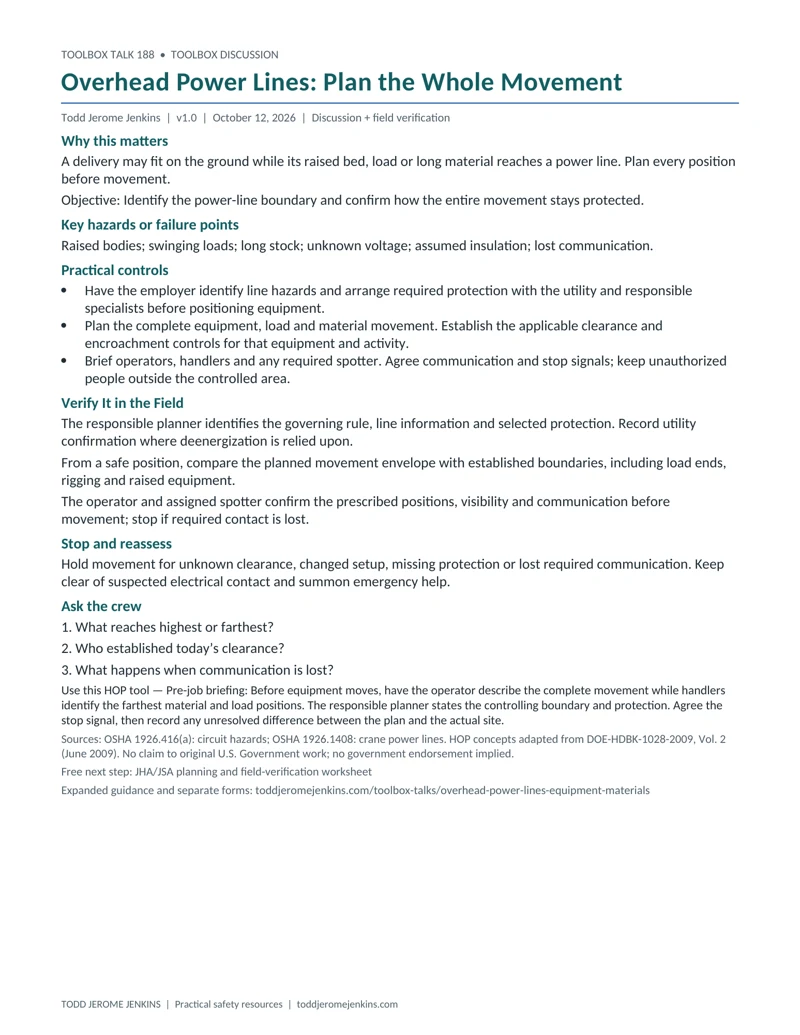
One-page toolbox talk
Download one-page toolbox talk (PDF, 1 page)Editable one-page toolbox talk (Word)Preview the one-page toolbox talk
Supporting documents
Included with free Safety & Systems membership.
Supervisor field check
A separate check to verify conditions and controls before work. Includes a one-page PDF and editable Word file.
Attendance sheet
A separate sign-in sheet to record the crew discussion. Includes a one-page PDF and editable Word file.
Need the crew records? Join free to use these supporting documents and the Safety & Systems Academy. No payment details. Email updates are optional.
Get supporting documents — free membershipAlready a member? Use the same link to sign in.
Hazard-based toolbox talk 13 of 52, with a practical HOP exercise.
Plan a 5–10 minute toolbox discussion, plus time to verify the actual controls. The one-page toolbox talk and editable Word version are public. Separate supervisor and attendance records are included with free Safety & Systems membership.
Why this matters
A delivery may fit on the ground while its raised bed, load or long material reaches a power line. Plan every position before movement.
Learning objective
Identify the power-line boundary and confirm how the entire movement stays protected.
Key hazards or failure points
Raised bodies; swinging loads; long stock; unknown voltage; assumed insulation; lost communication.
Practical controls
- Have the employer identify line hazards and arrange required protection with the utility and responsible specialists before positioning equipment.
- Plan the complete equipment, load and material movement. Establish the applicable clearance and encroachment controls for that equipment and activity.
- Brief operators, handlers and any required spotter. Agree communication and stop signals; keep unauthorized people outside the controlled area.
Verify It in the Field
- The responsible planner identifies the governing rule, line information and selected protection. Record utility confirmation where deenergization is relied upon.
- From a safe position, compare the planned movement envelope with established boundaries, including load ends, rigging and raised equipment.
- The operator and assigned spotter confirm the prescribed positions, visibility and communication before movement; stop if required contact is lost.
Stop and reassess
Hold movement for unknown clearance, changed setup, missing protection or lost required communication. Keep clear of suspected electrical contact and summon emergency help.
Crew discussion questions
- What reaches highest or farthest?
- Who established today’s clearance?
- What happens when communication is lost?
For each required control, record its acceptance source and criterion, safe verification method, responsible verifier, actual result and time. Mark VERIFIED, HOLD/NOT VERIFIED, or N/A with a reason. Complete all required inspections; never enter danger or improvise a test to fill out a form.
Use this HOP tool
Pre-job briefing
Before equipment moves, have the operator describe the complete movement while handlers identify the farthest material and load positions. The responsible planner states the controlling boundary and protection. Agree the stop signal, then record any unresolved difference between the plan and the actual site.
This exercise supports hazard identification or control verification. It does not replace safeguards, required training, specialist decisions or work authorization.
Leader preparation and practical detail
A single distance cannot cover every task
Construction 1926.416(a) requires identification of circuit hazards and protection against contact. Cranes covered by Subpart CC have additional power-line planning and encroachment provisions, including 1926.1408 for operations near lines up to 350 kV. Other activities and higher voltages require their applicable provisions. Do not turn a commonly quoted distance into a universal permission to approach.
Include the changing shape of the work
Study the full sequence: arrival, unloading, rotation, raising and departure. Long pieces may swing beyond the equipment footprint. Confirm the boundary for all relevant parts before moving; a spotter cannot compensate for an unplanned operating envelope or missing required protection. Rebrief when the equipment, delivery position or material changes.
Confirm electrical status through the responsible source
Do not infer that a line is safe because it looks coated or work occurred nearby yesterday. Under 1926.1408, lines are presumed energized unless the utility confirms the required continuing deenergized and visibly grounded condition. Record the responsible confirmation and restrictions. Workers must not approach a line to inspect or measure it themselves.
Short supervisor field check
- Line hazards identified
- Applicable criteria recorded
- Full movement considered
- Boundary controls established
- Communication confirmed
Use the separate sheet to document evidence, unresolved restrictions, correction owner, recheck and required release authority. Rebrief affected workers. This record does not replace specialist inspections, permits or engineering determinations.
Attendance and follow-through
Use the separate attendance record for participants, roles, questions, actions and late-arrival rebriefs. Attendance does not prove competence, functioning controls or authorization. Keep completed records private under employer procedures.
Source acknowledgment
HOP concepts are adapted from DOE-HDBK-1028-2009, Human Performance Improvement Handbook, Volume 2 (June 2009). Todd Jerome Jenkins makes no claim to authorship or copyright ownership of original U.S. Government work. The explanations and exercises are original adaptations; no endorsement by DOE or the U.S. Government is implied. Third-party material credited in the handbook retains its separate ownership.
HOP source: Volume 2/VOLUME 2 PRE-JOB BRIEFING.pdf; PDF1–4; printed34–37. The handbook supplies concepts; task-specific technical references are listed below.
Technical scope and references
Technical sources inspected October 9, 2026; resource edition October 12, 2026. Apply current jurisdictional requirements, the actual task procedure, manufacturer instructions, permits and required competent or qualified decisions. This resource supplies no equipment-specific acceptance criteria.
- OSHA 1926.416(a): circuit hazards — General construction electrical protection.
- OSHA 1926.1408: crane power lines — Subpart CC operations up to 350 kV; not a universal rule.
- DOE-HDBK-1028-2009 Volume 2 (June 2009) — PDF1–4; printed34–37; HOP concept basis, original exercise.
Connect this discussion to your JHA/JSA
Use the JHA/JSA planning and field-verification worksheet to connect this discussion to the actual task, controls and responsible people.
Related Todd Jerome Jenkins articles: How to Conduct a Job Safety Analysis and What Is Human and Organizational Performance?.
Related toolbox talks
- Electrical Work: Verify the Boundary
- Mobile Equipment: Separate People from Movement
- Line of Fire: Swing Radius & Suspended Loads
Continue the hazard series
Put one verification into practice
Record today’s change and evidence using the free JHA/JSA planning and field-verification worksheet.